¡Acompáñanos a viajar por el mundo de los libros!
Añadir este libro a la estantería
Grey
Escribe un nuevo comentario Default profile 50px
Grey
Suscríbete para leer el libro completo o lee las primeras páginas gratis.
All characters reduced
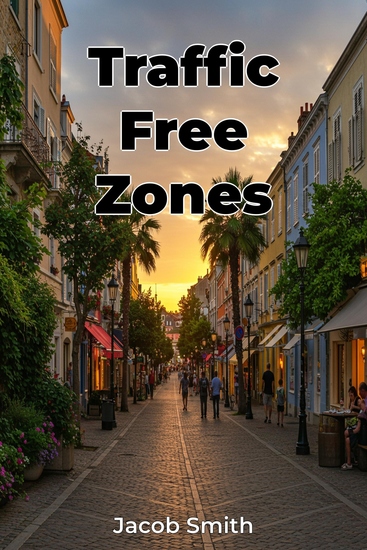
Traffic Free Zones - cover

Traffic Free Zones

Jacob Smith

Traductor A AI

Editorial: Publifye

  • 0
  • 0
  • 0

Sinopsis

Traffic Free Zones explores the increasingly vital concept of pedestrian-only zones in urban environments and their profound impact on creating more livable cities. It argues that prioritizing people over vehicles can lead to significant improvements in air quality, mobility, and social interaction, ultimately contributing to sustainable urban planning.

 
The book examines the historical context of car-centric urban design, which has led to increased pollution and decreased community bonds. It highlights how strategic implementation of traffic-free zones can reshape urban life, noting that some cities have seen dramatic improvements to pedestrian safety and public health after implementation.

 
The book is structured to provide a comprehensive understanding of traffic-free zones, starting with their definition and historical evolution. It then delves into core impact areas such as air quality, sustainable mobility, and social interaction, using empirical evidence and case studies. For example, data from pedestrian count sensors and ethnographic studies are used to support the arguments.

 
Later chapters address practical aspects of implementation, including traffic management and economic impacts, to provide policy recommendations for creating pedestrian-centered urban spaces.
Disponible desde: 21/02/2025.
Longitud de impresión: 84 páginas.

Otros libros que te pueden interesar

  • Self-Promote and Succeed - The No Boring Books Way to Build Your Brand Attract Your Audience and Market Your Non-Fiction Book - cover

    Self-Promote and Succeed - The...

    Julie Broad

    • 0
    • 0
    • 0
    Every nonfiction author dreams of being a bestselling author. This dream hinges on a well-positioned book and a savvy understanding of marketing. Many authors feel like they have tried everything in the world of self-publishing—launching mass press releases, designing attractive bookmarks, and attempting to run ads on Amazon. Yet the numbers crawl, the dream stalls, and the frustration mounts. 
    Julie Broad, author of Self-Publish and Succeed and Founder of Book Launchers, brings her high-energy approach and hold-nothing-back attitude with this compelling follow-up guide to Self-Publish & Succeed. Julie champions indie authors to book marketing success, showing you the secret goes beyond the narrow focus on book sales. She presents a map to use your book to become an industry thought leader, bolster your personal brand and leverage your book as a tool for business growth. 
    You’ll discover how to: 
    ·     Architect a layered marketing strategy, optimizing every aspect of your book production and marketing, for success. 
    ·     Position your author brand to appeal directly to your target audience. 
    ·     Choose your book launch strategy from four proven methods. 
    ·     Enhance your book’s visibility with the right pricing and keywords on platforms like Kindle Direct Publishing. 
    ·     Leverage speaking engagements to personally connect with readers and boost book sales. 
    It’s time to take your authorship to the next level. Navigate the intricacies of self-publishing and book marketing using the same methods clients pay her tens of thousands of dollars for. Get Self-Promote and Succeed and let this writer’s guide to promoting, marketing, and selling your nonfiction book be the reason your journey heads toward success.
    Ver libro
  • Who Gets to Write Fiction? - Opening Doors to Imaginative Writing for All Students - cover

    Who Gets to Write Fiction? -...

    Ariel Sacks

    • 0
    • 0
    • 0
    Writing and sharing fiction allows adolescents to glimpse other lives 


    The current curricular emphasis on analytical writing can make it feel risky to teach creative writing in ELA classrooms. But the opportunity to write fiction in school opens many doors for young people: doors the author argues are critical to the development of our students, our education system, and even our democracy. 


    This book will delight English teachers weary of focusing relentlessly on argument and information writing. Veteran teacher Ariel Sacks vividly describes the many academic, social–emotional, and community-building advantages of teaching imaginative writing in the classroom, not least of which is the impact it has on equity for marginalized students. Her book is a teacher-to-teacher text that folds in detailed, practical guidance about how to design lessons and meet standards, while presenting a powerful central argument: that the writing of fiction should be treated not as a luxury for some, but as a center of the English curriculum for all students.
    Ver libro
  • Passion for Compasses - Medieval Master Builders and their Cathedral Building Plans - cover

    Passion for Compasses - Medieval...

    Klug Sonja Ulrike

    • 0
    • 0
    • 0
    How medieval architects drew cathedral building plans
    The architectural history of the Middle Ages is full of surprises. It is difficult for us to imagine today that relatively few construction plans have been found for the impressive churches and cathedrals of the Romanesque and Gothic periods. Where did most of the drawings go? Have the plans been destroyed in Europe or lost over time? Or were they not made at all? 
    Although hardly any architectural drawings exist, there were numerous compasses. What were they used for and how? Was it possible to design complex buildings such as churches and cathedrals without blueprints? 
    The author takes her readers on an exciting cultural and historical journey through time. 
    She looks at the spread of papyrus, parchment and paper and traces the ability to write and calculate in Europe. She also looks at the construction process in historical illustrations and draws comparisons with Arabic architecture. Last but not least, she shows what types of compasses existed and how the drawing skills of master builders developed up to the Renaissance. 
    The insights into the history of architecture lead to surprising findings: The architects of the Middle Ages thought and planned very differently than we imagine today.
    Ver libro
  • Profiles in Courage - cover

    Profiles in Courage

    Anónimo

    • 0
    • 0
    • 0
    THE PULITZER PRIZE-WINNING CLASSIC OF POLITICAL INTEGRITY 
    Introduction Written and Read by Caroline Kennedy; Book read by John F. Kennedy Jr. 
    John F. Kennedy’s enduring classic resounds with timeless lessons on the most cherished of virtues—courage and patriotism—and remains a moving, powerful, and relevant testament to the indomitable American spirit  
    During 1954-55, Kennedy, then a junior senator from the state of Massachusetts, profiled eight American patriots, mainly United States Senators, who at crucial moments in our nation’s history, revealed a special sort of greatness: men who disregarded dreadful consequences to their public and private lives to do that one thing which seemed right in itself. They were men of various political and regional allegiances—their one overriding loyalty was to the United States. 
    Courage such as these men shared, Kennedy makes clear, is central to all morality—a man does what he must in spite of personal consequences—and these exciting stories suggest that, without in the least disparaging the courage with which men die, we should not overlook the true greatness adorning those acts of courage with which men must live.  
    As Robert F. Kennedy writes in the foreword, Profiles in Courage “is not just stories of the past but a book of hope and confidence for the future. What happens to the country, to the world, depends on what we do with what others have left us."" 
    Ver libro
  • A Drama in Mexico - cover

    A Drama in Mexico

    Jules Verne

    • 0
    • 0
    • 0
    A Drama in Mexico is a vivid and engaging short work by Charles Dickens that combines travel writing with historical reflection. Based on Dickens's experiences and observations during his journey to North America, the piece offers a sharply written account of a real-life political execution he witnessed while in Mexico.
    
    Through powerful narrative detail, Dickens recounts the tense atmosphere surrounding the public execution of a political figure, capturing the emotional weight of the moment and the reactions of the crowd. Rather than focusing solely on the event itself, the story reflects Dickens's deep concern with justice, authority, and the human cost of political conflict.
    
    The work stands out for its immediacy and moral seriousness. Dickens uses the event as a lens through which to examine themes of power, violence, and public spectacle, questioning the effectiveness and humanity of capital punishment. His prose is direct and compelling, blending journalistic observation with emotional insight.
    
    A Drama in Mexico is a striking example of Dickens's ability to transform real-world experiences into meaningful commentary. Short yet impactful, the piece offers readers a rare glimpse into Dickens as an eyewitness to history and serves as a thought-provoking reflection on justice, punishment, and human dignity.
    Ver libro
  • Illiberal Europe - Eastern Europe from the Fall of the Berlin Wall to the War in Ukraine - cover

    Illiberal Europe - Eastern...

    Leon Marc

    • 0
    • 0
    • 0
    Eighteen years have passed since ten countries from Central & Eastern Europe joined the European Union and more than three decades since the Berlin Wall was torn down in 1989 - but ignorance about what is popularly still called Eastern Europe is as widespread as ever. Slovenia still gets mixed up with Slovakia, the Slavs remain a mystery in a Europe apparently dominated by Romanic and Germanic nations and a country like the Czech Republic is labelled as Eastern European, although one needs to travel west to get from Vienna to Prague. 
     
    First published in 2009 under the title What's so eastern about Eastern Europe?, this book is much more than a revised and updated version of the first edition. Its presentation of the political and cultural history of Central, Eastern and South-Eastern Europe, written in an accessible language is now complemented with recent developments in the region. The new edition digs into the reasons behind the illiberal turn in Poland, Hungary and elsewhere, putting the alleged democratic backslide into the wider context of European populism. Leon Marc offers a new and fresh perspective in explaining the roots of populism and social conservativism in the region, which the book sees in a mixture of historical factors, economic conditions, the heavy burden of Communist legacy, as well as a reaction to contemporary social developments in the West. Drawing on a wide range of literature, the book calls for more sensibility to these underlying causes, critical examination of the true European values, and for a coalition of defenders of Humanism and Judeo-Christian tradition as key pillars of its identity, in order to save Europe and its liberal democracy. 
     
    This updated and expanded edition contains a brand new chapter bringing this book up to date with recent events, including Covid-19 and the Ukrainian conflict. 
     
    'Comprehensively and concisely, Leon Marc's book presents readers with vital insights into the different dimensions of our common European history and culture' - Professor Dr Jaap W. de Zwaan, Director of the Netherlands Institute of International Relations
    Ver libro