Rejoignez-nous pour un voyage dans le monde des livres!
Ajouter ce livre à l'électronique
Grey
Ecrivez un nouveau commentaire Default profile 50px
Grey
Abonnez-vous pour lire le livre complet ou lisez les premières pages gratuitement!
All characters reduced
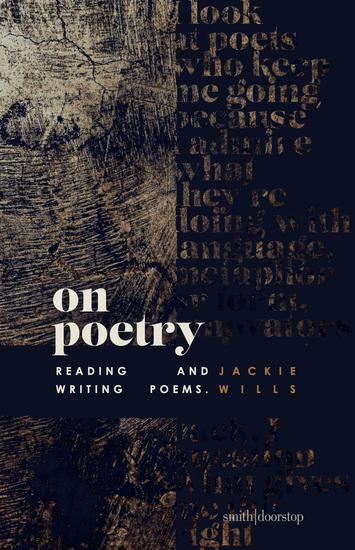
On Poetry - cover

On Poetry

Jackie Wills

Maison d'édition: The Poetry Business

  • 0
  • 0
  • 0

Synopsis

We begin with a drive to write something that's never been said before, to protest, to offload, to challenge or catch the zeitgeist. We imagine we write like the poets we admire. Slowly we learn the craft, understanding eventually that a writer is indentured for life.
Drawing on decades of experience as a poet and tutor, this compelling book is part hands-on guide and part reflection on ways that poetry can make a difference to how we live. It is also a survey of many varied and inspirational writers, especially women poets from the end of the 20th century.
The final section of this unique book offers starting points and resources that will prove essential for new and experienced poets alike. Jackie Wills is herself one of our most genuine and brilliantly insightful poets; and, as the sections on writing workshops show, she has helped people of all ages find their way into poetry.
Disponible depuis: 25/04/2022.
Longueur d'impression: 176 pages.

D'autres livres qui pourraient vous intéresser

  • The Last Face You'll Ever See - The Culture of Death Row - cover

    The Last Face You'll Ever See -...

    Ivan Solotaroff

    • 0
    • 0
    • 0
    In fascinating detail, Ivan Solotaroff introduces us to the men who carry out executions. Although the emphasis is on the personal lives of these men and of those they have to put to death, The Last Face You'll Ever See also addresses some of the deeper issues of the death penalty and connects the veiled, elusive figure of the executioner to the vast majority of Americans who, since 1977, have claimed to support executions. Why do we do it? Or, more exactly, why do we want to?The Last Face You'll Ever See is not about the polarizing issues of the death penalty -- it is a firsthand report about the culture of executions: the executioners, the death-row inmates, and everyone involved in the act. An engrossing, unsettling, and provocative book, this work will forever affect anyone who reads it.
    Voir livre
  • Summary: The Life-Changing Magic of Tidying Up – The Japanese Art of Decluttering and Organizing by Marie Kondo - cover

    Summary: The Life-Changing Magic...

    ExecutiveGrowth Summaries

    • 0
    • 0
    • 0
    The Life-Changing Magic of Tidying Up became a #1 New York Times bestseller for simple reasons… 
    (Notice: This is a SUMMARY of Marie Kondo’s bestseller, The Life-Changing Magic of Tidying Up: The Japanese Art of Decluttering and Organizing) 
    Marie Kondo’s unique approach to tidying changes lives. Both her book, The Life-changing Magic of Tidying, and her Netflix series have caught the attention – and application – of millions. And those millions sing her praises. 
    How has this petite Japanese woman persuaded so many people to joyfully and eagerly do what parents have been begging their children to do for ages? Why are people posting pictures on Instagram and Facebook of neatly folded shirts and shorts, lined up in drawers like soldiers, awaiting the opportunity to be put to use by their owner? Is there any way that you, too, could implement her system in your own home and life? 
    Millions of people have learned from the woman The London Times calls “Japan’s preeminent guru of tidiness, a warrior princess in the war on clutter.” You’ll learn why you can’t seem to stay organized no matter what you’ve tried, in which order to tidy your items, and how to tidy them well (including the KonMari folding technique). You’ll come to understand how and why tidying up can revolutionize your entire life and build the ability to discern what brings you joy. 
    If you truly resonate with Marie Kondo’s concepts we implore you to buy her full audiobook once you’re done! 
    DISCLAIMER: Testimonies show that our professional summaries introduce more readers to the full book who otherwise would have been overwhelmed by the initial commitment. Readers can use this summary as an introduction or a companion to the original, NOT AS A SUBSTITUTE.
    Voir livre
  • The Science of Mummification - Techniques and Secrets Revealed - cover

    The Science of Mummification -...

    Omar Khalil

    • 0
    • 0
    • 0
    Mummification, the art and science of preserving bodies after death, has fascinated both historians and scientists for centuries. In ancient Egypt, mummification was not merely a process of preservation but also a vital part of the culture’s religious beliefs. The Egyptians believed in an afterlife, where the soul would continue to exist in a parallel realm. The preservation of the body was considered essential for the soul’s journey, as it would serve as a vessel for the soul's return. This chapter delves into the origins and purpose of mummification, shedding light on the techniques that evolved over millennia. 
    The practice of mummification is believed to have begun around 3500 BCE, initially as a natural process. Early Egyptians buried their dead in shallow graves in the hot, dry desert sands. The dry conditions naturally desiccated the bodies, preserving them for years or even centuries. However, as Egyptian society developed and religious beliefs became more complex, the need for a more deliberate and refined method of preservation emerged. Over time, the Egyptians developed techniques to prevent decomposition, ensuring that the deceased would be preserved for the afterlife. 
    Mummification’s primary purpose was to ensure the deceased’s body remained intact for the soul’s journey to the afterlife. Ancient Egyptians believed that the body was necessary for the soul to recognize and reunite with the deceased in the next world. The process, therefore, was not just about keeping the body intact; it was about ensuring the deceased's spiritual well-being. Alongside the physical mummification process, elaborate burial rituals were performed, including the offering of food, goods, and prayers to help guide the deceased through the afterlife.
    Voir livre
  • Inside the Indyref - cover

    Inside the Indyref

    Pete Wishart

    • 0
    • 0
    • 0
    Indyref: the Scottish Referendum of 2014 in which 84.6% of the Scottish public voted, making it one of the largest voter turnouts in British political history.
    
    This book is an inside account of the independence referendum campaign. It captures the highs and lows and twists and turns from a perspective close to the decision-making frontline, but far enough removed to offer a dispassionate and personal perspective of the unfolding events. Wishart takes the reader back to the energy, excitement and drama of the biggest political decision the Scottish people have ever been asked to participate in – a truly immersive experience, with people previously uninterested in political campaigning engaged in trying to win for their respective camp. 
    
    The referendum changed everything in Scottish political life and its influence is felt in every one of our political institutions, and remains indelibly embedded in our political culture.
    
    There is a very real sense that the many promises made around more powers for Scotland, made during the independence referendum 
    by the uk Government, have not been realised.
    
    The independence referendum itself may be long concluded, but its impacts, effects and legacy remain very much live. There can be no doubt that many of the constitutional debates that continue to take place today have their origins in the absorbing and beguiling campaign for independence.
    Voir livre
  • What Is It Like to Be a Bat? - cover

    What Is It Like to Be a Bat?

    Thomas Nagel

    • 0
    • 0
    • 0
    "Consciousness is what makes the mind-body problem really intractable." So begins Thomas Nagel's classic 1974 essay "What is it Like to be a Bat?" Nagel's essay initiated the now widespread attention to consciousness as a central problem for philosophy, psychology, and neuroscience; it also influenced the recognition of the consciousness of nonhuman creatures as an important subject of study. Nagel argued that the essential subjectivity of conscious experience—what it is like for the creature undergoing it—means that reductionist theories of mind, which attempt to analyze it in physical terms, can never succeed. It follows that the physical sciences cannot provide a complete description of reality, and that the physical conception of objective reality must be transcended if science is going to comprehend the mind. 


    This edition reissues this classic and widely influential article on its fiftieth anniversary, along with a new preface discussing the origins and influence of the essay, as well as "Further Thoughts: The Psychophysical Nexus," a supplementary essay which describes Nagel's later thoughts about how to respond to the problem posed by "What Is It Like to Be a Bat?"
    Voir livre
  • A Hidden Wisdom - Medieval Contemplatives on Self-Knowledge Reason Love Persons and Immortality - cover

    A Hidden Wisdom - Medieval...

    Christina Van Dyke

    • 0
    • 0
    • 0
    Medieval philosophy is primarily associated today with university-based disputations and the authorities cited in those disputations. In their own time, however, scholastic debates were recognized as just one part of wide-ranging philosophical and theological discussions. A Hidden Wisdom breaks new ground by drawing attention to another crucial component of these conversations: the Christian contemplative tradition. 


    The period from 1200 to 1500, in particular, saw a dramatic increase in the production and consumption of mystical and contemplative literature in the "Christian West," by laypeople as well as religious scholars, women as well as men. A Hidden Wisdom focuses on five topics of particular interest, namely, self-knowledge, reason and its limits, love and the will, persons, and immortality and the afterlife. This focus centers the (often overlooked) contributions of medieval women and demonstrates that when we reunite scholasticism with its contemplative counterpart, we gain not only a more accurate understanding of the scope of medieval Christian philosophy and theology but also an increased awareness of a deeply practical tradition that builds up as well as tears down. 


    The book's treatment of topics and figures is meant to be representative rather than exhaustive: a tasting menu, rather than a comprehensive study.
    Voir livre