¡Acompáñanos a viajar por el mundo de los libros!
Añadir este libro a la estantería
Grey
Escribe un nuevo comentario Default profile 50px
Grey
Suscríbete para leer el libro completo o lee las primeras páginas gratis.
All characters reduced
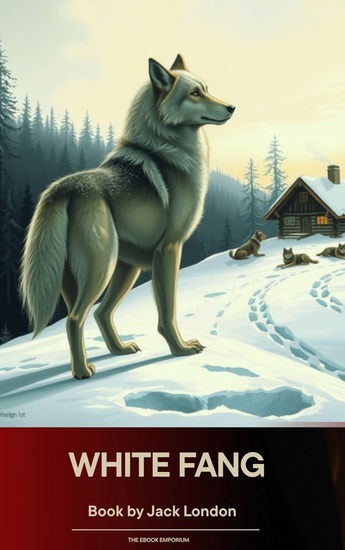
White Fang - cover

White Fang

Jack London

Editorial: The Ebook Emporium

  • 0
  • 0
  • 0

Sinopsis

"He was a killer, a thing of claw and fang... until he learned the law of love."

Born in the freezing wilds of the North, White Fang is three-quarters wolf and one-quarter dog—a creature caught between two worlds. His early life is a brutal lesson in the "Law of Meat": eat or be eaten. From the cold caves of the Yukon to the cruel hands of Gray Beaver and the sadistic "Beauty" Smith, White Fang is molded into a fierce, solitary fighter. But his life takes a dramatic turn when he is rescued by Weedon Scott. Through patience and kindness, White Fang must undergo the ultimate trial: unlearning the instincts of the wild to discover the meaning of loyalty.

Nature vs. Nurture: Jack London uses White Fang's life as a laboratory to explore the power of environment. The novel demonstrates how cruelty creates a "monstrosity" of hate, while affection can transform a predator into a protector. It is a masterpiece of animal psychology that challenges our understanding of the boundary between "tame" and "wild."

The "Wild" Reimagined: The opening of the novel, featuring the terrifying pursuit of two men by a starving wolf pack, is one of the most famous sequences in literature. London portrays the North not as a playground, but as a "Wild" that is indifferent to human suffering, setting the stage for White Fang's incredible resilience.

The Final Transition: The climax takes White Fang from the snow-covered Yukon to the sun-drenched valleys of California. Here, he must face his final challenge: protecting his new family from a threat that his wild instincts are uniquely qualified to handle.

Witness the journey of a lifetime. Purchase "White Fang" today and experience the power of the bond between man and beast.
Disponible desde: 09/01/2026.
Longitud de impresión: 150 páginas.

Otros libros que te pueden interesar

  • Dracula - cover

    Dracula

    Bram Stoker

    • 0
    • 0
    • 0
    “Welcome to my house! Enter freely and of your own will!” - and with these words, the English lawyer Johnathan Harker is drawn into a world of infamous and legendary horror... A genre defining gothic horror classic, of the fight between modern and learned civilisation and ancient and terrible superstition. 
    Narrated by Michael Ward.
    Ver libro
  • The Most Dangerous Game - cover

    The Most Dangerous Game

    Richard Connell

    • 0
    • 0
    • 0
    "The Most Dangerous Game" by Richard Connell is a gripping adventure thriller that explores the fine line between hunter and hunted. The story follows Sanger Rainsford, a seasoned big-game hunter who, after falling overboard from a yacht, washes up on a mysterious island. There, he encounters General Zaroff, an aristocratic hunter with a sinister passion—hunting humans for sport. As Rainsford becomes the next target in Zaroff’s deadly game, he must rely on his wits, survival skills, and sheer determination to outmaneuver his ruthless pursuer. This timeless tale of suspense, morality, and survival will keep listeners on the edge of their seats until the very last moment. 
    Cover photo by Ntsikelelo Radebe: https://www.pexels.com/photo/a-silhouette-of-a-wine-in-a-glass-and-bottle-11357544/
    Ver libro
  • The Tragedy Of Macbeth - cover

    The Tragedy Of Macbeth

    William Shakespeare

    • 0
    • 0
    • 0
    “By the pricking of my thumbs, something wicked this way comes.”“More is thy due than more than all can pay.”"What’s done cannot be undone."The Tragedy of Macbeth is a play by William Shakespeare. It is thought to have been first performed in 1606. It dramatizes the damaging physical and psychological effects of political ambition on those who seek power. Of all the plays that Shakespeare wrote during the reign of James I, Macbeth most clearly reflects his relationship with King James, patron of Shakespeare's acting company. It was first published in the Folio of 1623, possibly from a prompt book, and is Shakespeare's shortest tragedy.A brave Scottish general named Macbeth receives a prophecy from a trio of witches that one day he will become King of Scotland. Consumed by ambition and spurred to action by his wife, Macbeth murders King Duncan and takes the Scottish throne for himself. He is then wracked with guilt and paranoia. Forced to commit more and more murders to protect himself from enmity and suspicion, he soon becomes a tyrannical ruler. The bloodbath and consequent civil war swiftly take Macbeth and Lady Macbeth into the realms of madness and death.Shakespeare's source for the story is the account of Macbeth, King of Scotland, Macduff, and Duncan in Holinshed's Chronicles (1587), a history of England, Scotland, and Ireland familiar to Shakespeare and his contemporaries, although the events in the play differ extensively from the history of the real Macbeth. The events of the tragedy are usually associated with the execution of Henry Garnet for complicity in the Gunpowder Plot of 1605.In the backstage world of theatre, some believe that the play is cursed, and will not mention its title aloud, referring to it instead as "The Scottish Play". The play has attracted some of the most renowned actors to the roles of Macbeth and Lady Macbeth, and has been adapted to film, television, opera, novels, comics, and other media.
    Ver libro
  • Bartleby The Scrivener: A Story Of Wall-Street - cover

    Bartleby The Scrivener: A Story...

    Herman Melville

    • 0
    • 0
    • 0
    "Bartleby, the Scrivener: A Story of Wall-Street" is a novella written by Herman Melville, first published in 1853. The story is a poignant exploration of the dehumanizing effects of modern capitalism and the isolation that can result from the mechanization of work. The novella is narrated by an unnamed Wall Street lawyer who hires a scrivener named Bartleby to copy legal documents. Initially, Bartleby is diligent and efficient, but over time, he starts responding to requests with the phrase "I would prefer not to." This passive resistance leads to a series of confrontations and ultimately to Bartleby's refusal to do any work at all. The lawyer is both fascinated and perplexed by Bartleby's behavior, and the story explores themes of alienation, conformity, and the dehumanizing nature of modern office life.
    Ver libro
  • The Case of Vincent Pyrwhtt - From their pens to your ears genius in every story - cover

    The Case of Vincent Pyrwhtt -...

    Barry Pain

    • 0
    • 0
    • 0
    Barry Eric Odell Pain was born at 3 Sydney Street in Cambridge on 28th September 1864. He was one of 4 children. 
    He was educated at Sedbergh School and then Corpus Christi College, Cambridge. 
    In 1889, Cornhill Magazine published his short story ‘The Hundred Gates’.  This opened the way for Pain to advance his literary career on several fronts. He became a contributor to Punch and The Speaker, as well as joining the staff of both the Daily Chronicle and Black and White.  
    Pain was also a noted and prominent contributor to The Granta and from 1896 to 1928 a regular contributor to the Windsor Magazine. 
    It is often said that Pain was discovered by Robert Louis Stevenson, who compared his work to that of Guy de Maupassant.  It’s an apt comparison. Pain was a master of disturbing prose but was also able to inject parody and light comedy into many of his works.  A simple premise could in his hands suddenly expand into a world very real but somehow emotionally fraught and on the very edge of darkness. 
    Barry Pain died on 5th May 1928 in Bushey, Hertfordshire.
    Ver libro
  • Doom That Came to Sarnath The (Unabridged) - cover

    Doom That Came to Sarnath The...

    H. P. Lovecraft

    • 0
    • 0
    • 0
    "The Doom That Came to Sarnath" (1920) is a fantasy short story by American writer H. P. Lovecraft. It is written in a mythic/fantasy style and is associated with his Dream Cycle. It was first published in The Scot, a Scottish amateur fiction magazine, in June 1920.
    Ver libro