¡Acompáñanos a viajar por el mundo de los libros!
Añadir este libro a la estantería
Grey
Escribe un nuevo comentario Default profile 50px
Grey
Suscríbete para leer el libro completo o lee las primeras páginas gratis.
All characters reduced
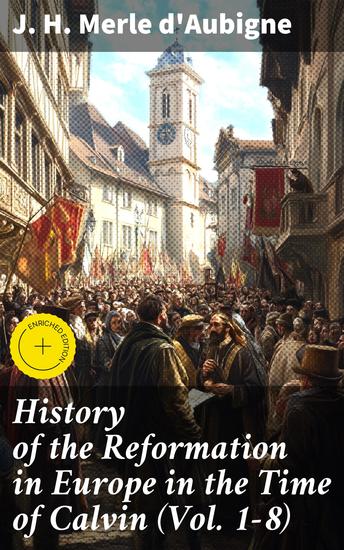
History of the Reformation in Europe in the Time of Calvin (Vol 1-8) - Complete Edition - cover

History of the Reformation in Europe in the Time of Calvin (Vol 1-8) - Complete Edition

J. H. Merle d'Aubigne

Traductor William L. R. Cates

Editorial: Good Press

  • 0
  • 0
  • 0

Sinopsis

"History of the Reformation in Europe in the Time of Calvin" by J. H. Merle d'Aubigne is a comprehensive and meticulously researched account that spans eight volumes, illuminating the tumultuous period of the Reformation during the 16th century. Written in a distinctive narrative style that intertwines detailed historical analysis with vivid storytelling, d'Aubigne presents the ideological and political upheavals that shaped Europe's transition from medieval to modern faiths. His work is situated within the broader context of Reformation scholarship, drawing upon primary sources, theological debates, and contrasting views to offer a nuanced understanding of Calvin's profound influence in Geneva and beyond. J. H. Merle d'Aubigne, a prominent historian and theologian of the 19th century, dedicated his life to exploring the dynamics of Protestant reform. His own experiences as a Protestant in a predominantly Catholic Europe undoubtedly fueled his passion for chronicling the Reformation's complexities. With a scholarly background rooted in both history and theology, d'Aubigne sought to document not only the events but also the spiritual fervor that characterized the Reformation, ensuring that the legacy of the Reformers endured. This monumental work is a must-read for scholars, students, and anyone captivated by the intricate tapestry of religious history. d'Aubigne'Äôs insights not only inform but also inspire, making a compelling case for the Reformation as a pivotal transformation in Western civilization. Readers will find in these volumes a rich source of knowledge that deepens their understanding of the era and challenges them to reflect on the enduring implications of faith and belief.
Disponible desde: 24/12/2023.
Longitud de impresión: 3595 páginas.


Otros libros que te pueden interesar

  • Black Power and the American Myth - 50th Anniversary Edition - cover

    Black Power and the American...

    C.T. Vivian

    • 0
    • 0
    • 0
    In 1970, C. T. Vivian, a close colleague of Martin Luther King, Jr. and a member of his executive staff, sat down to take stock of the civil rights movement and the progress it had made. His assessment was that it failed, and that the blame lay in the existence of myths about America. 


    As prophetic today as it was fifty years ago, Vivian's voice rings out as a critique and a call to action for a society in deep need of justice and peace. 


    The civil rights struggle that began when Rosa Parks, a seamstress in Montgomery, Alabama, decided to sit in the front of a bus has deeply altered American society and the American conscience. Yet from several perspectives, that movement has resulted in failure. The Black struggle for independence is more of an uphill climb than ever. Why? C. T. Vivian asserts that the civil rights movement failed because it was built on certain myths about America: 


    ● the myth that Americans will do what is right as soon as they know what is right. 


    ● the myth that legislation leads to justice. 


    ● the myth that America is an open society where any minority group can advance. 


    ● the myth that an ethic of love forms the core of the American conscience.
    Ver libro
  • How It Feels To Be Colored Me - cover

    How It Feels To Be Colored Me

    Zora Neale Hurston

    • 0
    • 0
    • 0
    How It Feels To Be Colored Me was first published in "The World Tomorrow" in May 1928. In this autobiographical piece that focuses on race and 1920s America, Hurston reflects on her early childhood in an all-black Florida town and her first experiences in life where she felt "different."Hurston focuses on the similarities we all share and on her own self-identity in the face of difference. "Through it all," she says, "I remain myself."
    Ver libro
  • Release Your Inner critic Coaching Session & Meditations Root cause healing - transforming toxic thought & emotions freedom from your mind no more harsh judgements seeking approval from others - cover

    Release Your Inner critic...

    Think ThinkAndBloom

    • 0
    • 0
    • 0
    There is a voice in your head that always criticizes you, belittle you, and judges you in a harsh way. And you know that you are the voice inside your head. It has a damaging effect on our self-esteem, self-value, and confidence level. If these inner critics overtake your mind, you will lose control in seeing your true beauty. 
    In this course, we will free ourselves from the critical mind. We bring out a new perspective for you to release sabotaging thought patterns. So that we do not need to seek out anyone's approval. We owe our power and stay in our center 
    Through coaching sessions, meditations & hypnosis, you will Release toxic thought patternsFinding the root causeHeal the emotions behindStop any harsh judgmentsKnow that you are good enoughEmbrace your values and uniquenessStop seeking approval from othersAnd much more 
    When you own your power back, you start to see yourself in a different eye. You will feel more compassionate towards yourself and others.
    Ver libro
  • Critical Thinking & Problem Solving - The Complete Guide to Superior Thinking Enhance Memory Hone Logic and Master Systematic Problem-Solving for Exceptional Decision-Making while Unraveling Logical Fallacies - cover

    Critical Thinking & Problem...

    LEOPOLD MCKINNEY

    • 0
    • 0
    • 0
    Ever wondered what makes some minds razor-sharp? Or how to make crucial decisions with absolute clarity? With "Critical Thinking & Problem Solving," dive into a realm of superior thinking, boosting your memory, sharpening your logic, and mastering the art of systematic problem-solving for exceptional decision-making. But there's more... 
    Embark on a journey of intellectual empowerment with "Critical Thinking & Problem Solving." In a world brimming with information and complexities, the ability to think critically and solve problems effectively is paramount. Authored by Leopold McKinney, this comprehensive guide offers a roadmap to sharpen your cognitive faculties, enhance your decision-making skills, and navigate the labyrinth of logical fallacies that often obscure clarity.Acquire strategies for effective time management and decision prioritization, enabling you to tackle tasks efficiently and make sound choices under pressure.Learn techniques for stress management and maintaining mental clarity in high-stakes situations, ensuring optimal performance when it matters most.Develop resilience and adaptability in the face of uncertainty, equipped with tools to navigate change and overcome obstacles with confidence.Explore the intersection of critical thinking and emotional intelligence, fostering self-awareness and empathy to enhance interpersonal relationships and collaboration.Access additional resources, including recommended readings, online courses, and practical exercises, to continue your journey of self-improvement beyond the pages of this book. 
    Gear up your brain to excel in every challenge! Purchase "Critical Thinking & Problem Solving" by Leopold McKinney now and embark on your journey toward superior thinking and exceptional decisions today!
    Ver libro
  • Imperial China - Foundations of a Great Civilization (3 in 1) - cover

    Imperial China - Foundations of...

    Jun Liu

    • 0
    • 0
    • 0
    This book offers an in-depth exploration of three of the most influential dynasties in Chinese history: the Han, Qin, and Tang Dynasties. This book delves into the powerful legacies of these dynasties, each of which shaped China’s cultural, political, and social development in profound ways. The Qin Dynasty, under the leadership of Emperor Qin Shi Huang, is known for unifying China and initiating monumental infrastructure projects such as the Great Wall and the Terracotta Army. The Han Dynasty, a golden age in Chinese history, expanded China’s borders, solidified Confucian ideals, and fostered the flourishing of trade along the Silk Road. Finally, the Tang Dynasty, often regarded as the most prosperous period in China’s imperial history, saw significant advancements in arts, culture, and governance. 
    In the Qin Dynasty, China was unified for the first time under a single ruler, marking the beginning of imperial rule. Emperor Qin’s centralization of power, creation of a standardized legal system, and the construction of defensive walls set the stage for the future of Chinese civilization. Although short-lived, the Qin Dynasty’s impact on Chinese governance and infrastructure would echo through the centuries.  
    Meanwhile, the Han Dynasty succeeded the Qin, ushering in an era of stability, economic prosperity, and cultural development. The Han established a strong bureaucracy and military, advanced in science and technology, and integrated Confucianism as the official philosophy, influencing Chinese society for over two millennia. 
    The Tang Dynasty, which followed the collapse of the Sui Dynasty, is celebrated for its cultural achievements, including the flourishing of poetry, painting, and literature. The Tang Empire expanded China's territory to its greatest extent, and its cosmopolitan capital, Chang'an, became a vibrant hub for international trade and cultural exchange.
    Ver libro
  • Kierkegaard - Existentialism and the Leap of Faith - cover

    Kierkegaard - Existentialism and...

    Hector Davidson

    • 0
    • 0
    • 0
    Søren Kierkegaard, often regarded as the father of existentialism, was born on May 5, 1813, in Copenhagen, Denmark. His early life was marked by tragedy, as his mother died when he was just a child, and his father, a deeply religious man, instilled in him a sense of guilt and the weight of existential questioning. Kierkegaard’s relationship with his father deeply influenced his philosophical development, particularly in his exploration of faith, despair, and the individual's relationship with God. 
    Kierkegaard’s intellectual journey began at the University of Copenhagen, where he studied theology and philosophy. He was deeply influenced by the works of philosophers such as Immanuel Kant and Friedrich Hegel, yet he sought to diverge from the systematic and rational approaches of these thinkers. Instead, he focused on the subjective aspects of human experience, emphasizing personal choice, individual responsibility, and the need for authentic existence. Kierkegaard believed that philosophy should not merely be an abstract pursuit but should directly address the real, lived experiences of individuals. 
    One of Kierkegaard's most significant contributions to philosophy was his critique of the established norms of society and religion. He believed that individuals often live in a state of "inauthenticity," blindly following social conventions and doctrines without truly reflecting on their own beliefs. For Kierkegaard, true existence could only be achieved through the individual’s leap of faith—an existential act that transcends reason and embraces the paradoxical nature of human life.
    Ver libro