Junte-se a nós em uma viagem ao mundo dos livros!
Adicionar este livro à prateleira
Grey
Deixe um novo comentário Default profile 50px
Grey
Assine para ler o livro completo ou leia as primeiras páginas de graça!
All characters reduced
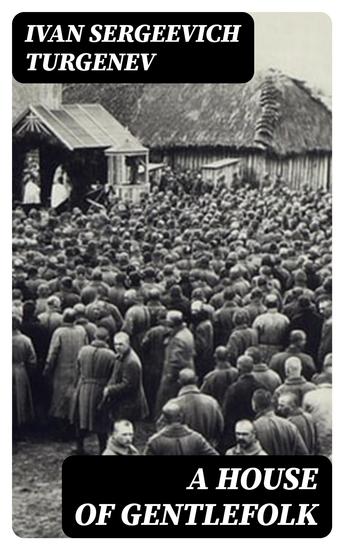
A House of Gentlefolk - cover
LER

A House of Gentlefolk

Ivan Sergeyevich Turgenev

Tradutor Constance Garnett

Editora: DigiCat

  • 0
  • 0
  • 0

Sinopse

In "A House of Gentlefolk," Turgenev masterfully weaves a rich tapestry of 19th-century Russian society, exploring themes of love, social class, and the generational divide through the lens of a fading noble family. The novel employs a delicate lyrical style, characterized by its nuanced characterizations and insightful psychological depth, reflecting Turgenev's admiration for the naturalistic approach. Set against the backdrop of a rapidly changing Russia, this work poignantly captures the tensions between the aristocracy and the emerging intelligentsia, highlighting the characters' complex emotions as they navigate their disillusionment and aspirations. Ivan Sergeevich Turgenev, a pivotal figure in Russian literature, was deeply influenced by his own upbringing in the privileged yet decaying nobility. His experiences as a landowner and his interactions with the Russian intelligentsia profoundly shaped his worldview, prompting him to articulate the struggles of a society in transition. Turgenev's own contemplative nature and Western exposure, especially to Romanticism, inform the meditative quality of this novel, embodying his sense of longing and societal critique. This classic novel is highly recommended for readers seeking an intimate exploration of the dynamics of love and societal change. Turgenev's elegant prose and sharp observations invite readers to not only immerse themselves in the lives of his characters but also reflect on the broader implications of their choices. "A House of Gentlefolk" remains a significant work, resonating with contemporary discussions on class, identity, and the human experience.
Disponível desde: 15/08/2022.
Comprimento de impressão: 153 páginas.


Outros livros que poderiam interessá-lo

  • White Fang - cover

    White Fang

    Jack London

    • 0
    • 0
    • 0
    It was the she-wolf who had first caught the sound of men's voices and the whining of the sled-dogs; and it was the she-wolf who was first to spring away from the cornered man in his circle of dying flame. The pack had been loath to forego the kill it had hunted down, and it lingered for several minutes, making sure of the sounds, and then it, too, sprang away on the trail made by the she-wolf. Running at the forefront of the pack was a large grey wolf—one of its several leaders.    It was he who directed the pack's course on the heels of the she-wolf. It was he who snarled warningly at the younger members of the pack or slashed at them with his fangs when they ambitiously tried to pass him. And it was he who increased the pace when he sighted the she-wolf, now trotting slowly across the snow. She dropped in alongside by him, as though it were her appointed position, and took the pace of the pack. He did not snarl at her, nor show his teeth, when any leap of hers chanced to put her in advance of him.    On the contrary, he seemed kindly disposed toward her—too kindly to suit her, for he was prone to run near to her, and when he ran too near it was she who snarled and showed her teeth. Nor was she above slashing his shoulder sharply on occasion. At such times he betrayed no anger. He merely sprang to the side and ran stiffly ahead for several awkward leaps, in carriage and conduct resembling an abashed country swain. This was his one trouble in the running of the pack; but she had other troubles.    On her other side ran a gaunt old wolf, grizzled and marked with the scars of many battles. He ran always on her right side. The fact that he had but one eye, and that the left eye, might account for this. He, also, was addicted to crowding her, to veering toward her till his scarred muzzle touched her body, or shoulder, or neck. As with the running mate on the left, she repelled these attentions with her teeth; but when both bestowed their attentions at the same time she was roughly jostled, being compelled, with quick snaps to either side, to drive both lovers away and at the same time to maintain her forward leap with the pack and see the way of her feet before her.    At such times her running mates flashed their teeth and growled threateningly across at each other. They might have fought, but even wooing and its rivalry waited upon the more pressing hunger-need of the pack. After each repulse, when the old wolf sheered abruptly away from the sharp-toothed object of his desire, he shouldered against a young three-year-old that ran on his blind right side. This young wolf had attained his full size; and, considering the weak and famished condition of the pack, he possessed more than the average vigour and spirit. Nevertheless, he ran with his head even with the shoulder of his one-eyed elder. When he ventured to run abreast of the older wolf (which was seldom), a snarl and a snap sent him back even with the shoulder again.    Sometimes, however, he dropped cautiously and slowly behind and edged in between the old leader and the she-wolf. This was doubly resented, even triply resented. When she snarled her displeasure, the old leader would whirl on the three-year-old. Sometimes she whirled with him. And sometimes the young leader on the left whirled, too. At such times, confronted by three sets of savage teeth, the young wolf stopped precipitately, throwing himself back on his haunches, with fore-legs stiff, mouth menacing, and mane bristling. This confusion in the front of the moving pack always caused confusion in the rear. The wolves behind collided with the young wolf and expressed their displeasure by administering sharp nips on his hind-legs and flanks. He was laying up trouble for himself, for lack of food and short tempers went together; but with the boundless faith of youth he persisted in repeating the manoeuvre every little while, though it never succeeded in gaining anything for him but discomfiture.
    Ver livro
  • Symzonia - A Voyage of Discovery (Unabridged) - cover

    Symzonia - A Voyage of Discovery...

    Nathaniel Ames

    • 0
    • 0
    • 0
    Symzonia: A Voyage of Discovery is a piece of fictional travel literature published on November 2, 1820, by Jonathan Seymour. It was written under the pseudonym Captain Adam Seaborn and its true authorship is uncertain, although stylometric analysis performed by Paul Collins suggests that the author was Nathaniel Ames. The book is premised on the earth's being hollow and was influenced by the theories of John Symmes. The account by the fictional Captain Seaborn details a voyage from the United States in which Captain Seaborn leads a crew of sailors to the center of the Earth.
    Ver livro
  • Stories Of Santa Claus - cover

    Stories Of Santa Claus

    L. Frank Baum

    • 0
    • 0
    • 0
    L. Frank Baum was an American author best known for his children’s books, particularly The Wonderful Wizard of Oz and its sequels. He wrote 14 novels in the Oz series, plus 41 other novels (not including four lost, unpublished novels), 83 short stories, over 200 poems, and at least 42 scripts. He made numerous attempts to bring his works to the stage and screen; the 1939 adaptation of the first Oz book became a landmark of 20th-century cinema. The Life and Adventures of Santa Claus is a 1902 children’s book. Santa Claus, as a baby, is found in the Forest of Burzee by Ak, the Master Woodsman of the World (a supreme immortal), and placed in the care of the lioness Shiegra; but thereupon adopted by the Wood Nymph, Necile. Upon reaching young adulthood, Claus is introduced by Ak to human society, wherein he sees war, brutality, poverty, child neglect, and child abuse. Because he cannot reside in Burzee as an adult, he settles in the nearby Laughing Valley of Hohaho, where the immortals regularly assist him, and Peter Knook gives him a little cat named Blinky.
    Ver livro
  • Odyssey of the North An - cover

    Odyssey of the North An

    Jack London

    • 0
    • 0
    • 0
    Things are not what they seem. A grizzled traveler arrives in a bluster. He doesn't make sense when he speaks. But once he warms up from the brink of death, his story and his heartbreak unfolds. 
    Enjoy this classic from Jack London, narrated by Audible best seller Evan Schmitt. 
    Story originally published in 1900. Production copyright 2023 by Riveting Publishing
    Ver livro
  • By the Rule of Contrary (Unabridged) - cover

    By the Rule of Contrary...

    L. M. Montgomery

    • 0
    • 0
    • 0
    Lucy Maud Montgomery (November 30, 1874 - April 24, 1942), published as L. M. Montgomery, was a Canadian author best known for a series of novels beginning in 1908 with Anne of Green Gables. The book was an immediate success. The title character, orphan Anne Shirley, made Montgomery famous in her lifetime and gave her an international following.
    By the Rule of Contrary: "Look here, Burton," said old John Ellis in an ominous tone of voice, "I want to know if what that old busybody of a Mary Keane came here today gossiping about is true. If it is well, I've something to say about the matter!
    Ver livro
  • War and Peace - Book 2: 1805 (Unabridged) - cover

    War and Peace - Book 2: 1805...

    Leo Tolstoy

    • 0
    • 0
    • 0
    War and Peace is a literary work mixed with chapters on history and philosophy by the Russian author Leo Tolstoy. It was first published serially, then published in its entirety in 1869. It is regarded as one of Tolstoy's finest literary achievements and remains an internationally praised classic of world literature.
    Book 2: 1805: In October, 1805, a Russian army was occupying the villages and towns of the Archduchy of Austria, and yet other regiments freshly arriving from Russia were settling near the fortress of Braunau and burdening the inhabitants on whom they were quartered. Braunau was the headquarters of the commander in chief, Kutúzov.
    Ver livro