¡Acompáñanos a viajar por el mundo de los libros!
Añadir este libro a la estantería
Grey
Escribe un nuevo comentario Default profile 50px
Grey
Suscríbete para leer el libro completo o lee las primeras páginas gratis.
All characters reduced
Fathers and Sons - cover

Fathers and Sons

Ivan Sergeevich Turgenev

Traductor C. J. Hogarth

Editorial: DigiCat

  • 0
  • 0
  • 0

Sinopsis

In "Fathers and Sons," Ivan Sergeevich Turgenev navigates the chasm between generations during the mid-19th century in Russia, illuminating the ideological rift between the traditional values of the aristocracy and the progressive sentiments of the nihilist youth. Written in a lyrical yet incisive style, Turgenev employs rich character development and dialogue to explore themes of love, conflict, and the quest for identity. The novel's intricate tapestry of interactions deftly captures the turbulence of societal change, making it a pivotal work in the context of Russian literature and its reflective commentary on contemporary social dilemmas. Turgenev, a prominent figure in the Russian literary canon, was influenced by the rapid transformations occurring in both his homeland and Europe. His own experiences with Western philosophy and the rise of a new generation mirrored the characters' struggles, fueling his desire to present a balanced portrayal of differing perspectives. The author's upper-class upbringing and his deep affinity for nature and the human condition resonate throughout the narrative, shaping his characters' struggles and aspirations. "Fathers and Sons" is essential reading for those interested in exploring the conflicts of ideological evolution and personal relationships. Turgenev's profound insights into human nature and his evocative prose will leave readers reflecting on their own values and connections, making this novel a timeless exploration of generational conflict.
Disponible desde: 10/08/2022.
Longitud de impresión: 200 páginas.
Otros libros que te pueden interesar

  • The Bucket Rider - A poor man seeks compassion but is found wanting - cover

    The Bucket Rider - A poor man...

    Franz Kafka

    • 0
    • 0
    • 0
    Franz Kafka was born on 3rd July 1883 in Prague, then in Bohemia, the eldest of 6, into a middle-class Jewish family. 
     
    Life for the young Kafka and his passion for literature was often made an ordeal by his over-bearing and domineering entrepreneur of a father.   
     
    In 1889 Kafka was sent to the Deutsche Knabenschule, an elementary school in Prague. His father would only allow him to be educated in German-speaking schools and even went so far as to limit visits to the synagogue to four a year. 
     
    In 1901 he graduated from the classics-oriented Altstädter Gymnasium. Kafka did well there and across a large range of subjects.  He now enrolled at the Charles Ferdinand University, to study chemistry, but quickly switched to law for which he obtained his degree in June 1906 and then performed the mandatory year of unpaid service as clerk at the civil and criminal courts. 
     
    A job at an Italian insurance company left him little time to write and after a year he took another job with the Worker's Accident Insurance Institute for the Kingdom of Bohemia where he stayed until ill health led to his resignation in 1922. 
     
    Although he saw work as a means to pay the bills and to allow him time to write, he received several promotions and was noted as a good employee. 
     
    By 1917 Kafka was suffering from tuberculosis, which required frequent periods of convalescence. Interspersed with this, were several intense affairs before he settled in Berlin with Dora Diamant, a 25-year-old kindergarten teacher who herself having left the ghetto now influenced Kafka's interest in the book of Jewish law, the Talmud. 
     
    Kafka’s on-going health was littered with problems. Apart from TB there were several other ailments, including migraines, insomnia, boils, depression, all usually brought on by excessive stresses and strains. He attempted to counteract all of this by naturopathic treatments, a vegetarian diet and consuming large quantities of unpasteurized milk. 
     
    His tuberculosis still worsened. He returned to Prague, where he died on 3rd June 1924. He was 40. 
     
    His literary works are few in number but towering in influence.  His masterpieces include ‘The Trial’, ‘The Metamorphosis’ as well as a number of short stories which reveal facets of humankind that truthfully could only be born from Kafka’s brain and pen.
    Ver libro
  • Alexander's Bridge - cover

    Alexander's Bridge

    Willa Cather

    • 0
    • 0
    • 0
    ""Alexander's Bridge" is the first novel by the American author Willa Cather. It was initially published in 1912 and later re-released with an author's preface in 1922. The novel also ran as a serial in McClure's magazine, providing Cather with some free time from her work for that publication1.    Here's a brief summary of the novel:    Plot Introduction:  The protagonist, Bartley Alexander, is a construction engineer and a world-renowned builder of bridges.  Bartley is undergoing a mid-life crisis and is married to Winifred.  Despite his marriage, Bartley resumes his acquaintance with a former lover, Hilda Burgoyne, in London.  The affair gnaws at Bartley's sense of propriety and honor.  Plot Summary:  Professor Lucius Wilson arrives at the Alexanders' house in Boston. Bartley had persuaded him to attend a Congress of Psychologists in the city.  Bartley's wife, Winifred, greets Professor Wilson.  Bartley discusses his trouble with a bridge in Canada.  Bartley's relationship with Hilda becomes a central conflict.  The novel takes a tragic turn when Bartley is called to inspect the failing bridge in Canada.  While on the bridge, he realizes its structural integrity is compromised, but it collapses before he can prevent disaster.  Bartley dies along with many workers.  The aftermath involves Winifred making arrangements for her husband's corpse, and Professor Wilson reflecting on the consequences of Bartley's actions.  "Alexander's Bridge" explores themes of love, ambition, and the impact of choices. Cather's portrayal of human connections and their fragility resonates throughout the novel."
    Ver libro
  • A Profitable Weakness - From their pens to your ears genius in every story - cover

    A Profitable Weakness - From...

    George Gissing

    • 0
    • 0
    • 0
    George Robert Gissing was born on November 22nd, 1857 in Wakefield, Yorkshire.  
    He was educated at Back Lane School in Wakefield. Gissing loved school. He was enthusiastic with a thirst for learning and always diligent.  By the age of ten he was reading Dickens, a lifelong hero. 
    In 1872 Gissing won a scholarship to Owens College. Whilst there Gissing worked hard but remained solitary. Unfortunately, he had run short of funds and stole from his fellow students. He was arrested, prosecuted, found guilty, expelled and sentenced to a month's hard labour in 1876. 
    On release he decided to start over.  In September 1876 he travelled to the United States. Here he wrote short stories for the Chicago Tribune and other newspapers. On his return home he was ready for novels. 
    Gissing self-published his first novel but it failed to sell.  His second was acquired but never published. His writing career was static.  Something had to change.  And it did. 
    By 1884 The Unclassed was published.  Now everything he wrote was published. Both Isabel Clarendon and Demos appeared in 1886. He mined the lives of the working class as diligently as any capitalist. 
    In 1889 Gissing used the proceeds from the sale of The Nether World to go to Italy. This trip formed the basis for his 1890 work The Emancipated. 
    Gissing's works began to command higher payments. New Grub Street (1891) brought a fee of £250.  
    Short stories followed and in 1895, three novellas were published; Eve's Ransom, The Paying Guest and Sleeping Fires. Gissing was careful to keep up with the changing attitudes of his audience.  
    Unfortunately, he was also diagnosed as suffering from emphysema. The last years of his life were spent as a semi-invalid in France but he continued to write. 1899; The Crown of Life. Our Friend the Charlatan appeared in 1901, followed two years later by The Private Papers of Henry Ryecroft. 
    George Robert Gissing died aged 46 on December 28th, 1903 after catching a chill on a winter walk.
    Ver libro
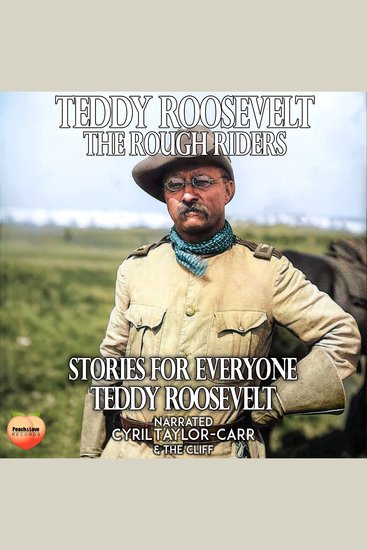
  • Teddy Roosevelt The Rough Riders - Stories For Everyone - cover

    Teddy Roosevelt The Rough Riders...

    Teddy Roosevelt

    • 0
    • 0
    • 0
    The Rough Riders was a nickname given to the 1st United States Volunteer Cavalry, one of three such regiments raised in 1898 for the Spanish–American War and the only one to see combat. The United States Army was small, understaffed, and disorganized in comparison to its status during the American Civil War roughly thirty years prior. Following the sinking of USS Maine, President William McKinley needed to muster a strong ground force swiftly, which he did by calling for 125,000 volunteers to assist in the war. The U.S. had gone to war in opposition to Spanish colonial policies in Cuba, which was then torn by a rebellion.[1] The regiment was also nicknamed "Wood's Weary Walkers" for its first commander, Colonel Leonard Wood. This reflected their dissatisfaction that despite being cavalry, they ended up fighting in Cuba as infantry since their horses were not sent there with them. 
     
    Wood's second in command was former Assistant Secretary of the Navy Theodore Roosevelt, a strong advocate for the Cuban War of Independence. When Wood was promoted to become commander of the 2nd Cavalry Brigade, the regiment became known as "Roosevelt's Rough Riders." That term was borrowed from Buffalo Bill, who called his traveling Western show "Buffalo Bill's Wild West and Congress of Rough Riders of the World." 
     
    The original plan called for the regiment to be composed of frontiersmen from the Indian Territory, the New Mexico Territory, the Arizona Territory, and the Oklahoma Territory. However, after Roosevelt joined the ranks, it attracted an odd mixture of Ivy League athletes, glee club singers, Texas Rangers, and Native Americans. All accepted into the regiment had to be skilled horsemen and eager to see combat. The Rough Riders would receive more publicity than any other Army unit in that war, and they are best remembered for their conduct during the Battle of San Juan Hill.
    Ver libro
  • Treasure Island - cover

    Treasure Island

    Robert Lewis Stevenson

    • 0
    • 0
    • 0
    A children's classic for young adventurers. 
    When an old sea Captain named Billy Bones leaves behind a mysterious chest at Jim Hawkins' parents inn, Jim discovers a map to the legendary Treasure Island! Jim sets sail to Treasure Island with Long John Silver and his ragtag crew but can they be trusted?
    Ver libro
  • Oscar Wilde : Four Stories - Lord Arthur Savile's Crime; The Canterville Ghost; The Sphinx Without a Secret; The Model Millionaire - cover

    Oscar Wilde : Four Stories -...

    Oscar Wilde

    • 0
    • 0
    • 0
    The four tales gathered here reveal Oscar Wilde’s gift for blending wit, irony, and moral reflection within the form of the short story.
    
     Lord Arthur Savile’s Crime is a darkly comic exploration of fate and free will, where polite society collides with the absurd. 
    
    
    The Canterville Ghost playfully turns the traditional ghost story on its head, offering satire as sharp as it is humorous. 
    
    
    In The Sphinx Without a Secret, Wilde meditates on mystery and illusion, showing how beauty and enigma may dissolve under the scrutiny of truth.
    
    
     Finally, The Model Millionaire provides a tender moral fable, reminding us that generosity and kindness carry more value than wealth or charm.


    Head Stories Audio presents "Oscar Wilde - Four Stories", with narration and original music by Simon Hester.
    Ver libro