¡Acompáñanos a viajar por el mundo de los libros!
Añadir este libro a la estantería
Grey
Escribe un nuevo comentario Default profile 50px
Grey
Suscríbete para leer el libro completo o lee las primeras páginas gratis.
All characters reduced
Mental Health Care - cover

Mental Health Care

Isabella Brooks

Traductor A AI

Editorial: Publifye

  • 0
  • 0
  • 0

Sinopsis

"Mental Health Care" addresses the often-overlooked importance of self-care for maternal mental well-being, amidst the pressures of modern parenting. This book tackles how mothers can prioritize their mental health and what practices can prevent burnout. With rising rates of postpartum depression and anxiety highlighting the urgent need for solutions, it emphasizes that self-care isn't selfish, but rather essential for both the mother’s well-being and her children's healthy development.

 
Did you know that prioritizing self-care is significantly linked to healthier family dynamics? Or that mindfulness practices can be a key tool in preventing maternal burnout?

 
This book begins by defining self-care in motherhood, dispelling myths and highlighting its multifaceted nature. It then explores societal expectations, evidence-based techniques like mindfulness and exercise, and the impact of social support. The approach culminates in a practical guide for integrating self-care into daily routines, with case studies and actionable advice.

 
The book uniquely frames self-care as a core component of responsible parenting, encouraging a balanced approach to motherhood.
Disponible desde: 22/02/2025.
Longitud de impresión: 108 páginas.
Otros libros que te pueden interesar

  • Observers and Their Worlds - cover

    Observers and Their Worlds

    Anónimo

    • 0
    • 0
    • 0
    In this groundbreaking work, I challenge the metaphysical foundations that have shaped Western thought since ancient Greece. Following Nietzsche's call to question the interpretations of Plato and Aristotle—what I designate as the "metaphysical ontology"—I propose a radical alternative: the ontology of language.
    For centuries, we have been faithful to metaphysical assumptions that now compromise both our capacity to give meaning to our lives and the ways we relate to others. Western civilization has reached an impasse, and it is imperative that we step back and forge a new path.
    This work examines the fundamental axes of the observer and demonstrates that human beings are linguistic beings who invent themselves through language.
    I developed the concept of metaphysical ontology to distinguish the dominant Western tradition from my proposal of a non-metaphysical ontology—one that opens new possibilities for human transformation, learning, and coexistence. This is my invitation to reimagine what it means to be human.
    —Rafael Echeverría
    Ver libro
  • The Greatest Evil is War - cover

    The Greatest Evil is War

    Chris Hedges

    • 0
    • 0
    • 0
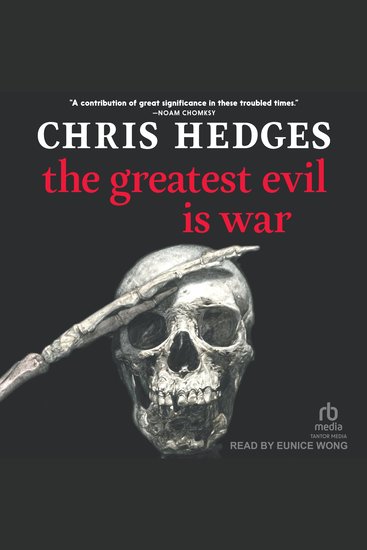
    In fifteen short chapters, Chris Hedges astonishes us with his clear and cogent argument against war, not on philosophical grounds or through moral arguments, but in an irrefutable stream of personal encounters with the victims of war, from veterans and parents to gravely wounded American serviceman who served in the Iraq War, to survivors of the Holocaust, to soldiers in the Falklands War, among others. Hedges reported from Sarajevo, and was in the Balkans to witness the collapse of the Soviet Union. 


    In 2002 he published War Is a Force That Gives Us Meaning, which the Los Angeles Times described as "the best kind of war journalism . . . bitterly poetic and ruthlessly philosophical" and the New York Times called "a brilliant, thoughtful, timely, and unsettling book." In the twenty years since, Hedges has not wanted to write another book on the subject of war—until now, with the outbreak of war in Ukraine. It is important again to be reminded who are the victors of the spoils of war and of other unerring truths, not only in this war but in all modern wars, where civilians are always the main victims, and the tools and methods of war are capable of so much destruction it boggles the mind. This book is an unflinching indictment of the horror and obscenity of war by one of our finest war correspondents.
    Ver libro
  • How to Become a Preschool Teacher Career Professional Development Planning Audio Book - With Job Interview Preparation & Coaching Guide for Men Women Teens & Young Adults - cover

    How to Become a Preschool...

    Brian Mahoney

    • 0
    • 0
    • 0
    End Money Worries! 
    How to Become a Preschool Teacher Career Professional Development Planning Audio Book 
    With Job Interview Preparation & Coaching Guide for Men, Women, Teens & Young Adults 
    by Brian Mahoney  
           Discover... 
    * What a Preschool Teacher does 
         * How to Become a Preschool Teacher  
          * What is the salary of a Preschool Teacher  
             * What is the Preschool Teacher Work Environment like 
                 * What is the future Job outlook for a Preschool Teacher  
             * how long does it take to become a Preschool Teacher 
          * How to Prepare for Your Job Interview 
       * Tips the pros use to Ace their Job Interview 
    * You'll be confident with the best answers for the toughest job interview questions 
    The knowledge and ability to change your life all for less than the cost of 1 movie ticket! 
     If you are ready to get started & want the knowledge, help & motivation to change your life now!... 
    Then this Book is for you!!! 
                         So Don't wait. You'll wait your life away...
    Ver libro
  • How to Grieve - An Ancient Guide to the Lost Art of Consolation - cover

    How to Grieve - An Ancient Guide...

    Marcus Tullius Cicero

    • 0
    • 0
    • 0
    An engaging new translation of a timeless masterpiece about coping with the death of a loved one 


    In 45 BCE, the Roman statesman Cicero fell to pieces when his beloved daughter, Tullia, died from complications of childbirth. But from the depths of despair, Cicero fought his way back. In an effort to cope with his loss, he wrote a consolation speech—not for others, as had always been done, but for himself. And it worked. Cicero's Consolation was something new in literature, equal parts philosophy and motivational speech. Drawing on the full range of Greek philosophy and Roman history, Cicero convinced himself that death and loss are part of life, and that if others have survived them, we can, too; resilience, endurance, and fortitude are the way forward. 


    Lost in antiquity, Cicero's Consolation was recreated in the Renaissance from hints in Cicero's other writings and the Greek and Latin consolatory tradition. The resulting masterpiece—translated here for the first time in 250 years—is infused throughout with Cicero's thought and spirit. 


    Complete with an inviting introduction, Michael Fontaine's engaging translation makes this searching exploration of grief available to readers once again.
    Ver libro
  • Slavery and the Law: The History of the Legal Systems and Cases that Enabled Slavery in the United States - cover

    Slavery and the Law: The History...

    Editors Charles River

    • 0
    • 0
    • 0
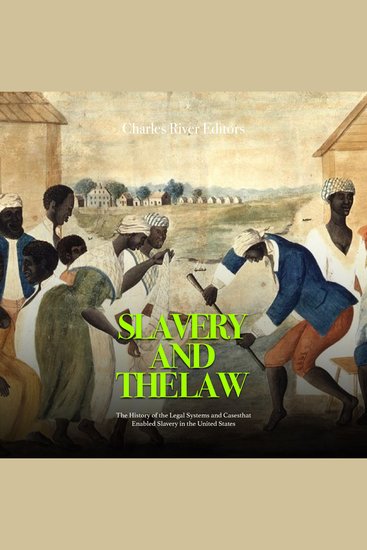
    Ultimately, while the institution of slavery existed, the principle of protecting individual property rights prevailed, alongside a necessary acknowledgment that slaves were property first and sentient human beings second. It also required a great deal of careful drafting and verbal contortions to construct the Constitution for the young republic that supported those principles of freedom and equality while at the same time facilitating the perpetuation of the “peculiar institution.” 
    	It was not until 1865, with the adoption of the Thirteenth Amendment, the instrument that abolished slavery, that any overt mention of slavery found its way into the Constitution. Before that, direct reference was always carefully avoided, although, at the same time, unmistakably alluded to. The document is filled with provisions specific to slavery, protecting and codifying it on a federal level, without anywhere making direct or overt mention of it. By 1788, when the Constitution of the United States was formally adopted, slavery had been a fact of life in the colonies for 169 years, since the first recorded arrival of black Africans in Virginia in 1619. At that time, around the institution, had evolved a system of laws that were derived in the main from English common law. The irony here is that the regime of English common law was at its root hostile to the principle of human bondage, had no tradition of slavery to call upon, and was desirous on the whole to avoid making any overt judgment or pronouncement on the matter. It, therefore, fell to colonial lawmakers to resolve that essential contradiction between treating Africans as either people or property or both. This tension remained in play throughout the era of slavery in English-speaking America until the matter was finally resolved by the outcome of the American Civil War.
    Ver libro
  • Transformations in China - Cultural and Economic Shifts (3 in 1) - cover

    Transformations in China -...

    Jun Liu

    • 0
    • 0
    • 0
    Transformations in China explores the sweeping cultural, political, and economic changes that have reshaped China from ancient times to the modern era. This 3-in-1 volume covers pivotal periods in Chinese history, focusing on three major forces of transformation: Modernization and Reform, The Cultural Revolution, and The Silk Road. From the ancient trade routes that connected China to the rest of the world, to the turbulent policies of the 20th century, this book captures the resilience and complexity of a civilization in constant evolution. 
    The journey begins with the Silk Road, which served as the lifeblood of commerce and cultural exchange for centuries. More than a trade route, it was a corridor for sharing religions, inventions, languages, and ideas between East and West. The narrative then moves to the 20th century, examining The Cultural Revolution, a period of radical upheaval that profoundly altered Chinese society. Spearheaded by Mao Zedong, this political campaign reshaped education, tradition, and family life, leaving a lasting mark on Chinese identity. 
    Finally, the book explores Modernization and Reform, spotlighting China’s transition from a closed, agrarian state to a global economic superpower. Beginning with Deng Xiaoping’s reforms in the late 20th century, this section details the rapid industrialization, urbanization, and globalization that have defined modern China. Transformations in China presents a sweeping yet accessible account of how a nation has continuously redefined itself—often through conflict, always through change.
    Ver libro