Unisciti a noi in un viaggio nel mondo dei libri!
Aggiungi questo libro allo scaffale
Grey
Scrivi un nuovo commento Default profile 50px
Grey
Iscriviti per leggere l'intero libro o leggi le prime pagine gratuitamente!
All characters reduced
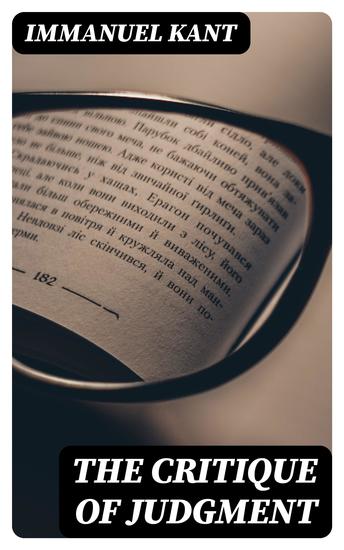
The Critique of Judgment - Enriched edition - cover

The Critique of Judgment - Enriched edition

Immanuel Kant

Traduttore J. H. Bernard

Casa editrice: DigiCat

  • 0
  • 0
  • 0

Sinossi

In "The Critique of Judgment," Immanuel Kant meticulously explores the intricate relationship between aesthetics and teleology, positioning judgment as a critical faculty that bridges the domains of the sublime and the beautiful. This seminal work is divided into two main sections, the Critique of Aesthetic Judgment and the Critique of Teleological Judgment, offering profound insights into the nature of human perception and the principles governing our appreciation of art and nature. Kant employs a distinctive philosophical style, combining rigorous analysis with eloquent prose, reflecting the Enlightenment's quest for objectivity and universality amidst subjective experiences. Immanuel Kant, a central figure in modern Western philosophy, was significantly influenced by the Enlightenment ideals of reason and freedom. Writing "The Critique of Judgment" in 1790, he sought to bridge the gap between empiricist and rationalist thought, examining how aesthetic values and notions of purpose resonate within human consciousness. Kant's rich intellectual heritage, including his engagement with the works of Rousseau and Hume, profoundly shaped his inquiries into the aesthetic and teleological dimensions of human experience. This book is essential for those interested in philosophy, art, and science, offering a fundamental understanding of how we evaluate and appreciate beauty and purpose. Readers will find Kant's reflections not only intellectually stimulating but also highly relevant to contemporary discussions surrounding aesthetics and the nature of judgment.

In this enriched edition, we have carefully created added value for your reading experience:
- A succinct Introduction situates the work's timeless appeal and themes.
- The Synopsis outlines the central plot, highlighting key developments without spoiling critical twists.
- A detailed Historical Context immerses you in the era's events and influences that shaped the writing.
- An Author Biography reveals milestones in the author's life, illuminating the personal insights behind the text.
- A thorough Analysis dissects symbols, motifs, and character arcs to unearth underlying meanings.
- Reflection questions prompt you to engage personally with the work's messages, connecting them to modern life.
- Hand‐picked Memorable Quotes shine a spotlight on moments of literary brilliance.
- Interactive footnotes clarify unusual references, historical allusions, and archaic phrases for an effortless, more informed read.
Disponibile da: 17/05/2022.
Lunghezza di stampa: 423 pagine.

Altri libri che potrebbero interessarti

  • How to Write a Grant: Become a Grant Writing Unicorn - cover

    How to Write a Grant: Become a...

    Meredith Noble

    • 0
    • 0
    • 0
    #1 bestseller for nonprofit fundraising and grants 
    This book answers all your questions related to grant writing and the questions you want to ask like… 
    🔸 How do I build a career in grant writing? 
    🔸 What if the grant I write doesn’t win? 
    🔸 How do I make time for this? 
    Here’s what we want you to know: if you can think critically and commit to being the best version of yourself, you will succeed as a grant writing unicorn. 
    We often get ahead of ourselves, and fear overruns our hopes and dreams. But did you know that you can get started sooner than you realize? As soon as you close this book, you are ready. Marked with chocolate fingerprints, coffee stains, post-its, and highlights, you will feel confident and inspired to take action. 
    Freshen that cup of joe or tea my friend. We move quickly around here. You are on your way to becoming a Grant Writing Unicorn! 🦄 
    🧡 Meredith, Alex, and the Entire Team at Learn Grant Writing
    Mostra libro
  • Bricks that Build Us Book 2 - Family and a successful childhood concerning constructive beliefs and influences Christian virtues philosophy's rolecommunity with fallible education and law - cover

    Bricks that Build Us Book 2 -...

    Rob Howat

    • 0
    • 0
    • 0
    Since you recognize that things are going dangerously wrong both worldwide and on our streets, this is a series of four short books for you. They develop the calling for immediate action with many of the avoidable causes identified, listed and remedies stated clearly all in 'crystal clear' language. Now is the time to push back and protect our loved ones, our young, those who are vulnerable and all our futures. Later may well be too late. For many thinking people there is a well-founded and growing disquiet about where our world is going. Undeniably we observe that wasteful preoccupation with owning things which has replaced family values, sound reason, decency and necessary self-discipline for far too many. The me-first society focuses upon personal gratification while rejecting the more central need to think and work together to maintain our community and social family. Discarded is the we-first, polite and supportive normality of quieter times, led now by the shallow, self-interested more grotesque ideas, ideals and human actors. Through this storm of mediocracy and shallow existence can be heard the tramping of media moguls, the infected internet and dead actors of artificial "intelligence", cold scam 'phone callers that daily threaten our loved ones and us. We must most urgently identify our enemies with their manipulative control methods and develop effective counterarguments with successful countermeasures. Unified, self-disciplined, clarified actions, focused on restoring our interdependent caring communities, can and will successfully rebuild common sense and social sanity one brick at a time.
    Mostra libro
  • Patience: The Art of Waiting - Finding Peace in the Process - cover

    Patience: The Art of Waiting -...

    Esther Jameson

    • 0
    • 0
    • 0
    Patience is often regarded as a simple virtue, but it carries profound power in shaping our lives. It goes beyond just waiting for something to happen. True patience is the ability to endure the waiting process with grace, calm, and peace of mind. It allows us to maintain focus on our long-term goals while navigating the uncertainties of life. In today’s fast-paced world, where instant gratification has become the norm, patience has become an increasingly rare but invaluable skill. Learning to practice patience empowers us to take a step back, remain composed, and make decisions with clarity, even in the face of adversity. 
    Patience serves as a bridge between desire and fulfillment. It gives us the resilience to endure the waiting period without losing sight of what we’re striving for. Whether we’re waiting for a promotion, healing from an injury, or working toward personal growth, patience allows us to trust that things are unfolding in the right timing. It is often in the waiting process that we learn the most valuable lessons. We discover new strengths, build resilience, and deepen our understanding of ourselves and the world around us. 
    In scientific terms, patience is closely linked to emotional regulation. Studies have shown that those who practice patience tend to experience less stress and anxiety, as they are better able to cope with frustration and setbacks. Patience doesn’t mean passively sitting by and waiting for things to happen; it involves active participation in the process, understanding that timing plays a critical role in achieving our goals. It teaches us to manage our impulses, temper our expectations, and stay grounded during difficult moments.
    Mostra libro
  • Domestication of Dogs and Cats The: The History and Legacy of People’s Favorite Pets - cover

    Domestication of Dogs and Cats...

    Editors Charles River

    • 0
    • 0
    • 0
    As the oft-repeated and invariably accurate pearl of wisdom goes, a dog truly is man's best friend. For a long time, people have almost universally loved dogs, and it seems to have been that way for at least tens of thousands of years. When affection is abundantly and consistently expressed, this pure, unspoken, wholesome love is one that is very much requited, and then some. This bond can be demonstrated by the mere existence of pet keepers who unironically refer to themselves as “dog parents,” not merely “dog owners.” 
    Of course, this camaraderie between man and dog did not materialize overnight. Quite the contrary, the relationship between people and dogs gradually evolved and steadily strengthened over several millennia, following a premise best summed up by the dog's metamorphosis from a predator to a lifelong companion. Apart from friendship and companionship, dogs may have been the first animal to be domesticated, and they have been trained to provide loyal and competent service in a variety of fields, ranging from seeing-eye dogs to vest-wearing police partners, among other lines of work. 
    People's obsession with felines is an enigma in and of itself. Unlike dogs, famously known as man's most excitable, trustworthy, and loyal friend, cats are oftentimes indifferent, guarded, and yet finicky little furry creatures who only yearn for attention and affection when one is neck-deep in work or otherwise preoccupied. And still, people adore them all the same. 
    In a recent poll that surveyed 600 American college students, 60% of the participants identified themselves as “dog lovers,” whereas only 11% pledged their love for cats. The remaining 29% regarded themselves as fans of both critters or fans of neither. Be that as it may, there is said to be anywhere between a staggering 88=94 million pet cats in the United States alone, which eclipses the roughly 84-90 million pet dogs in the country.
    Mostra libro
  • Kidnapped by the Junta - Inside Argentina's Wars with Britain and Itself - cover

    Kidnapped by the Junta - Inside...

    Julian Manyon

    • 0
    • 0
    • 0
    'Heart-thumpingly powerful ... history told from the closest and most frightening quarters.' SINCLAIR MCKAY, author of The Secret Life of Bletchley Park
    
    'Shocking, terrifying and revealing. Ground-breaking history, expertly told - a dramatic new insight into the Falklands conflict.' ROGER BOLTON, BBC journalist and broadcaster
    Forty years on from the outbreak of the war, acclaimed TV journalist Julian Manyon digs down into Argentina's 'Dirty War' and its effect on the Falklands conflict
    
    On May 12th, 1982, after the first bloody exchanges of the Falklands War, journalist Julian Manyon and his TV crew were kidnapped on the streets of Buenos Aires and put through a traumatic mock execution by the secret police. Less than eight hours later they were invited to the Presidential Palace to film a world-exclusive interview with an apologetic President Galtieri, the dictator and head of the Argentine Junta.
    
    Spurred on by the recent release of declassified CIA documents about Argentina's 'Dirty War', Manyon discovered that his kidnapper was a key figure in the Junta's bloody struggle against left-wing opposition, with a terrifying record of torture and murder. Also in the secret documents were details of the wider picture - the turmoil inside the Junta as the war with Britain got under way, and how Argentina succeeded in acquiring vital US military equipment which made its war effort possible.
    
    Published on the 40th anniversary of the Falklands conflict, this book is an extraordinary insight into the war behind the war. Manyon provides a harrowing depiction of the campaign of terror that the Junta waged on its own population, and a new perspective on an episode of history more often centred on Mrs Thatcher, the Belgrano and the battle of Goose Green.
    Mostra libro
  • Beauty and Imitation - A Philosophical Reflection on the Arts - cover

    Beauty and Imitation - A...

    Daniel McInerny

    • 0
    • 0
    • 0
    The human person is a truth seeker, and one of the most compelling ways human beings pursue truth is through the arts. In Beauty and Imitation: A Philosophical Reflection on the Arts, Daniel McInerny argues for an understanding of art as a form of inquiry into truth that proceeds by way of sensible beauty.  Drawing upon the thought of Aristotle and St. Thomas Aquinas, McInerny argues for the unfashionable yet philosophically compelling view that art is essentially “mimetic,” imitative of human action. But what does it mean for art to imitate human action? It means that art imitates the way human beings by nature quest for fulfillment, or happiness. In questing for fulfillment, human life takes the form of a story, and so the arts—all the arts, from painting to music, from fiction to film—are storytelling arts whose beauty reveals the truth about human happiness.  The first part of the book features a renewed defense of the ancient Aristotelian claim that art is mimetic and that its imitation of the human story takes the form of a moral argument. The second part shows how audiences are transformed by the moral arguments the mimetic arts make, and the third concludes with a guided tour of the mimetic arts, where specific arts are considered in light of the Aristotelian and Thomistic principles advanced earlier.
    Mostra libro