Junte-se a nós em uma viagem ao mundo dos livros!
Adicionar este livro à prateleira
Grey
Deixe um novo comentário Default profile 50px
Grey
Assine para ler o livro completo ou leia as primeiras páginas de graça!
All characters reduced
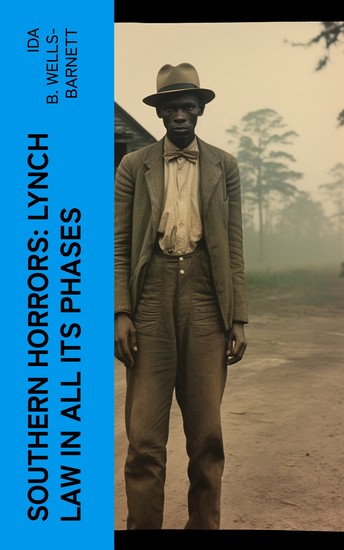
Southern Horrors: Lynch Law in All Its Phases - cover
LER

Southern Horrors: Lynch Law in All Its Phases

Ida B. Wells-Barnett

Editora: e-artnow

  • 0
  • 0
  • 0

Sinopse

Southern Horrors: Lynch Law in All Its Phases is an essay by Ida B. Wells-Barnett. It presented the horrors of lynching and advocated ending the practice entirely after the US Civil War.
Disponível desde: 22/11/2023.
Comprimento de impressão: 190 páginas.

Outros livros que poderiam interessá-lo

  • Alexander Graham Bell: A short biography - 5 Minutes: Short on time - long on info! - cover

    Alexander Graham Bell: A short...

    5 Minutes, 5 Minute Biographies,...

    • 0
    • 0
    • 0
    Alexander Graham Bell, inventor of the telephone: Life and work in a short biography! Everything you need to know, brief and concise. Infotainment, education and entertainment at its best!
    Ver livro
  • African Mythology - Exploring African Mythology and Spiritual Traditions - cover

    African Mythology - Exploring...

    Christiano Farrezi

    • 0
    • 0
    • 0
    African mythology is a vast and complex field that encompasses the myths, legends, and spiritual beliefs of numerous cultures across the continent. Unlike mythologies from other parts of the world that often center around a single pantheon or narrative, African mythology is a tapestry of stories that vary widely among regions, tribes, and languages. These myths serve not only as captivating tales but also as the foundation for many African cultural values, ethics, and social norms. Through mythology, African societies have historically explained the mysteries of the universe, human existence, and the relationship between the physical and spiritual realms. The myths often act as a bridge that connects the people to their ancestors, guiding them through life’s challenges, reinforcing traditions, and celebrating the wonders of nature and the supernatural. 
    Myths hold a central place in African culture, weaving through every aspect of life, from religious practices and ceremonies to moral lessons and social structures. They serve as more than just entertainment; they are the backbone of cultural identity, teaching values, history, and spiritual wisdom. In many African communities, myths are used to instill societal values such as respect, bravery, honesty, and the importance of community over individualism. These stories also shape the rituals and ceremonies that mark significant life events, including birth, initiation into adulthood, marriage, and death. Myths give people a sense of belonging and identity, linking them to their ancestors, land, and the unseen forces that govern their world. Through these narratives, individuals are reminded of their place in a larger cosmic order, where human actions and natural elements are interconnected.
    Ver livro
  • Matisse at War - cover

    Matisse at War

    Christopher C. Gorham

    • 0
    • 0
    • 0
    In 1940, with the Nazis sweeping through France, Henri Matisse found himself at a personal and artistic crossroads. His marriage had ended, he was gravely ill, and after decades at the forefront of modern art, he was beset by doubt. As scores of famous figures escaped the country, Matisse took refuge in Nice, with his companion, Lydia. By defiantly remaining, Matisse was a source of inspiration for his nation. 


    While enemy agents and Resistance fighters played cat-and-mouse in the alleyways of Nice, Matisse's son, Jean, engaged in sabotage efforts with the Allies. In Paris, under the swastika, Matisse's estranged wife worked for the Communist underground. His daughter, Marguerite, active in the French Resistance, was arrested and tortured by the Gestapo, sentenced to Ravensbruck concentration camp—and miraculously escaped when her train was halted by Allied bombs. His younger son, Pierre helped Jewish artists escape to New York; even his grandson risked his life by defying the Germans and their Vichy collaborators. Amidst this chaos, Matisse responded to the dark days of war by inventing a dazzling new paper technique that led to some of his most iconic pieces, including The Fall of Icarus, his profile of Charles De Gaulle, Monsieur Loyal, and his groundbreaking cut-out book, Jazz. His wartime works were acts of resistance, subtly patriotic, and daringly new.
    Ver livro
  • Strange but True Stories Tales and Facts - Time & Dimensional Travel Real Monsters Aliens UFOs OOPAs and Much More - cover

    Strange but True Stories Tales...

    Martin K. Ettington

    • 0
    • 0
    • 0
    I have researched and written over 150 books on strange and mysterious phenomena. Some of these books are based on my own experiences and most topics are based on my research. My fascination with strange things has become a major passion in my life.This book includes over sixty true stories on many different subjects to provide a lot of food for thought on these topics.These stories cover Bigfoot, Aliens & UFOs, Time and Dimensional travel stories, survival stories, ancient civilizations, Out Of Place Artifacts, Dragons, Giant Snakes, the Paranormal, Longevity, Outer Space, Spiritual Experiences, Impossible Ruins, and much more.Graduated from Engineering School and also had many paranormal experiences from learning meditation and other practices. My goal is to write about weird topics from an analytical perspective.When you finish this volume maybe you will see my point of view which is that as much as we think we know about this world and the Universe, there are still many mysteries and strange things out there.
    Ver livro
  • Han Dynasty - Silk Roads Science and the Confucian Revival - cover

    Han Dynasty - Silk Roads Science...

    Rolf Hedger

    • 0
    • 0
    • 0
    The Han Dynasty, lasting from 206 BCE to 220 CE, is one of the most significant periods in Chinese history, shaping the culture, politics, and identity of China for centuries. It followed the brief but influential Qin Dynasty, which had laid the foundations for imperial rule but also faced internal strife and rebellion. The Han emerged as the new power, restoring stability and expanding China's borders, making significant contributions to science, technology, trade, and philosophy. 
    The dynasty's rise was primarily due to the leadership of Liu Bang, a former peasant who became Emperor Gaozu. He defeated his rival, Xiang Yu, and took control of the vast Qin Empire, establishing the Han Dynasty. Gaozu's leadership marked the beginning of a new era, one that would see the consolidation of power and the implementation of reforms that would shape the future of the empire. 
    The Han Dynasty’s political structure was deeply influenced by the collapse of the Qin Dynasty. Emperor Gaozu restored the decentralized feudal system of governance, but with modifications to ensure more central control. Over time, the emperors of the Han Dynasty would strengthen the centralized bureaucracy, establishing a model that would endure for centuries in imperial China. One of the key developments was the introduction of Confucianism as the state philosophy. Confucian ideals, emphasizing hierarchy, duty, and moral governance, became deeply embedded in the political and social structure of the Han Empire. Confucian scholars played an essential role in the administration, and the dynasty itself was viewed as a time when the state was governed by virtuous and learned rulers.
    Ver livro
  • The Status Quo Bias - Preferring Things to Stay the Same over Change - cover

    The Status Quo Bias - Preferring...

    William Rands

    • 0
    • 0
    • 0
    The Status Quo Bias is a psychological phenomenon in which individuals have a preference for the current state of affairs, often resisting change even when the alternatives might be more beneficial. This bias manifests in various aspects of life, from personal decisions to larger social, political, and economic systems. People tend to prefer things staying the same because it feels safer and more familiar, even if change could lead to improved outcomes. It is a powerful force that influences how we make choices, how we interact with others, and even how societies evolve over time. 
    At its core, the Status Quo Bias can be seen as a form of cognitive inertia—our minds prefer to stick with what we know, as a way of minimizing discomfort and uncertainty. This preference for the familiar is deeply rooted in our psychological and evolutionary makeup. Throughout history, stability was often synonymous with survival. In ancient environments, maintaining the status quo, or sticking to known behaviors and environments, increased the chances of safety and survival. However, in the modern world, where innovation and change are often necessary for progress, this bias can become a hindrance to growth and adaptation. 
    The effects of Status Quo Bias can be seen across many facets of life. In personal decision-making, individuals may resist making changes to their routines, relationships, or careers, even when they recognize that change could improve their situation. In the workplace, organizations may be slow to implement new technologies or adopt innovative strategies due to a preference for maintaining established systems and practices. On a societal level, political and social systems are often resistant to change, with entrenched interests and historical norms reinforcing the status quo.
    Ver livro