¡Acompáñanos a viajar por el mundo de los libros!
Añadir este libro a la estantería
Grey
Escribe un nuevo comentario Default profile 50px
Grey
Suscríbete para leer el libro completo o lee las primeras páginas gratis.
All characters reduced
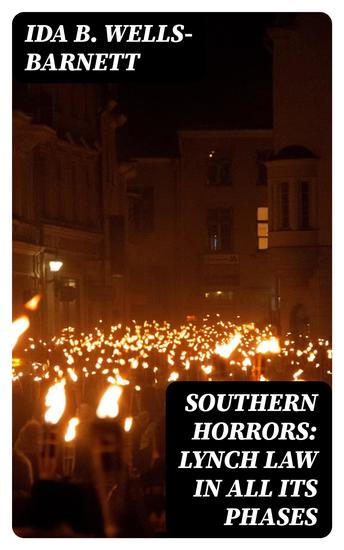
Southern Horrors: Lynch Law in All Its Phases - cover

Southern Horrors: Lynch Law in All Its Phases

Ida B. Wells-Barnett

Editorial: DigiCat

  • 0
  • 0
  • 0

Sinopsis

In "Southern Horrors: Lynch Law in All Its Phases," Ida B. Wells-Barnett confronts the brutal reality of lynching in the American South, offering a poignant indictment of racial violence and injustice. Utilizing a compelling blend of journalistic rigor and personal narrative, Wells-Barnett employs meticulous research and firsthand accounts to expose the systemic racism underpinning lynching. Her work stands as a pivotal contribution to the anti-lynching movement, intertwining history with a powerful call for social justice, all while navigating the complex landscape of post-Reconstruction America. The text is not just a plea for awareness but an invitation to confront uncomfortable truths about racial terror and its enduring impact on society. Ida B. Wells-Barnett was a prominent African American journalist and activist, renowned for her unwavering commitment to civil rights. Born into slavery in 1862, her experiences fueled her dedication to fighting systemic oppression. Her investigative journalism blossomed out of personal tragedy and a profound sense of justice, propelling her to scrutinize the false narratives surrounding lynching and challenge the complacency of both white society and African American leaders. Wells-Barnett became a leading figure in the anti-lynching crusade, risking her safety to shed light on these atrocious acts. This groundbreaking work is essential reading for anyone seeking to understand the intersection of race, history, and justice in America. It is not only a historical document but a clarion call for equality that remains relevant today. "Southern Horrors" is a must-read for those looking to engage with the complexities of America's racial past and its implications for the present and future.
Disponible desde: 28/05/2022.
Longitud de impresión: 25 páginas.

Otros libros que te pueden interesar

  • Summary: Trading in the Zone - Trading in the Zone: Master the Market with Confidence Discipline and a Winning Attitude by Mark Douglas: Key Takeaways Summary & Analysis - cover

    Summary: Trading in the Zone -...

    Brooks Bryant

    • 0
    • 0
    • 0
    Disclaimer: This is not the official book; it is a summary & it does not accompany the official. 
    In 'Trading in the Zone', Douglas delves deep into the subconscious factors that can either boost or hamper your trading performance. It's not just about strategy and analysis—it's about confidence, discipline, and eliminating the emotional baggage that stands between you and consistent trading success. 
    Our summary distills Douglas's profound insights on how to achieve a focused state, comparable to the "zone" athletes experience, where time seems to slow, and you're equipped to make intuitive decisions that align with your strategy. Learn how to deal with losses, develop a robust trading plan, and understand the five fundamental truths of trading. 
    Perfect for both novice and seasoned traders aiming for peak performance, our synopsis of 'Trading in the Zone' arms you with the psychological tools and mindset shifts essential for consistent profitability in the unpredictable realm of trading.
    Ver libro
  • John Fisher and Thomas More - Keeping Their Souls While Losing Their Heads - cover

    John Fisher and Thomas More -...

    Robert J. Conrad Jr.

    • 0
    • 0
    • 0
    In 1929, nearly four hundred years after the deaths of Saints Thomas More and John Fisher, G.K. Chesterton observed in words equally attributable to Fisher, “Blessed Thomas More is more important at this moment than at any moment since his death, even perhaps the great moment of his dying; but he is not quite so important as he will be in a hundred years.” Judge Robert J Conrad, Jr. anticipates Chesterton’s one-hundred-year mark in a collection of stories from the lives of More and Fisher, demonstrating how their sanctity and integrity carried them and those who loved them through tumultuous and heart-wrenching times which, perhaps surprisingly, bear a striking resemblance to the present epoch. At first blush, nothing could appear more different than the pre-industrial sixteenth century and the tech-centered modern era. But a closer examination presents a similar tale of political maneuvering and hostile hearings, legal corruption, viral pandemics, riots, suppression of speech, loss of religious liberty, and a profound indifference for truth. Judge Conrad effortlessly weaves together tales of both men and what made them who they were—family, faith, friendship, oaths, vocation, detachment, conscience—inviting those who strive for holiness down the same narrow path these two martyrs walked with a clarity founded upon the truth of Christ’s Church, and a wit that charmed even their persecutors.  Both these men refused to consent to the theological farce that would permit the king’s divorce and remarriage and drive a wedge into the unity of the Christian world, and both paid for their convictions with their lives. More died the king’s good servant and God’s first. Fisher approached his execution with joy befit for a wedding. And yet, both stand today, long after they are gone, as models of courage in a time when it is desperately needed. 
    Ver libro
  • Miscarriage - Finding Hope and Healing After Loss - cover

    Miscarriage - Finding Hope and...

    Stacey Wilmore

    • 0
    • 0
    • 0
    Miscarriage is a deeply personal and often painful experience that affects millions of women and families worldwide. Despite its prevalence, it remains a topic shrouded in silence, leaving many to navigate their grief alone. This book aims to provide comfort, understanding, and hope to those who have experienced miscarriage, offering guidance through the emotional and physical healing process.  
      
    For many, the loss of a pregnancy brings a complex mix of emotions—grief, guilt, anger, and even isolation. Society often struggles to acknowledge miscarriage as a significant loss, leading many women to feel as though they must grieve in silence. Friends and family may offer well-meaning but unhelpful advice, leaving those affected feeling misunderstood. It is important to recognize that miscarriage is not just a medical event but an emotional and psychological one as well. The pain of losing a child, even in the early stages of pregnancy, is real and valid.  
      
    While no two experiences are exactly alike, one common thread among those who have suffered miscarriage is the search for meaning and healing. Some find solace in talking about their experience, while others prefer quiet reflection. Many turn to faith, support groups, or counseling to help them process their grief. Regardless of the path taken, healing is possible, and hope can be found even in the darkest moments. 
    Ver libro
  • Farewell Address Oval Office - cover

    Farewell Address Oval Office

    Ronald Reagan

    • 0
    • 0
    • 0
    On January 11, 1989, Reagan gave the following farewell address to the nation from the Oval Office. The two things I’m proudest of are the economic recovery which created 19 million new jobs and that America is respected again in the world.  
    In 1980 pundits said our economic policies would cause inflation and collapse while our foreign policies would lead to war. Instead, tax cuts created “the longest peacetime expansion in our history” and “an explosion in research and new technology.” We knocked “down protectionist walls abroad instead of erecting them at home.” 
    We rebuilt our defenses and saw a new peacefulness around the globe. “Countries across the globe are turning to free markets and free speech and turning away from the ideologies of the past.” 
    I went into politics to protect something precious. “Our Constitution is a document in which ‘We the People’ tell the government what it is allowed to do. In the 1960s the government was taking our freedom with rules and regulations and confiscatory taxes.  
    People are “not free unless government is limited. There's a clear cause and effect here that is as neat and predictable as a law of physics: As government expands, liberty contracts.” 
    Are “we doing a good enough job teaching our children what America is and what she represents in the long history of the world?” “America is freedom -- freedom of speech, freedom of religion, freedom of enterprise. And freedom is special and rare.” Let’s start with more attention to American history. 
    I see America as a “shining city upon a hill” teeming with all kinds of people living in harmony, with ports humming with commerce, with doors open to anyone with the will to get here, a beacon and magnet for all who must have freedom. 
    Audio recording courtesy of the Ronald Reagan Presidential Library. 
    AspenLeafMedia.com
    Ver libro
  • Liberty Equality Fashion - The Women who Styled the French Revolution - cover

    Liberty Equality Fashion - The...

    Anne Higonnet

    • 0
    • 0
    • 0
    Joséphine Bonaparte, future Empress of France; Térézia Tallien, the most beautiful woman in Europe; and Juliette Récamier, muse of intellectuals, had nothing left to lose. After surviving incarceration and forced incestuous marriage during the worst violence of the French Revolution of 1789, they dared sartorial revolt. Together, Joséphine and Térézia shed the underwear cages and massive, rigid garments that women had been obliged to wear for centuries. They slipped into light, mobile dresses, cropped their hair short, wrapped themselves in shawls, and championed the handbag. Juliette made the new style stand for individual liberty. 


    The erotic audacity of these fashion revolutionaries conquered Europe, starting with Napoleon. Everywhere a fashion magazine could reach, women imitated the news coming from Paris. It was the fastest and most total change in clothing history. Two centuries ahead of its time, it was rolled back after only a decade by misogynist rumors of obscene extravagance. 


    New evidence allows the real fashion revolution to be told. This is a story for our time: of a revolution that demanded universal human rights, of self-creation, of women empowering each other, and of transcendent glamor. 


    This audiobook includes bonus lectures from the author's "Clothing" course she teaches as professor of art history at Barnard College, Columbia University.
    Ver libro
  • Thanks for Your Service - The Causes and Consequences of Public Confidence in the US Military - cover

    Thanks for Your Service - The...

    Peter D. Feaver

    • 0
    • 0
    • 0
    A definitive study on the decades-long run of high public confidence in the military and why it may rest on some shaky foundations. 


    What explains the high levels of public confidence in the US military and does high confidence matter? In Thanks for Your Service, the eminent civil-military relations scholar Peter D. Feaver addresses this question and focuses on what it means for the military. Proprietary survey data show that confidence is partly based on public beliefs about the military's high competence, adherence to high professional ethics, and a determination to stand apart from the bitter divisions of partisan politics. However, as Feaver argues, confidence is also shaped by a partisan gap and by social desirability bias, the idea that some individuals express confidence in the military because they believe that is the socially approved attitude to hold. Not only does Feaver help us understand how and why the public has confidence in the military, but he also exposes problems that policymakers need to be aware of. Specifically, this book traces how confidence in the institution shapes public attitudes on the use of force and may not always reinforce best practices in democratic civil-military relations.
    Ver libro