Join us on a literary world trip!
Add this book to bookshelf
Grey
Write a new comment Default profile 50px
Grey
Subscribe to read the full book or read the first pages for free!
All characters reduced
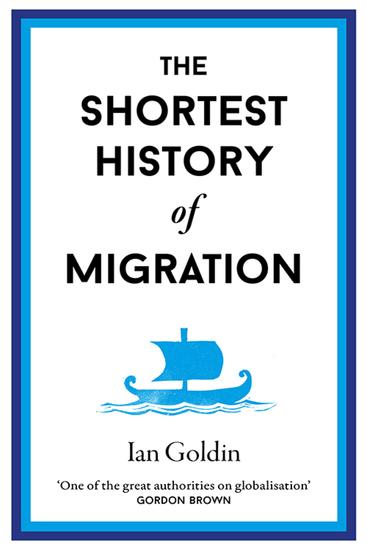
The Shortest History of Migration - cover

The Shortest History of Migration

Ian Goldin

Publisher: Old Street Publishing

  • 0
  • 0
  • 0

Summary

*Released early for the UK election.*

From our earliest wanderings to the rise of the digital nomad, here is the story of human migration.

For hundreds of thousands of years, the ability of Homo sapiens to travel across vast distances and adapt to new environments has been key to our survival as a species. Yet this deep migratory impulse is being tested as never before. By building ever stronger walls and raising barriers to progress, governments are harming the lives of migrants and threatening the future well-being of our societies.

In The Shortest History of Migration, a visionary thinker tells a story of the movement of peoples that spans every age and continent and goes to the heart of what makes us human. Drawn from ancient records and the latest genetic research, it recounts strange, terrible and uplifting tales of migrants past and present, examining the legacies of empire, slavery and war.

Finally, Goldin turns his attention to today's world, bringing together the evidence of history with the most recent data to suggest how we might create a more humane future -- one that allows us to reap the tremendous benefits that migration can offer.
Available since: 06/20/2024.
Print length: 272 pages.

Other books that might interest you

  • Agents of Influence - Britain's Secret Intelligence War Against the IRA - cover

    Agents of Influence - Britain's...

    Aaron Edwards

    • 0
    • 0
    • 0
    Recruited by British Intelligence to infiltrate the IRA and Sinn Féin during the height of the Northern Ireland Troubles, they were ‘agents of influence’. With codenames like INFLICTION, STAKEKNIFE, 3007 and CAROL, these spies played a pivotal role in the fight against Irish republicanism. Now, for the first time, some of these agents have emerged from the shadows to tell their compelling stories. Agents of Influence takes you behind the scenes of the secret intelligence war which helped bring the IRA’s armed struggle to an end. 
     
    Historian Aaron Edwards, the critically acclaimed author of UVF: Behind the Mask, explains how the IRA was penetrated by British agents, with explosive new revelations about the hidden agendas of prominent republicans like Martin McGuinness and Freddie Scappaticci and lesser-known ones like Joe Haughey and John Joe Magee. Bringing to light recently declassified TOP SECRET documents and the firsthand testimonies of agents and their handlers, Edwards reveals how British Intelligence gained extraordinary access to the IRA’s inner circle and manipulated them into engaging with the peace process. 
     
    With new insights into the spy masters behind the scenes, their strategies and tactics, and Britain’s international intelligence network in Northern Ireland, Europe, and beyond, Agents of Influence offers a rare and shocking glimpse into the clandestine world of secret agents, British intelligence strategy and the betrayal at the heart of militant Irish republicanism during the vicious decades of the Troubles.
    Show book
  • The New Goliaths - How Corporations Use Software to Dominate Industries Kill Innovation - cover

    The New Goliaths - How...

    James Bessen

    • 0
    • 0
    • 0
    An approach to reinvigorating economic competition that doesn’t break up corporate giants, but compels them to share their technology, data, and knowledge 
      
    “Bessen is a master of unpacking the nuances of a complex array of interrelated trends to build a coherent story of how the promise of the democratized Internet ended up under the control of just a few. Read The New Goliaths to see how the forest came to have only room for a few tall trees with the rest of us in the undergrowth.”—Joshua Gans, coauthor of Prediction Machines: The Simple Economics of Artificial Intelligence 
      
    Historically, competition has powered progress under capitalism. Companies with productive new products rise to the top, but sooner or later, competitors come along with better innovations and disrupt the threat of monopoly. Dominant firms like Walmart, Amazon, and Google argue that this process of “creative destruction” prevents them from becoming too powerful or entrenched. 
      
    But the threat of competition has sharply decreased over the past twenty years, and today’s corporate giants have come to power by using proprietary information technologies to create a tilted playing field. This development has increased economic inequality and social division, slowed innovation, and allowed dominant firms to evade government regulation. In the face of increasing calls to break up the largest companies, James Bessen argues that a better way to restore competitive balance and dynamism is to encourage or compel these companies to share technology, data, and knowledge.
    Show book
  • Hospitality - Creating a Space for Others to Feel at Home - cover

    Hospitality - Creating a Space...

    Esther Jameson

    • 0
    • 0
    • 0
    The concept of hospitality goes beyond simply entertaining guests. It is the art of making people feel valued, comfortable, and at ease in a given space. True hospitality is not about perfection or impressing others but about creating an environment where people feel welcomed and cared for. It is an intentional practice that involves thoughtfulness, warmth, and a genuine desire to serve. 
    Why hospitality matters can be seen in everyday interactions. Whether welcoming a friend into your home, greeting a stranger with kindness, or ensuring a guest feels at ease, hospitality has the power to transform relationships. It fosters connection, builds trust, and creates lasting memories. In a world where many feel disconnected, a hospitable spirit can make all the difference. It allows people to feel seen and valued, offering them a sense of belonging in an unfamiliar or even familiar space. 
    There is a difference between hosting and hospitality. Hosting often focuses on preparation, aesthetics, and the logistics of entertaining, such as planning meals or setting up a guest room. While these elements are valuable, true hospitality goes deeper. It is about the atmosphere and emotions a person experiences in a space. A well-decorated home means little if guests feel uncomfortable, unwelcome, or like an inconvenience. On the other hand, a modest setting can feel like a sanctuary when hospitality is extended with sincerity and care.
    Show book
  • Senility And the Brain Cells - Ojai 1980 - Dialogue 8 - cover

    Senility And the Brain Cells -...

    Jiddu Krishnamurti

    • 0
    • 0
    • 0
    Senility and the brain cells - 1 June 1980  
    • Is the human brain deteriorating? 
    • The human brain is not a particular brain, it doesn’t belong to me or to anyone 
    else, it is the human brain which has evolved for millions of years. 
    • Can the brain not only be aware of its own movement but can the brain itself 
    have enough energy to break all patterns and move out of it? 
    • Is psychological knowledge not in itself a factor of the shrinking of the brain? 
    • The ending of suffering comes about when the self, which is built up through 
    time, is no longer there. 
    • If there is an insight into the nature of time the very brain cells which are part 
    of time break down. The brain cells mutate, bring about a change in 
    themselves. 
    • Meditation is insight.
    Show book
  • Means and Ends - The Revolutionary Practice of Anarchism in Europe and the United States - cover

    Means and Ends - The...

    Zoe Baker

    • 0
    • 0
    • 0
    An expansive and accessible account of anarchism as a theory of practice. 


    Means and Ends is a new overview of the revolutionary strategy of anarchism in Europe and the United States between 1868 and 1939. Zoe Baker clearly and accessibly explains the ideas that historical anarchists developed in order to change the world. This includes their views on direct action, revolution, organization, state socialism, reforms, and trade unions. Throughout, she demonstrates that the reasons anarchists gave for supporting or opposing particular strategies were grounded in a theoretical framework—a theory of practice—which maintained that, as people engage in activity, they simultaneously change the world and themselves. This theoretical framework was the foundation for the anarchist commitment to the unity of means and ends: the means that revolutionaries propose to achieve social change have to involve forms of activity which transform people into individuals who are capable of, and driven to, both overthrow capitalism and the state and build a free society. The consistent heart of anarchism was the idea that anarchist ends can only be achieved through anarchist means. Cutting through misconceptions and historical inaccuracies, Baker draws upon a vast assortment of examples to show how this simple premise underpinned anarchist attempts to put theory into action.
    Show book
  • Cradles of African Civilization - Pioneers of Governance Art and Social Structure in Africa (5 in 1) - cover

    Cradles of African Civilization...

    Rolf Hedger

    • 0
    • 0
    • 0
    This book consists of the following titles: 
    - Ghana Empire  
    - Kingdom of Kush  
    - Luba Empire  
    - Nok Civilization  
    - Oyo Empire  
    Get your hands on this bundle now!
    Show book