¡Acompáñanos a viajar por el mundo de los libros!
Añadir este libro a la estantería
Grey
Escribe un nuevo comentario Default profile 50px
Grey
Suscríbete para leer el libro completo o lee las primeras páginas gratis.
All characters reduced
The Home Life of the Ancient Greeks - cover

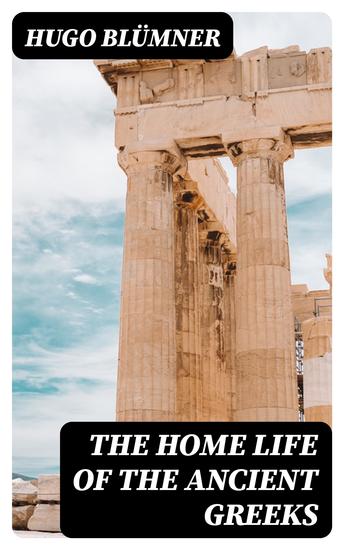
The Home Life of the Ancient Greeks

Hugo Blümner

Traductor Alice Zimmern

Editorial: DigiCat

  • 0
  • 0
  • 0

Sinopsis

In "The Home Life of the Ancient Greeks," Hugo Blümner meticulously explores the domestic sphere of ancient Greek society, providing readers with an insightful look into the everyday lives of its inhabitants. Blümner's literary style is both accessible and informative, employing descriptive precision and scholarly rigor that engages both general readers and those with a deeper interest in classical studies. He delves into aspects such as architecture, family dynamics, and social customs, placing them within the broader historical context of Greek civilization and illuminating the values that shaped their existence. Hugo Blümner, a distinguished philologist and archaeologist, dedicated his career to understanding the nuances of ancient cultures. His extensive travels and research in Greece and Romani territories provided him with a unique perspective on the practical realities of ancient life, undoubtedly influencing his desire to document and share this knowledge. Blümner's background in philology allowed him to draw from a wealth of primary sources, enriching his exploration of the Athenian home and its significance in the larger tapestry of Greek society. This book is an essential read for anyone interested in classical antiquity, as it offers a nuanced portrayal of an often-overlooked aspect of Greek heritage. Those seeking to understand the social fabric and daily practices of ancient Greeks will find Blümner's work invaluable, enhancing their appreciation of this foundational civilization.
Disponible desde: 13/06/2022.
Longitud de impresión: 446 páginas.

Otros libros que te pueden interesar

  • Vote With Your Phone - Why Mobile Voting Is Our Final Shot at Saving Democracy - cover

    Vote With Your Phone - Why...

    Bradley Tusk

    • 0
    • 0
    • 0
    Gun Control. Abortion. From the halls of Congress, it may seem that Americans are bitterly polarized on the biggest policy issues of the day. But Americans are not as divided as we think, and polls show that most of us largely agree on even the most divisive issues. The problem lies in how we vote. 


    Politics is more extreme because only the most extreme voters turn out in primaries. And with politicians prioritizing reelection above all else, they shun compromise, feed this extremism, and get rewarded for it. If a lot more people vote, the views of the electorate become more mainstream, and our politicians and policies will shift to the center. 


    Mobile voting is the solution. We do just about everything on our phones, and yet we still can't use them to vote. But the technology exists, provides enhanced security over traditional paper ballots, and it could exponentially increase voter turnout. 


    Including essays by Martin Luther King Jr. III, David Hogg, and other prominent political figures, Vote with Your Phone shows us that a solution to restoring faith in our representative democracy is right in the palm of our hands.
    Ver libro
  • The Great Russian Famine of 1601-1603 - Causes and Consequences - cover

    The Great Russian Famine of...

    Sarah Willards

    • 0
    • 0
    • 0
    The Great Russian Famine of 1601-1603 was one of the most catastrophic events in Russian history, causing widespread death, social instability, and economic distress. This famine occurred during a period of political turmoil, just after the death of Tsar Ivan the Terrible and amid the struggle for the Russian throne. The famine’s impact was felt across Russia, particularly in the central and southern regions, and it highlighted both the fragility of the agrarian economy and the vulnerability of the Russian people to climatic and political disruptions. 
    The context of the famine is crucial to understanding its devastating effects. In the late 16th century, Russia was already experiencing significant strain, including the collapse of the feudal system, a declining central government, and the outbreak of the Time of Troubles, a series of civil wars and foreign invasions. The Russian agricultural system, heavily dependent on the success of yearly harvests, was not equipped to deal with the combination of extreme weather, crop failure, and a lack of effective governance. 
    The famine itself was primarily caused by a series of poor harvests, which were exacerbated by severe weather conditions, including droughts and unseasonably cold winters. The summer of 1601 saw a significant drought, which devastated crops, and the following winter brought freezing temperatures that further hindered the ability to cultivate food. As a result, grain production plummeted, and prices soared, making food increasingly inaccessible to the general population.
    Ver libro
  • "SOCIAL INTELLIGENCE": 10-MINUTE SUMMARY BY DANIEL GOLEMAN - Goleman introduces concepts such as emotional contagion empathy mirror neurons and the importance of attachment from infancy - cover

    "SOCIAL INTELLIGENCE": 10-MINUTE...

    Daniel Goleman

    • 0
    • 0
    • 0
    In "Social Intelligence," Daniel Goleman explores how our relationships affect the brain, health, and well-being. He proposes that humans are biologically programmed to connect emotionally and distinguishes between two neural pathways: a fast, intuitive one (the low road) and a rational, conscious one (the high road). Goleman introduces concepts such as emotional contagion, empathy, mirror neurons, and the importance of attachment from infancy. 
     Goleman also differentiates between I/Thou relationships, based on genuine connection, and I/It relationships, which are more impersonal. He warns about the risks of the "dark triad" (narcissism, psychopathy, and Machiavellianism) and the emotional blindness that can affect individuals with trauma or autism spectrum conditions. He emphasizes that social intelligence is not innate but moldable through experience and environment, thanks to social epigenetics. 
     The author analyzes how love, leadership, education, and emotional health are influenced by our social skills. He also critiques the negative impact of technology and the mechanization of the medical system on empathy. Finally, Goleman advocates for a more compassionate society where social intelligence is cultivated through cultural, educational, and community efforts to improve our lives and relationships.
    Ver libro
  • Liberal Theory of Justice A: Book Summary & Analysis - cover

    Liberal Theory of Justice A:...

    Briefly Summaries

    • 0
    • 0
    • 0
    This is a concise summary and analysis of A Liberal Theory of Justice, by Brian Barry.
    It is not the original book and is not affiliated with or endorsed by 
    Brian Barry.
    Ideal those seeking a quick and insightful overview.
     
    A Liberal Theory of Justice explores the foundational principles of justice within a liberal framework, analyzing how fairness and equality can be achieved in diverse societies. Through rigorous argumentation and philosophical inquiry, the book critiques alternative theories while advocating for a system of justice grounded in impartiality and rational deliberation. With its emphasis on reason, fairness, and the social contract, this work offers profound insights into the role of justice in fostering democratic coexistence.
    Ver libro
  • Bagavad Gita in Tamil - Chapter 9 - cover

    Bagavad Gita in Tamil - Chapter 9

    Viyasar

    • 0
    • 0
    • 0
    The Bhagavad Gita is a 700-verse Hindu scripture embedded within the epic Mahabharata, depicting a dialogue between Arjuna and Krishna on the battlefield of Kurukshetra. Arjuna, facing his relatives in battle, experiences despair and a crisis of conscience. Krishna, his charioteer and an avatar of Vishnu, provides philosophical and spiritual guidance, addressing themes of duty (dharma), action (karma), devotion (bhakti), and knowledge (jnana). The Gita explores the nature of the self, the divine, and humanity's place in the world, offering paths to liberation and spiritual fulfillment. 
    Ver libro
  • From Where You Dream - The Process of Writing Fiction - cover

    From Where You Dream - The...

    Robert Olen Butler

    • 0
    • 0
    • 0
    The Pulitzer Prize-winning author "shares his insights into—and passion for—the creation and experience of fiction with total openness" (Publishers Weekly, starred review). 


    Robert Olen Butler, author of Perfume River, A Good Scent from a Strange Mountain, and A Small Hotel, teaches graduate fiction at Florida State University—his version of literary boot camp. In From Where You Dream, Butler reimagines the process of writing as emotional rather than intellectual and tells writers how to achieve the dream space necessary for composing honest, inspired fiction. Proposing that fiction is the exploration of the human condition with yearning as its compass, Butler reinterprets the traditional tools of the craft using the dynamics of desire. Offering a direct view into the mind and craft of a literary master, From Where You Dream is an invaluable tool for the novice and experienced writer alike. 


    "Incisive and provocative, Butler's tutorials are a must for anyone even thinking about writing fiction, and readers, too, will benefit from his passionate exhortations." —Booklist
    Ver libro