Join us on a literary world trip!
Add this book to bookshelf
Grey
Write a new comment Default profile 50px
Grey
Subscribe to read the full book or read the first pages for free!
All characters reduced
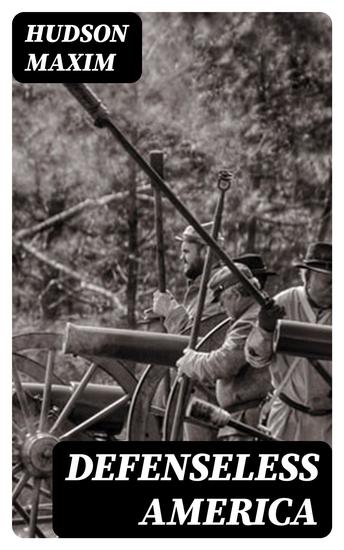
Defenseless America - cover

Defenseless America

Hudson Maxim

Publisher: DigiCat

  • 0
  • 0
  • 0

Summary

In "Defenseless America," Hudson Maxim presents a provocative and prescient examination of the vulnerabilities that America faces in a changing world. Written during the early 20th century and characterized by its incisive rhetoric and logical reasoning, the book delves deep into military preparedness and national security, arguing for the necessity of an advanced defense strategy. Maxim effectively combines a mix of historical analysis and speculative foresight, critiquing complacency in a time of growing international threats while drawing on examples from past conflicts to underscore his assertions. Hudson Maxim, a prominent American inventor and a passionate advocate for military reform, brings a wealth of experience and a unique perspective to this work. His background as an artillery expert and his involvement in munitions development lend authority to his arguments, as he implores his nation to be vigilant in the face of external aggressions. This work is informed by the tumultuous context of World War I, during which America grappled with its position and responsibilities on the world stage. "Defenseless America" is a must-read for those interested in military history, national security, and the evolution of American defense policy. Maxim's compelling arguments challenge readers to consider the implications of national vulnerability and the moral imperative of preparedness, making it a timeless call to action for citizens and policymakers alike.
Available since: 09/16/2022.
Print length: 207 pages.

Other books that might interest you

  • The Writing on the Wall - 100 Iconic Blue Plaques Commemorating Britain's History - cover

    The Writing on the Wall - 100...

    Mike Read

    • 0
    • 0
    • 0
    A blue plaque is a recognised symbol of our national heritage; a living footprint of our history with each one serving as a permanent reminder of an important contribution to the history of the country.
    The blue plaques commemorate notable, influential and successful people from all walks of life. They are erected in the present to celebrate our past and inspire our future.
    This book contains 100 blue plaques, and the stories and people behind them, from across the United Kingdom, each linking, through a common denominator, to the next.
    From David Bowie to William Shakespeare, we run the gamut of plaques remembering kings, actors, singers, explorers, footballers, cricketers, writers, inventors, scientists, politicians, musicians, reformers, broadcasters, songwriters, comedians, pioneers, artists, the military, athletes, dancers, activists, poets and education.
    From Lennon and McCartney to the victims of Jack the Ripper this is an eclectic representation of British life, through our blue plaques, from the 1500s to 2017.
    Show book
  • Equality and Efficiency: Book Summary & Analysis - cover

    Equality and Efficiency: Book...

    Briefly Summaries

    • 0
    • 0
    • 0
    This is a concise summary and analysis of 
    Equality and Efficiency, by Arthur M. Okun.
    It is not the original book and is not affiliated with or endorsed by 
    Arthur M. Okun.
    Ideal those seeking a quick and insightful overview.
     
    "Equality and Efficiency: The Big Tradeoff" explores the delicate balance between economic equality and efficiency, a tension that shapes policy decisions and societal outcomes. Through clear, thought-provoking analysis, the book examines how efforts to achieve fairness often come at the cost of productivity and growth, and vice versa. This accessible exploration dives into key economic concepts, social trade-offs, and the challenges of designing systems that promote both justice and prosperity, making it an essential read for those interested in economics, public policy, and social justice.
    Show book
  • Inside the Gas Chambers - Eight Months in the Sonderkommando of Auschwitz - cover

    Inside the Gas Chambers - Eight...

    Shlomo Venezia

    • 0
    • 0
    • 0
    Slomo Venezia was born into a poor Jewish-Italian community living in Thessaloniki, Greece. At first, the occupying Italians protected his family; but when the Germans invaded, the Venezias were deported to Auschwitz. His mother and sisters disappeared on arrival, and he learned, at first with disbelief, that they had almost certainly been gassed. Given the chance to earn a little extra bread, he agreed to become a 'Sonderkommando', without realizing what this entailed. He soon found himself a member of the 'special unit' responsible for removing the corpses from the gas chambers and burning their bodies. 


    Dispassionately, he details the grim round of daily tasks, evokes the terror inspired by the man in charge of the crematoria, 'Angel of Death' Otto Moll, and recounts the attempts made by some of the prisoners to escape, including the revolt of October 1944. 


    It is usual to imagine that none of those who went into the gas chambers at Auschwitz ever emerged to tell their tale—but, as a member of a 'Sonderkommando', Shlomo Venezia was given this horrific privilege. He knew that, having witnessed the unspeakable, he in turn would probably be eliminated by the SS in case he ever told his tale. He survived: this is his story.
    Show book
  • It Did Happen Here - A History of Art Culture and Politics as Amerika Drifted from Depression into Dictatorship 1929-1939 - cover

    It Did Happen Here - A History...

    Jeronimo Herodotease

    • 0
    • 0
    • 0
    In this satirical alternative history, Professor Jeronimo Herodotease and his team of documentary filmmakers and reenactors revivify the dark days of the Grim Depression and Amerika's descent into dictatorship. In the chaos and strife that followed the assassination of President-elect Frankie van Rosenvelt, General Jackson and a cadre of Forcist-minded cockroaches swarmed the stage, gnawed away at democratic norms, and declared martial law under the guise of restoring "Law and Order." Minorities and illegal aliens were scapegoated for the nation's woes, and dissenters daring to oppose the regime found themselves attacked by the Faux Outlet for News and Entertainment, whisked away to detention camps, or forced into exile. In retelling the stories of radicals and reactionaries, statesmen and demagogues, cultural producers and political censors, Herodotease reveals a polarized Amerika not unlike that of our own contentious age. Woven into the fabric of the narrative are a plethora of vintage photographs, historical artifacts, and propaganda art, all courtesy of The Wolfsonian–Florida International University. While included with the aim of bringing the persons and events of the 1930s back to life, many of these illustrations have been purposefully manipulated or supplied with deliberately deceptive descriptions to challenge those persons who believe everything they see, to think again. In this era of Facebook fakes, misinformation, and disinformation, unless we remain ever vigilant, it can happen here!
    Show book
  • Bohemian Club The: The History of One of America’s Most Secretive and Controversial Private Clubs - cover

    Bohemian Club The: The History...

    Editors Charles River

    • 0
    • 0
    • 0
    Conspiracy theories, and particularly the belief that elements of the world are secretly controlled by individuals or groups, have been around for as long as people have lived in groups. Perhaps that’s inevitable - after all, those who are excluded from power are very likely to be inclined to see their position not as an outcome of their own choices or situation but because of the secret machinations of shadowy groups.  
    One topic that has been a constant in Internet debates is the group known as the Bohemian Club. Founded in 1872 in San Francisco, this began as a club for journalists with an interest in the arts, but over the subsequent 150 years, it appears to have changed into a vehicle for the annual conclave of some of the most wealthy and powerful men on the planet. Each year, hundreds of men gather in a luxurious camp known as Bohemian Grove in a remote forest in California to do something.  
    	Just what it is they do is a secret, which has inevitably led to some intense speculation. Is it no more than a fun-filled frolic where the super-rich and powerful can go to escape their cares for a few days, or is it something more sinister, a cabal in which secret decisions are made that affect everybody else? Finding out about the Bohemian Club and the annual gatherings at Bohemian Grove isn’t easy. Most of those invited to join this exclusive club remain members until they die, meaning there are no disaffected former members willing to talk about what goes on there. Current members are unwilling to talk about the club or its activities.  
    	It’s this secrecy that has led to some bizarre speculation about just what it is that happens in Bohemian Grove every summer. Coming up with answers is no easy feat, as the group takes its secrecy seriously and members have the wealth and power to make sure the club’s business stays secret.
    Show book
  • The American Open Road - Narrative and Popular Imagination - cover

    The American Open Road -...

    Jeffrey Alan Melton

    • 0
    • 0
    • 0
    WINNER OF THE ELIZABETH AGEE PRIZE IN AMERICAN LITERATURE  
     
    The American Open Road offers a rich exploration of how the mythos of the open road has shaped, and been shaped by, American culture. Beginning with the post–World War II boom that solidified car culture as central to American life, Melton reflects on how roads, automobiles, and landscapes have been represented in literature, film, and other cultural texts, highlighting the interplay between mobility and narrative. 
     
    Melton examines how the open road functions as a symbol of autonomy, reinvention, and resistance. He highlights how road narratives have also exposed deeper tensions in American life―especially around race, gender, and power―and how historically marginalized voices have used the road to reclaim space and tell new stories. 
     
    From the romanticism of Route 66 to the political edge of modern road films, The American Open Road offers an engaging analysis of the narratives that continue to define American identity and longing. For listeners interested in cultural history, travel literature, or the enduring pull of the highway, this book offers a compelling view from the passenger seat of America's most iconic journeys.
    Show book