Junte-se a nós em uma viagem ao mundo dos livros!
Adicionar este livro à prateleira
Grey
Deixe um novo comentário Default profile 50px
Grey
Assine para ler o livro completo ou leia as primeiras páginas de graça!
All characters reduced
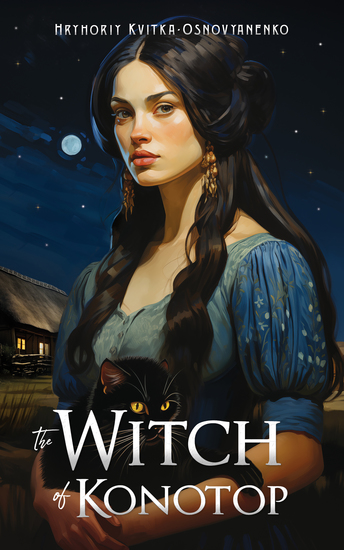
The Witch of Konotop - cover
LER

The Witch of Konotop

Hryhoriy Kvitka-Osnovyanenko

Tradutor Michael M. Naydan, Alla Perminova

Editora: Glagoslav Publications B.V. (N)

  • 0
  • 0
  • 0

Sinopse

The Witch of Konotop (written in 1833 and published in 1836–37) is a beloved, classic Ukrainian comic novella that is little known outside of Ukraine. Part of the reason for this has been the difficulty in translating its complex stylistic levels that range from archaic Old Church Slavonic to colorful, colloquial Ukrainian. It shares several stylistic similarities to Mykola Hohol’s (aka Nikolai Gogol’s) Ukrainian horror tales in Evenings on a Farm Near Dikanka (1833). These include a folksy, rambling narrator; comical situations with moral lessons; insignificant detail; ironic asides; as well as a thematic focus on Ukrainian folk belief in witches and demons.
 
This book has been published with the support of the Translate Ukraine Translation Program.
Disponível desde: 10/09/2024.
Comprimento de impressão: 172 páginas.

Outros livros que poderiam interessá-lo

  • War and Peace (Book Fourteen: 1812) - cover

    War and Peace (Book Fourteen: 1812)

    Leo Tolstoy

    • 0
    • 0
    • 0
    War and Peace is a literary work mixed with chapters on history and philosophy by the Russian author Leo Tolstoy. It was first published serially, then published in its entirety in 1869. It is regarded as one of Tolstoy's finest literary achievements and remains an internationally praised classic of world literature.
    Book 14: 1812: The Battle of Borodinó, with the occupation of Moscow that followed it and the flight of the French without further conflicts, is one of the most instructive phenomena in history. All historians agree that the external activity of states and nations in their conflicts with one another is expressed in wars, and that as a direct result of greater or less success in war the political strength of states and nations increases or decreases.
    Ver livro
  • Hamlet - Full Cast Drama - cover

    Hamlet - Full Cast Drama

    William Shakespeare

    • 0
    • 0
    • 0
    The play begins with the guards of Elsinore Castle encountering the ghost of the recently deceased King Hamlet, the father of Prince Hamlet. The ghost appears to be a harbinger of doom, hinting at foul play surrounding the former king's death. Prince Hamlet is informed of this mysterious apparition and decides to meet the ghost, who reveals that he was murdered by Hamlet's uncle, Claudius, who has now assumed the throne and married Queen Gertrude. Hamlet is deeply disturbed by this revelation and the apparent betrayal by his mother. He grapples with his grief, anger, and a profound sense of disillusionment. To confirm the ghost's claims, Hamlet stages a play within a play called "The Mousetrap," which mirrors the circumstances of his father's murder. Claudius's reaction to this play confirms Hamlet's suspicions. As Hamlet navigates the complexities of the court, he feigns madness as a way to investigate further and protect himself. His erratic behavior confuses those around him, and he alienates his lover, Ophelia, and her brother, Laertes, in the process. Meanwhile, Hamlet's obsession with revenge intensifies, and he contemplates the moral and philosophical implications of taking another person's life. His famous soliloquies, such as "To be or not to be," reflect his inner turmoil and contemplation of existence and mortality. "Hamlet" is not only a story of revenge and political intrigue but also a profound exploration of the human psyche, existentialism, and the moral and emotional complexities of life. The character of Hamlet is an enduring symbol of the human condition, and his journey through the play continues to captivate and resonate with audiences to this day. 
     
    Ver livro
  • It's a Battlefield - cover

    It's a Battlefield

    Graham Greene

    • 0
    • 0
    • 0
    An "adventurous . . . intelligent . . . ingenious" novel of crime and punishment in pre–World War II London (V. S. Pritchett). 


    During a demonstration in Hyde Park, Communist bus driver Jim Drover acts on instinct to protect his wife by stabbing to death the policeman set to strike her down. Sentenced to hang—whether as a martyr, tool, or murderer—Drover accepts his lot, unaware that the ramifications for the crime, and the battle for his reprieve, are inflaming political unrest in an increasingly divided city. But Drover's single, impulsive act is also upending the lives of the people he loves and trusts. Caught in a quicksand of desperation, sexual betrayal, and guilt, they will not only play a part in Drover's fate, but they'll become agents—both unwitting and calculated—of their own fates as well. 


    Turning the traditional narrative of the police procedural, domestic drama, and political thriller on its head, It's a Battlefield was described by Graham Greene himself as "a panoramic novel of London," one without heroes and villains, only "the injustice of man's justice."
    Ver livro
  • The Tap Dancer - cover

    The Tap Dancer

    Andrew Barrow

    • 0
    • 0
    • 0
    ‘My favourite novel and one I wish I’d written.’ ALAN BENNETT 
    Winner of the McKitterick Prize for best first novel by an author aged over 40, and the Hawthornden Prize for imaginative literature. 
    Everyone craves retirement from the Civil Service, don’t they? That time for an ageing patriarch to enjoy the fruits of a well-earned pension and the respect of his family; maybe even to indulge in a love of music halls and metropolitan life. If only people would listen and do as they were told… 
    His fourth son William, the long-suffering narrator, is the constant butt of his father’s jokes and victim of his brothers’ indifference. But as death, divorce and other darker dramas follow, father and son slowly establish a strange harmony. 
    The Tap Dancer, the latest from award-winning author Andrew Barrow, is a humorous fiction that has been short-listed for its literary excellence. This new classic is a top choice for readers around the globe. 
    For fans of Alan Bennett (The Laying On Of Hands), Anne Tyler (Vinegar Girl), Nina Stibbe (One Day I Shall Astonish the World), Rose Tremain (Absolutely and Forever), and India Knight (Darling). 
    HarperCollins 2023
    Ver livro
  • Straw the Coal and the Bean The - Story Time Episode 50 (Unabridged) - cover

    Straw the Coal and the Bean The...

    Brothers Grimm

    • 0
    • 0
    • 0
    An old woman has some beans that she intends to cook over her fire. Being in a hurry, she grabs some straw to make the fire light faster. She pours the beans in the pot and, being in a hurry, she drops one on the floor which lands next to a piece of straw.
    Ver livro
  • Fading Voices - From their pens to your ears genius in every story - cover

    Fading Voices - From their pens...

    Boleslaw Prus

    • 0
    • 0
    • 0
    Aleksander Głowacki who wrote under the nom de plume Boleslaw Prus was born on 20th August 1847 at Hrubieszów in the Kingdom of Poland, at that time, controlled by the Russian Empire. 
    At three his mother died and then at nine his father.  Female relatives helped raise him but at 15 he joined the Polish uprising against the might of Imperial Russia.  Wounded on the battlefield, arrested and imprisoned, he was later released into the care of a relative and resumed secondary school and then Warsaw University but poverty forced him to leave after two years.  At some point he developed agoraphobia which often caused problems. 
    In 1869, he enrolled in the Forestry Department at Puławy but was soon sacked and so he began a system of self-education that led to work as a newspaper columnist on a wide-ranging series of topics that eventually became the ‘Weekly Chronicles’ and spanned 40 years. 
    With his finances now stabilized he married and then adopted his late brother-in-law’s son.  
    It seems he had doubts as to the scale of his talents and early on adopted the name ‘Boleslaw Prus’ for both his journalistic and literary offerings. 
    His work as a short-story writer met with much acclaim. He wrote several dozen of them, originally published in newspapers and ranging in length from micro-story to novella. His keen observation of everyday life and sense of humor are evident in them.  
    During his career he also wrote novels. After ‘Pharoah’, in 1895, he embarked on a four-month journey taking in Berlin, Dresden, Nuremberg, Rapperswil in Switzerland, where he stayed for two months, and his final destination, Paris.  Here his agoraphobia was so bad he couldn’t cross the Seine.  
    However, his writing continued and in 1911 his novel ‘Changes’, though uncompleted, began to be serialised.  It was never finished. 
    Boleslaw Prus died on 19th May 1912, at his Warsaw apartment.  He was 64.  A National Hero, thousands attended both his funeral service and interment.
    Ver livro