¡Acompáñanos a viajar por el mundo de los libros!
Añadir este libro a la estantería
Grey
Escribe un nuevo comentario Default profile 50px
Grey
Suscríbete para leer el libro completo o lee las primeras páginas gratis.
All characters reduced
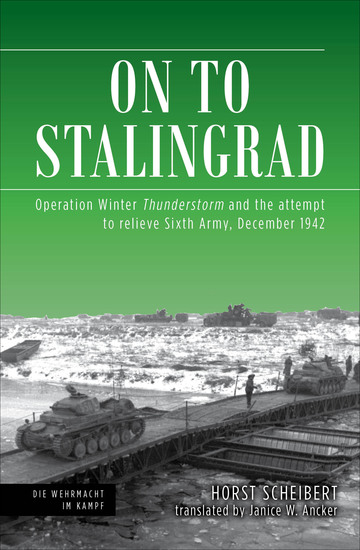
On to Stalingrad - Operation Winter Thunderstorm and the Attempt to Relieve Sixth Army December 1942 - cover

On to Stalingrad - Operation Winter Thunderstorm and the Attempt to Relieve Sixth Army December 1942

Horst Scheibert

Traductor Janice W. Ancker

Editorial: Casemate

  • 0
  • 0
  • 0

Sinopsis

The first English translation of a German account of the attempt to relieve the Nazis’ Sixth Army at Stalingrad during World War II. In late November 1942, Soviet forces surrounded General Friedrich Paulus’ Sixth Army in a pocket at the Russian city of Stalingrad. In response the Germans planned a relief operation, Operation Winter Thunderstorm, intended to break through the Soviet forces and open the pocket, releasing the encircled units. The 6th Panzer Division was the spearhead of the German relief force. The attack started on 12 December 1942 and was aborted on 23 December after heavy Soviet counterattacks. This failure sealed the fate of the German Sixth Army in Stalingrad. This account of the operation was first published in German in 1956, written by the well-respected military historian and retired German officer, Horst Scheibert, who was a tank commander in 6th Panzer Division during the attempt. Utilizing many excerpts from war diaries, and telegrams sent during operations, it is a unique account of the entire operation from the situation in mid-November through the two German offensives, the Soviet counteroffensive, and ongoing fighting until early January. This book includes 16 maps from the original edition and is the first English translation of this important German account.Praise for On to Stalingrad “Rich and detailed like very few of its kind are, with a crisp writing style and critical eye for the events of the battlefield that almost makes you feel as if you were there with Sixth Panzer. On to Stalingrad is a book so compelling that it simply should not be overlooked for your personal and professional enjoyment.” —ARMOR Magazine “Offers a unique viewpoint from an actual veteran who is able to provide an immediate military analysis of this mostly forgotten operation of the Stalingrad campaign.” —New York Journal of Books
Disponible desde: 10/01/2022.
Longitud de impresión: 144 páginas.


Otros libros que te pueden interesar

  • Art of Fantacy - cover

    Art of Fantacy

    Mervat Abu Ouf

    • 0
    • 0
    • 0
    Dr. Mervat Abou Oaf chronicles the journey of Egypt's film industry from the days of its commencement to the contemporary era of digitization and streaming platforms, all while painting a better, brighter, and bigger picture of what the future could entail.
    
    The book maneuvers around significant dates and milestones, highlighting Egyptian cinema's cultural, political, and economic importance.
    
    Through the lens of expert interviews, Dr. Abou Oaf examines regulatory frameworks operating backstage and maps out what's required to sustain and develop a thriving industry, proposing a regulatory model that embraces economic prosperity, cultural values, and industry independence.
    Ver libro
  • Modernising Irish Government - The Politics of Administrative Reform - cover

    Modernising Irish Government -...

    Neil Collins, Terry Cradden

    • 0
    • 0
    • 0
    Modernising Irish Government presents the major historical turning points in the development of Irish public services with a particular focus on the civil service, covering the mid-nineteenth-century reforms, the foundations of the State and the Lemass-Whittaker economic initiative. It introduces the Strategic Management Initiative, its origins and its impact, discussed in terms of efficiency, responsibility and democracy.
    Authors Neil Collins, Terry Cradden and Patrick Butler examine the current, key issues within the Civil Service, including the contentious issue of decentralisation. Providing reviews of the institutional framework for regulating monopolies in such sectors as telecommunications, aviation and retail competition, they present a critique of the new kinds of relationships between government and the people by reviewing Social Partnership, the Citizen Charters of government departments and other similar instruments.
    This textbook at once examines the scale, scope and structure of the delivery of services to the public and their relationship to the civil service, government departments, commercial semi-state companies and other public bodies, while identifying a number of significant failures in service delivery in detail and offering an analysis for their reasons.
    Ver libro
  • The Yoga Sutras of Patanjali - The Book of the Spiritual Man - cover

    The Yoga Sutras of Patanjali -...

    Maharishi Patanjali

    • 0
    • 0
    • 0
    "The Yoga Sutras of Patanjali: The Book of the Spiritual Man" by Maharishi Patanjali is a timeless spiritual manual that distills the essence of yoga philosophy into concise aphorisms. This profound work elucidates the path to spiritual enlightenment, focusing on ethical disciplines, physical postures, breath control, and meditation. Patanjali's sutras offer invaluable insights and practices for achieving inner peace, self-realization, and ultimate union with the divine, guiding seekers on their spiritual journey.
    Ver libro
  • Psychological Trauma - Inflicting Severe Mental Distress or Damage - cover

    Psychological Trauma -...

    Cito Harder

    • 0
    • 0
    • 0
    Psychological trauma refers to the emotional, mental, and psychological injury that results from an overwhelming or distressing event. Unlike physical trauma, which can often be seen and treated directly, psychological trauma is more subtle, affecting the mind and emotions in profound ways. It can arise from various experiences, such as accidents, violence, abuse, loss, or even long-term stressors. The effects of trauma are far-reaching and can impact an individual’s life for many years, manifesting in different forms depending on the person’s resilience, support system, and coping mechanisms. 
    At its core, trauma can alter an individual's perception of the world, themselves, and their relationships. It often creates a sense of helplessness, loss of control, and an inability to feel safe or secure. The distress from trauma can be so severe that it leads to lasting mental health issues such as anxiety, depression, post-traumatic stress disorder (PTSD), and other emotional disorders. Understanding the nature of psychological trauma involves recognizing how these experiences affect the brain and the body. Trauma is not merely an emotional reaction; it is a complex response involving neurological, biological, and psychological processes. The brain’s response to trauma can involve changes in brain structures and functions, particularly in areas like the amygdala (responsible for processing emotions) and the hippocampus (which processes memories). These changes can result in heightened fear responses, emotional instability, and difficulty processing memories related to the traumatic event. 
    Furthermore, trauma is often misunderstood or underestimated due to the invisible nature of its impact. While a broken bone is easily visible and can be treated, the effects of trauma are not always immediately apparent.
    Ver libro
  • Captive Queen - The Decrypted History of Mary Queen of Scots - cover

    Captive Queen - The Decrypted...

    Jade Scott

    • 0
    • 0
    • 0
    An expert historian on Mary, Queen of Scots draws on hundreds of her encrypted letters to paint a vivid portrait of one of history's most compelling figures. 


    For almost two decades before her execution at Fotheringhay Castle in 1587, Mary, Queen of Scots was a prisoner. From her chambers, she wrote countless letters, many encrypted using complex ciphers to prevent her communications from being intercepted. In this way, she used language to exert her will and her influence, even while incarcerated. 


    More than four hundred years after Mary's death, the discovery of further encoded letters has led to renewed interest in the breadth of her correspondence while in captivity. 


    In Captive Queen: The Decrypted History of Mary, Queen of Scots, Jade Scott draws on hundreds of these ground-breaking letters to create a vivid picture of one of history's most fascinating personalities. She interprets Mary's complex relationships with friends and enemies alike throughout the years of her imprisonment, illuminating Mary's strategic vision while bringing her captivity to life like never before.
    Ver libro
  • Handsome Lake: The Life and Legacy of the Iroquois Prophet - cover

    Handsome Lake: The Life and...

    Editors Charles River

    • 0
    • 0
    • 0
    The name "Iroquois", like many Native American tribal names, is not a name the people knew themselves by, but a word applied to them by their enemies the Huron, who called them “Iroquo” (rattlesnake) as an insult. The French later added the suffix “ois.” Moreover, the Iroquois are not even a single tribe but a confederation of several different tribal nations that include the Seneca, Oneida, Onondaga, Mohawk, Cayuga and the Tuscarora, who didn’t become part of the union until the early 1700’s. The name Haudenosaunee (pronounced “ho-den-oh-SHO-nee”) is the name the people use for themselves, which translates as “the People of the Longhouse.” They are also commonly known as the Six Nations. 
    	Despite their own cultural differences, the nations that comprised the Iroquois Confederacy established their political dominance across much of America’s East Coast and Midwest through conquest, and it is that aspect which has perhaps best endured among Americans in terms of the Iroquois’ legacy. European settlers who came into contact with the Mohawks in the Northeast certainly learned to respect their combat skills, to the point that there were literally bounties on the Mohawks’ heads, with scalps fetching money for colonists who succeeded in slaying them and carrying away the “battle prize”. 
    	Handsome Lake (1735-1815) lived through the confederacy’s most turbulent time. His long life started when the Iroquois were powerful and widely feared and respected by all the tribal peoples in the region, and also by the French and the British. He lived through wars, some victories and some defeats, as well as the disunity and the collapse of traditional ways. Handsome Lake experienced his visions late in his life, at a time when the Six Nations, and his own life, were at their nadir.
    Ver libro