Junte-se a nós em uma viagem ao mundo dos livros!
Adicionar este livro à prateleira
Grey
Deixe um novo comentário Default profile 50px
Grey
Assine para ler o livro completo ou leia as primeiras páginas de graça!
All characters reduced
The Count of Narbonne - A Tragedy in Five Acts - cover
LER

The Count of Narbonne - A Tragedy in Five Acts

Horace Walpole, Robert Jephson

Editora: DigiCat

  • 0
  • 0
  • 0

Sinopse

The collection "The Count of Narbonne" serves as a vital exploration of the evolving Gothic drama genre, capturing the unnerving atmosphere and emotional complexities that define this literary form. Assembled with precision, it weaves a tapestry of haunting tales and morally ambiguous characters, with stories that move fluidly between realms of horror and the supernatural. In this anthology, the tension between fate and free will plays out against backdrops that are both grandiose and claustrophobic, a testament to the skillful narrative techniques employed throughout. Herein, the true essence of Gothic literature is distilled, offering readers a wealth of thrilling narratives. The compilation features works by notable figures, such as Horace Walpole and Robert Jephson, whose influence on late 18th-century British literature is indisputable. Both authors set the stage for a rich dialogue on societal anxieties and psychological fears, tapping into the collective subconscious of their era. These writers adeptly interweave the political and the personal, drawing from the burgeoning Gothic tradition while also contributing uniquely to its development. Their collective efforts chart the intersection of historical and narrative invention, collectively offering deeper insight into the culture that birthed these spine-chilling tales. This anthology is an essential read for those interested in the Gothic tradition and its profound impact on literary history. It appeals to both casual readers and scholars by offering a compendium of styles and voices, each contributing to a larger narrative landscape. Readers will find themselves immersed in a world of dark corridors and foreboding landscapes, gaining not only entertainment but also an enriched understanding of the Gothic genre's origins and enduring legacy. Through this collection, one embraces both the sensation of fear and the pleasure of masterful storytelling.
Disponível desde: 16/09/2022.
Comprimento de impressão: 39 páginas.
Outros livros que poderiam interessá-lo

  • The Japanese Famine of 1782-1788 - The Great Tenmei Famine - An Era of Scarcity - cover

    The Japanese Famine of 1782-1788...

    Sarah Willards

    • 0
    • 0
    • 0
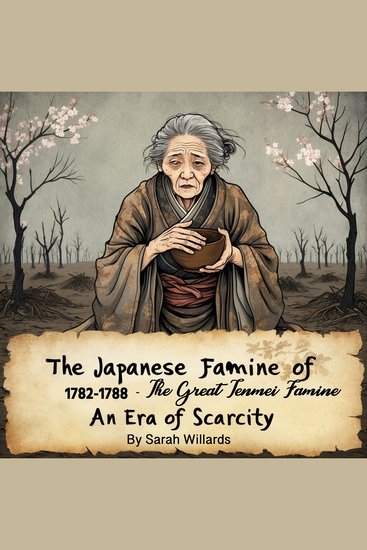
    The Tenmei era, spanning from 1781 to 1789, marked one of the most tumultuous periods in early modern Japanese history. Under the rule of the Tokugawa shogunate, Japan faced a complex web of challenges that created the perfect storm for one of the country’s most devastating famines. The political leadership at the time struggled to manage internal pressures, while nature unleashed a series of disasters that exposed deep structural weaknesses in Japanese society and governance. 
    Politically, the Tokugawa regime was already under strain. After more than 150 years of relative stability, cracks had begun to appear in the shogunate’s centralized control. Corruption was increasingly evident among regional officials, and the rigid class system left little room for social mobility or adaptive governance. Daimyōs, or feudal lords, often prioritized local interests over national concerns, making unified responses to crises difficult. These issues weakened the ability of the central government to respond decisively to the hardships that were beginning to unfold. 
    Economically, Japan in the late 18th century was a fragile system, heavily reliant on rice production. Despite modest attempts at economic reform, the country remained vulnerable to crop failure, inflation, and regional imbalances. Merchant classes were rising in wealth and influence, while peasants bore the brunt of heavy taxation and poor harvests. The disconnect between economic policy and rural reality would prove fatal when disaster struck.
    Ver livro
  • When I Passed the Statue of Liberty I Became Black - cover

    When I Passed the Statue of...

    Harry Edward

    • 0
    • 0
    • 0
    The lost memoir of Britain's first Black Olympic medal winner—and the America he discovered 


    After winning Olympic medals for Britain in 1920, Harry Edward (1898–1973) decided to try his luck in America. The country he found was full of thrilling opportunity and pervasive racism. 


    Immensely capable and energetic, Harry rubbed shoulders with kings and presidents, was influential in the revival of Black theatre during the Harlem Renaissance, and became a passionate humanitarian and advocate for child welfare. He was present at some of the twentieth century's most significant moments, worked alongside W. E. B. Du Bois and Orson Welles, and witnessed two world wars and the civil rights movement. Yet he was frustrated at almost every turn. 


    Toward the end of his life he set down his story, crafting this memoir of athletics and activism, race and racism on both sides of the Atlantic. His manuscript went unpublished until now. This is the deeply engaging tale of Edward's life—and a moving testament to his drive to form a better world.
    Ver livro
  • Existential Stories - Tales of characters questioning their existence and place in the world - cover

    Existential Stories - Tales of...

    Franz Kafka

    • 0
    • 0
    • 0
    Everything we know must end.  In the fundamentals of our lives its usually our own deaths which bring that to an end.  But what if we widen that premise.  What if we are caught in its quixotic jaws. Held fast with escape merely a fleeting thought. 
    In this volume authors of real note bring their narratives of existential crisis and threat directly to our senses.  That conflict can yield terrible results. 
    And for that place the blame on Franz Kafka, Boleslaw Prus, Herman Melville, Oscar Wilde and many others. 
     
    1 - Existential Stories - An Introduction 
    2 - The Dream of a Ridiculous Man by Fyodor Dostoyevsky 
    3 - Bartleby the Scrivener - Part 1 by Herman Melville 
    4 - Bartleby the Scrivener - Part 2 by Herman Melville 
    5 - A Legend of Old Egypt by Boleslaw Prus 
    6 - An Egyptian Cigarette by Kate Chopin 
    7 - A Hunger Artist by Franz Kafka 
    8 - Mold of the Earth by Boleslaw Prus 
    9 - Solid Objects by Virginia Woolf 
    10 - An Honest Thief by Fyodor Dostoyveskey 
    11 - The Bet by Anton Chekhov 
    12 - Shades by Boleslaw Prus 
    13 - An Occurrence At Owl Creek Bridge by Ambrose Bierce 
    14 - In the Penal Colony by Franz Kafka 
    15 - The Happy Prince by Oscar Wilde 
    16 - Youth - Part 1 by Joseph Conrad 
    17 - Youth - Part 2 by Joseph Conrad
    Ver livro
  • The Case of Vincent Pyrwhtt - From their pens to your ears genius in every story - cover

    The Case of Vincent Pyrwhtt -...

    Barry Pain

    • 0
    • 0
    • 0
    Barry Eric Odell Pain was born at 3 Sydney Street in Cambridge on 28th September 1864. He was one of 4 children. 
    He was educated at Sedbergh School and then Corpus Christi College, Cambridge. 
    In 1889, Cornhill Magazine published his short story ‘The Hundred Gates’.  This opened the way for Pain to advance his literary career on several fronts. He became a contributor to Punch and The Speaker, as well as joining the staff of both the Daily Chronicle and Black and White.  
    Pain was also a noted and prominent contributor to The Granta and from 1896 to 1928 a regular contributor to the Windsor Magazine. 
    It is often said that Pain was discovered by Robert Louis Stevenson, who compared his work to that of Guy de Maupassant.  It’s an apt comparison. Pain was a master of disturbing prose but was also able to inject parody and light comedy into many of his works.  A simple premise could in his hands suddenly expand into a world very real but somehow emotionally fraught and on the very edge of darkness. 
    Barry Pain died on 5th May 1928 in Bushey, Hertfordshire.
    Ver livro
  • From Penal Colony to Paper Justice - The Hidden Truth of Australia’s Justice System - cover

    From Penal Colony to Paper...

    Ylia Callan

    • 0
    • 0
    • 0
    This audiobook is narrated by an AI Voice.   
    From its very beginnings as a penal colony, Australia's justice system was designed not for fairness, but for control. From Penal Colony to Paper Justice investigates how this history continues to shape modern courts, laws, and policing. 
    This hard-hitting exposé explores: 
    The colonial foundations of punishment and control. 
    How British legal traditions still dominate an "independent" nation. 
    The role of judges, police, and public servants in maintaining the system. 
    Real-world cases that reveal systemic injustice. 
    The cost to ordinary citizens - financial, social and personal. 
    Practical solutions for a fairer, more transparent legal system. 
    Blending history, analysis, and shocking examples, this book challenges the illusion of equality before the law. It shows how justice often functions as "paper justice" - words and procedures that protect power while leaving ordinary people vulnerable. 
    Engaging, uncompromising, and thought-provoking, this audiobook is for anyone who wants to understand the truth behind Australia’s justice system - and what must change for it to finally deliver justice for all.
    Ver livro
  • The Only Kayak - A Journey Into The Heart Of Alaska - cover

    The Only Kayak - A Journey Into...

    Kim Heacox

    • 0
    • 0
    • 0
    Winner of the 2020 National Outdoor Book Award for Outdoor Classic! 


    In this coming-of-middle-age memoir, Kim Heacox, writing in the tradition of Abbey, McPhee, and Thoreau, discovers an Alaska reborn from beneath a massive glacier, where flowers emerge from boulders, moose swim fjords, and bears cross crevasses with Homeric resolve. In such a place Heacox finds that people are reborn too, and their lives begin anew with incredible journeys, epiphanies, and successes. All in an America free of crass commercialism and overdevelopment. 


    Braided through the larger story are tales of gold prospectors and the cabin they built sixty years ago; John Muir and his intrepid terrier, Stickeen; and a dynamic geology professor who teaches earth science "as if every day were a geological epoch." 


    Nearly two million people come to Alaska every summer, some on large cruise ships, some in single kayaks—all in search of the last great wilderness, the Africa of America. It is exactly the America Heacox finds in this story of paradox, love, and loss.
    Ver livro