Rejoignez-nous pour un voyage dans le monde des livres!
Ajouter ce livre à l'électronique
Grey
Ecrivez un nouveau commentaire Default profile 50px
Grey
Abonnez-vous pour lire le livre complet ou lisez les premières pages gratuitement!
All characters reduced
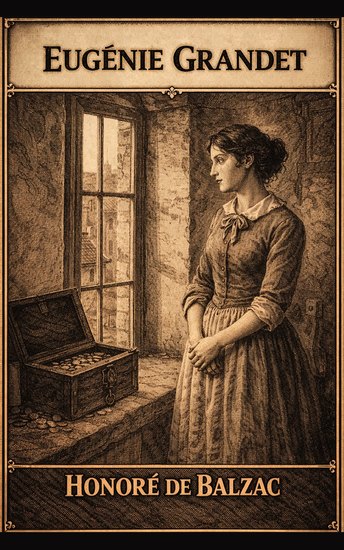
Eugénie Grandet - cover

Eugénie Grandet

Honoré de Balzac

Maison d'édition: CLXBX

  • 0
  • 0
  • 0

Synopsis

Honoré de Balzac's Eugénie Grandet is a masterful portrait of love, greed, sacrifice, and quiet resilience set against the backdrop of provincial France in the early nineteenth century. As one of the most celebrated works in Balzac's monumental series La Comédie Humaine, this powerful novel offers an intimate and penetrating exploration of human character, social ambition, and the corrosive effects of avarice.

At the heart of the story is Eugénie Grandet, a gentle and innocent young woman living in the small town of Saumur. She is the only daughter of Félix Grandet, a former cooper who has amassed a vast fortune through shrewd investments and relentless frugality. Though immensely wealthy, Grandet lives in near poverty by choice, ruling his household with rigid authority and obsessive control over every coin spent. His miserliness casts a long shadow over the lives of his wife and daughter, shaping their existence with silence, sacrifice, and emotional restraint.

Eugénie's sheltered world changes forever with the unexpected arrival of her cousin, Charles Grandet, a refined and charming young man from Paris. Raised in luxury and accustomed to elegance, Charles brings with him a glimpse of a broader, more vibrant world beyond the gray walls of Saumur. As affection blossoms between Eugénie and Charles, she experiences the awakening of love and hope—feelings that challenge her father's cold calculations and strict dominance.

Balzac masterfully contrasts innocence and ambition, generosity and greed, love and self-interest. Through Eugénie's quiet strength and moral integrity, the novel reveals the dignity of selfless devotion in a society driven by money and social advancement. As fortunes rise and fall, promises are tested, and loyalties strained, Eugénie must confront betrayal, heartbreak, and the harsh realities of adulthood.

With keen psychological insight and vivid realism, Balzac paints an unforgettable portrait of provincial life—its rigid social hierarchies, economic maneuverings, and unspoken tensions. His meticulous attention to detail gives the novel a powerful authenticity, while his deep understanding of human motivation makes each character strikingly real.

Both a poignant love story and a sharp social critique, Eugénie Grandet remains one of Balzac's most enduring and moving works. It is a timeless examination of the human heart in conflict with material obsession, and a profound reflection on sacrifice, endurance, and the quiet heroism found in compassion.
Disponible depuis: 18/02/2026.
Longueur d'impression: 234 pages.

D'autres livres qui pourraient vous intéresser

  • When the Door Opens - From their pens to your ears genius in every story - cover

    When the Door Opens - From their...

    Sarah Grand

    • 0
    • 0
    • 0
    The bookshelves of British literature are incredible collections that have gathered together centuries of very talented authors.  From these Isles their fame spread and whilst among their number many are now forgotten or neglected their talents endure.  Among them is the Suffragette Sarah Grand.
    Voir livre
  • The Celestial Omnibus and Other Stories - cover

    The Celestial Omnibus and Other...

    E. M. Forster

    • 0
    • 0
    • 0
    "It is only the small people who are afraid of great things."
    
    This collection of short stories by E.M. Forster, originally published in 1911, is notable for its exploration of complex themes of morality and human connections, juxtaposed against the more the mundane aspects of life.
    
    The titular story features a young boy who discovers a celestial bus that transports him beyond the confines of his ordinary life, and into a magical world that adults—limited by convention—cannot perceive. In the remaining stories, ordinary people encounter extraordinary forces in ways that expose the limits of their social conditioning, forming a meditation on how modern life—with its rules, anxieties, and obsession with progress—can deaden the spirit. Forster suggests that true vitality comes from listening to instinct, embracing beauty, and allowing oneself to be changed by the mysterious and the unexpected.
    
    The titles included in this collection are:
    
    - The Story of a Panic
    - The Other Side of the Hedge
    - The Celestial Omnibus
    - Other Kingdom
    - The Curate's Friend
    - The Road from Colonus
    Edward Morgan Forster (1879–1970) was an influential English novelist, essayist, and critic, known for his insightful observations on society and human relationships. He is often recognised as a prominent humanist writer, which reflects in both his literary works and his philosophical outlook; his books highlight the constraints that societal norms impose on individuals and advocate for greater empathy and understanding across class lines. His most famous novels include A Room with a View, Howards End, and A Passage to India, and his posthumously published novel Maurice revealed his identity as a gay man and his belief in the necessity of allowing individuals to live authentically.
    This audiobook is fully indexed. Once downloaded, each book and chapter will be listed so you can easily navigate to the individual section
    Voir livre
  • A Diagnosis of Death - From their pens to your ears genius in every story - cover

    A Diagnosis of Death - From...

    Ambrose Bierce

    • 0
    • 0
    • 0
    Ambrose Gwinnett Bierce was born on 24th June 1842 at Horse Cave Creek in Meigs County, Ohio. His parents were poor but they introduced him to literature at an early age, instilling in him a deep appreciation of books, the written word and the elegance of language.  
    Growing up in Koscuisko County, Indiana poverty and religion were defining features of his childhood, and he would later describe his parents as “unwashed savages” and fanatically religious, showing him little affection but always quick to punish. He came to resent religion, and his introduction to literature appears to be their only positive effect. 
    At age 15 Bierce left home to become a printer’s devil, mixing ink and fetching type at The Northern Indian, a small Ohio paper. Falsely accused of theft he returned to his farm and spent time sending out work in the hopes of being published. 
    His Uncle Lucius advised he be sent to the Kentucky Military Institute. A year later he was commissioned as an Officer.  As the Civil War started Bierce enlisted in the 9th Indiana Infantry Regiment.  
    In April 1862 Bierce fought at the Battle of Shiloh, an experience which, though terrifying, became the source of several short stories. Two years later he sustained a serious head wound and was off duty for several months. He was discharged in early 1865.  
    A later expedition to inspect military outposts across the Great Plains took him all the way to San Francisco. He remained there to become involved with publishing and editing and to marry, Mary Ellen on Christmas Day 1871.  They had a child, Day, the following year.  
    In 1872 the family moved to England for 3 years where he wrote for Fun magazine. His son, Leigh, was born, and first book, ‘The Fiend’s Delight’, was published.  
    They returned to San Francisco and to work for a number of papers where he gained admiration for his crime reporting. In 1887 he began a column at the William Randolph Hearst’s San Francisco Examiner.  
    Bierce’s marriage fell apart when he discovered compromising letters to his wife from a secret admirer. The following year, 1889 his son Day committed suicide, depressed by romantic rejection. 
    In 1891 Bierce wrote and published the collection of 26 short stories which included ‘An Occurrence at Owl Creek Bridge’.  Success and further works including poetry followed.  
    Bierce with Hearst’s resources helped uncover a financial plot by a railroad to turn 130 million dollars of loans into a handout. Confronted by the railroad and asked to name his price Bierce answered “my price is $130 million dollars. If, when you are ready to pay, I happen to be out of town, you may hand it over to my friend, the Treasurer of the United States”.  
    He now began his first foray as a fabulist, publishing ‘Fantastic Fables’ in 1899.  But tragedy again struck two years later when his second son Leigh died of pneumonia relating to his alcoholism.  
    He continued to write short stories and poetry and also published ‘The Devil’s Dictionary’.  
    At the age of 71, in 1913 Bierce departed from Washington, D.C., for a tour of the battlefields where he had fought during the civil war. At the city of Chihuahua he wrote his last known communication, a letter to a friend. It’s closing words were “as to me, I leave here tomorrow for an unknown destination,” Ambrose Bierce then vanished without trace.
    Voir livre
  • Trio of Stories A - Alun Lewis - A great introduction to a great author - cover

    Trio of Stories A - Alun Lewis -...

    Alun Lewis

    • 0
    • 0
    • 0
    Alun Lewis was born on the 1st July 1915 in Cwmaman in South Wales. 
    He studied history at Aberystwyth and Manchester Universities before beginning a career as a teacher. 
    In 1940, despite his pacifism, he enlisted to serve in the Royal Engineers and later received a commission in the South Wales Borderers. 
    His first poetry collection ‘Raider’s Dawn’ was published in 1942 as was his short story collection ‘The Last Inspection’.  Both brought him critical acclaim and an admiring audience. 
    Later that year he was posted to India where his conscience and morality wrestled with suffering and poverty that so was so evident all around him. 
    Alun Lewis died on the 5th March 1944 in Rakhine, Myanmar, from a self-inflicted gunshot wound, that was officially declared accidental.  He was 28.  
    His second poetry collection, ‘Ha! Ha! Among the Trumpets’, was published posthumously in 1945.
    Voir livre
  • Ma'ame Pelagie - From their pens to your ears genius in every story - cover

    Ma'ame Pelagie - From their pens...

    Kate Chopin

    • 0
    • 0
    • 0
    Katherine O'Flaherty was born on the 8th February 1850 in St Louis, Missouri to parents of French and Irish descent. 
    At age 5, she was sent to the Sacred Heart Academy and, apart from a 2 year period at home when her father died, remained there until graduating in 1868.  Whilst there she began writing and became an avid reader of almost anything that crossed her path.   
    Kate married Oscar Chopin in 1870 and the couple moved to New Orleans, and later to the rural setting of Cloutierville, Louisiana to raise their 6 children.  
    In 1882 her husband died leaving her in a deep trench of debt.  Despite her best efforts to turn the businesses around they were sold, and she moved the family back to St Louis and the financial help of her mother.  Sadly, her mother died within the year.  Kate, now struggling with depression, pushed herself to write and gained a local reputation as a writer of short stories that captured the local color and vibrancy of her surroundings.  
    By the early 1890’s her short stories were published nationally.  With this widespread audience also came negative reviews, controversy, and cries of immorality as themes such as interracial relationships, the rights of women and other burning issues of the day were written about. 
    Despite the criticism, which unnerved her, she continued to write though in the main her works, around 100 short stories and two novels, were not attributed with any literary worth. 
    Kate Chopin died from a brain haemorrhage in St Louis Missouri on the 22nd of August 1904.  She was 54. 
    For much of the 20th Century her work was forgotten and out of print.  It was only in early 1970’s, with the rise of feminism and the call for a more just society that she was given the status her works had long described and shone a literary light at.  She is now safely revered as one of America’s great authors.
    Voir livre
  • All Quiet on the Western Front - cover

    All Quiet on the Western Front

    Erich Maria Remarque, A.W. Wheen...

    • 0
    • 0
    • 0
    Paul Bäumer is just 19 years old when he enlists in the German army during World War I. What starts as a journey full of optimism turns to horror as he encounters the grim reality of trench warfare.  Amid the mud, blood, and chaos of battle, Paul forges deep bonds with his fellow soldiers, but these friendships only heighten the sense of isolation he experiences among civilians. 
     
    This 20th-century masterpiece immerses listeners in the violence of the trenches, the tenderness and tragedy of comradeship, and the lasting impact of war.
    Voir livre