Junte-se a nós em uma viagem ao mundo dos livros!
Adicionar este livro à prateleira
Grey
Deixe um novo comentário Default profile 50px
Grey
Assine para ler o livro completo ou leia as primeiras páginas de graça!
All characters reduced
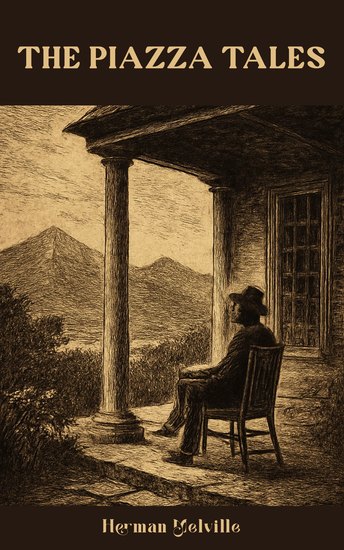
The Piazza Tales - cover
LER

The Piazza Tales

Herman Melville

Editora: CLXBX

  • 0
  • 0
  • 0

Sinopse

First published in 1856, The Piazza Tales is a masterful collection of short stories by Herman Melville that highlights his brilliance beyond the novel and his deep engagement with the moral and psychological tensions of human life.

This collection brings together six powerful and diverse works: "The Piazza," "Bartleby, the Scrivener," "Benito Cereno," "The Lightning-Rod Man," "The Encantadas," and "The Bell-Tower." Each tale offers a distinct setting and tone, yet all are united by Melville's penetrating insight into isolation, authority, freedom, and the hidden forces that shape human behavior.

From the haunting stillness of "Bartleby, the Scrivener," with its quiet rebellion against modern life, to the intense moral drama of "Benito Cereno," which confronts slavery, power, and perception, Melville challenges readers to question appearances and assumptions. "The Encantadas" presents stark, imaginative sketches of the Galápagos Islands, while the remaining stories explore superstition, obsession, and the limits of human control.

Philosophical, symbolic, and often unsettling, The Piazza Tales stands as one of Melville's most important works—an essential collection that reveals his daring experimentation and lasting influence on American literature.
Disponível desde: 07/02/2026.
Comprimento de impressão: 290 páginas.


Outros livros que poderiam interessá-lo

  • The First Writing Machines - From their pens to your ears genius in every story - cover

    The First Writing Machines -...

    Mark Twain

    • 0
    • 0
    • 0
    Samuel Langhorne Clemens was born in Florida, Missouri on the 30th November 1835 and is far better known by his pen name of Mark Twain.  An American writer and humorist of the first order he is perhaps best known for his novels ‘The Adventures of Tom Sawyer’ and its sequel ‘The Adventures of Huckleberry Finn’ which are often described with that mythic line The Great American Novel. 
    Twain grew up in Hannibal, Missouri which would later provide the backdrop to these great novels.  Apprenticed to a printer he also became a typesetter and then a master riverboat pilot on the Mississippi.  Later, heading west with his brother Orion to make his fortune, he failed at gold mining and instead turned to journalism and thence his true calling as a writer of humorous stories where his wit and humor sparkled from every paragraph, his craft evident with every page and punctured target. 
    A staunch supporter of copyright protections this helped him keep much of the wealth his writing created, though much money was also lost on investments that he pursued in his love for science and technology as well as investing in his own inventions. 
    Twain was born during a visit by Halley’s comet, and he predicted that he would go out with it as well.  He died the day after its subsequent return on 21st April 1910, at his house, Stormfield, located in Redding, Connecticut.
    Ver livro
  • The Last Inspection - A story written during WW2 from a author that tragically died in it - cover

    The Last Inspection - A story...

    Alun Lewis

    • 0
    • 0
    • 0
    Alun Lewis was born on the 1st July 1915 in Cwmaman in South Wales. 
    He studied history at Aberystwyth and Manchester Universities before beginning a career as a teacher. 
    In 1940, despite his pacifism, he enlisted to serve in the Royal Engineers and later received a commission in the South Wales Borderers. 
    His first poetry collection ‘Raider’s Dawn’ was published in 1942 as was his short story collection ‘The Last Inspection’.  Both brought him critical acclaim and an admiring audience. 
    Later that year he was posted to India where his conscience and morality wrestled with suffering and poverty that so was so evident all around him. 
    Alun Lewis died on the 5th March 1944 in Rakhine, Myanmar, from a self-inflicted gunshot wound, that was officially declared accidental.  He was 28.
    Ver livro
  • The Corpse Rider - From their pens to your ears genius in every story - cover

    The Corpse Rider - From their...

    Lafcadio Hearn

    • 0
    • 0
    • 0
    Lafcadio Hearn was born on the 27th June 1850 on the Ionian isle of Levkás in Greece to a British Army officer and a Greek Mother. 
    His father, fearing for his career prospects at being married to a Greek Orthodox wife, sent them to Dublin whilst he continued to advance his career with further postings.  Life there was difficult for mother and son.  His father returned, wounded and traumatised, when Lafcadio was three.  He annulled the marriage and she remarried but had to give up care of Lafcadio to her sister-in law.   
    After brief periods for Catholic education in England and France he emigrated to Ohio in the United States when he was 19, taking on a series of casual jobs before embarking on a career as a journalist, publishing poems and essays in Cincinnati.  It was whilst here that he began a side-line in translating, starting with Gautier and Flaubert.  He married in 1874 to a 20 year old African-American woman in violation of Ohio's anti-miscegenation law.  The marriage soon failed. 
    In 1877 he relocated to New Orleans to write on a variety of themes before picking up a two year assignment from Harper’s to write in the West Indies, where he also wrote his first novel. 
    In 1890 Harper’s sent him to Japan.  Here he left journalism and took the remarkable decision to become a schoolteacher in the north of Japan.   Enraptured by the culture he was driven to explain it in various Western publications to those who had little, if any, knowledge of its culture.  Within the year he had fallen in love with, and married, a high-born Japanese lady, together they would have four children.   
    In 1895 he became a Japanese national and took the name Koizumi Yakumo, Koizumi being his wife’s family name. 
    The following few years, whilst a professor of Literature at the Imperial University of Japan, were his most creative and admired period.   
    Lafcadio Hearn died of heart failure on the 26th of September 1904, in Tokyo, Japan shortly before leaving to deliver a series of lectures at Cornell University in New York State.  He was 54.
    Ver livro
  • The Beast in the Cave - cover

    The Beast in the Cave

    H.P. Lovecraft

    • 0
    • 0
    • 0
    This audiobook is narrated by an AI Voice.  
    Between 1903 and 1908, Lovecraft created many stories and sketches, about which we know nothing today beyond the fact that they existed. Almost all met the same fate: death in the flames at the hands of their creator. Lovecraft saved only two texts – "The Alchemist" (1908) and "The Beast in the Cave." 
    The sketch of the story was created as early as the spring of 1904, but Lovecraft needed some time in the Providence Public Library to get to know the location where he set the story, i.e., Mammoth Cave in Kentucky (now a national park). The plot can be summarized in one sentence: a tourist gets lost in a vast cave, where he encounters the titular beast. 
    It is immediately apparent how much Lovecraft had progressed in prose writing since he penned the weak "The Mysterious Ship" three years earlier. The story is mature, with a well-developed psychology of the main character. In the 1930s, the author considered "The Beast in the Cave" to be the first of his works, chronologically, that held any value for him. It is the first story that bears such a clear resemblance to the writer's later works. I particularly note the fact that Lovecraft uses for the first time the phenomenon of the so-called "terminal climax," where the climax coincides with the last sentence of the story. Another striking example of this technique can be found in "Pickman's Model." 
    The story was not published until 1918, just after Lovecraft returned to writing prose (from 1908 to 1917 he was exclusively engaged in studies and poetry). Lovecraft was convinced to publish it by his friend from the amateur writers' society, W. Paul Cook.
    Ver livro
  • The Ebony Frame - From their pens to your ears genius in every story - cover

    The Ebony Frame - From their...

    Edith Nesbit

    • 0
    • 0
    • 0
    Edith Nesbit was born on the 15th August 1858 in Kennington, then part of Surrey.   
    Due to the health issues and tuberculosis of her sister Mary, Nesbit’s early life was one of constant changes of house both in England and on the continent. 
    At age 17, Nesbit met Hubert Bland and they married three years later―whilst she was 7 months pregnant.  Bland also kept his affair with another woman going throughout their marriage and the two children of that relationship were raised by Nesbit as well as her own three with Bland. 
    Together they were founder members of the Fabian Society in 1884 naming their son Fabian in its honour.  They also edited the Society's journal; ‘Today’.  Nesbit was an active lecturer and prolific writer on socialism during those years but gradually her work for them dwindled as her career as a children’s writer grew.  Her most famous success was ‘The Railway Children’ but she was also very prolific and greatly accomplished in poetry, short stories―especially her macabre ghost and supernatural stories―and novels for adults.  
    In February 1917, some three years after the death of Bland she married Thomas ‘the Skipper’ Tucker in Woolwich, where he was a ship's engineer on the Woolwich Ferry. 
    Edith Nesbit died from lung cancer on the 4th May 1924 at her house ‘The Long Boat’ at Jesson, St Mary's Bay, New Romney in Kent.  She was 65.
    Ver livro
  • Gazing at the Moon - 1500 years of lunar exploration and encounters - cover

    Gazing at the Moon - 1500 years...

    Lucian of Samosata, Francis...

    • 0
    • 0
    • 0
    Collected here are six tales that span nearly two thousand years, from a Roman citizen writing a satire of the ‘historical’ literature of his time in 182 AD to Edgar Allan Poe exploring the idea of a scientific ascent to the moon in 1835. Humanity changed vastly across that time, and yet the moon never lost its allure, its promise of mystery and magic. By the late nineteenth century, it was clear that the moon’s surface was barren, and a wave of moon-based stories inaugurated the expansion into space of fiction. 
    Before we breached the atmosphere and sent men to our planet’s satellite, humanity spent countless millennia gazing up at the moon and wondering what might be there, telling stories by firelight of the mystery and magic of our constant and changing night-time companion.
    Ver livro