¡Acompáñanos a viajar por el mundo de los libros!
Añadir este libro a la estantería
Grey
Escribe un nuevo comentario Default profile 50px
Grey
Suscríbete para leer el libro completo o lee las primeras páginas gratis.
All characters reduced
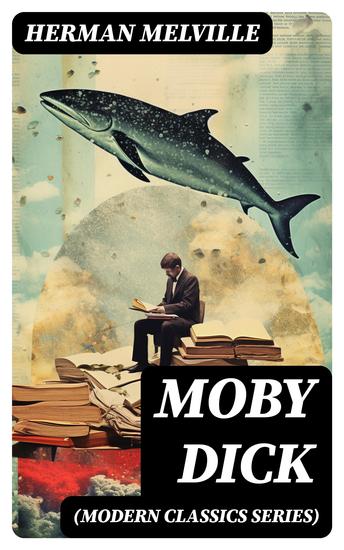
MOBY DICK (Modern Classics Series) - cover

MOBY DICK (Modern Classics Series)

Herman Melville

Editorial: DigiCat

  • 0
  • 0
  • 0

Sinopsis

Herman Melville's "Moby Dick," presented in this Modern Classics Series edition, is a profound exploration of obsession, vengeance, and the human spirit, narrated through the eyes of Ishmael, a sailor aboard the whaling ship Pequod. The novel employs a rich tapestry of literary styles, seamlessly blending poetic prose, philosophical musings, and detailed descriptions of whaling, thereby situating it within the broader context of 19th-century American literature. Melville grapples with existential themes and the sublime, encapsulated in Captain Ahab's manic pursuit of the titular white whale, an emblem of nature's indomitable force and the human condition's complexities. Herman Melville, born into a family with maritime ties, embarked on whaling adventures in his youth, which profoundly influenced his writing. These experiences, alongside his exposure to diverse cultures and philosophies, allowed him to grapple with the thematic richness of human experience and the moral dilemmas surrounding obsession and nature's brutality. His penchant for intricate narratives reflects the broader literary movements of Romanticism and Transcendentalism, further enriching his work. "Moby Dick" is an essential read for those seeking a deep, thought-provoking literary journey. It invites readers to ponder the depths of human ambition and the paradox of man's relationship with nature. This modern edition offers contemporary readers the opportunity to engage with Melville's timeless masterpiece, making it a crucial addition to any literary collection.
Disponible desde: 11/12/2023.
Longitud de impresión: 658 páginas.
Otros libros que te pueden interesar

  • Human Error - 30 stories beyond common sense - cover

    Human Error - 30 stories beyond...

    Dr Dimitrios Papadimitriadis

    • 0
    • 0
    • 0
    A collection of thirty short stories that move along the edges of the existential and the social, the tender and the ironic. Set against the backdrop of Greece, and drawing deeply from its unique spirit and contradictions, each story reveals a subtle fracture in the surface of daily life, where a person confronts themselves, the systems that enclose them, and the illusions they invent just to endure. 
    These are finely tuned explorations of the human psyche—part microscope, part mirror—unveiling the quiet absurdities we all share. In this space, reason withdraws, cynicism smirks, and mistakes are no longer silent; they speak, take on form, and, inevitably, a face.
    Ver libro
  • The Diary of a God - From their pens to your ears genius in every story - cover

    The Diary of a God - From their...

    Barry Pain

    • 0
    • 0
    • 0
    Barry Eric Odell Pain was born at 3 Sydney Street in Cambridge on 28th September 1864. He was one of 4 children. 
    He was educated at Sedbergh School and then Corpus Christi College, Cambridge where he read classics and contributed to and edited Granta. 
    Four years of service as an Army coach followed before he moved to London. In 1889, Cornhill Magazine published his short story ‘The Hundred Gates’.  This opened the way for Pain to advance his literary career on several fronts. He became a contributor to Punch and The Speaker, as well as joining the staff of both the Daily Chronicle and Black and White.  
    In 1897 he succeeded Jerome K Jerome as editor of To-Day but still contributed regularly, until 1928, to the Windsor Magazine. 
    It is often said that Pain was discovered by Robert Louis Stevenson, who compared his work to that of Guy de Maupassant.  It’s an apt comparison. Pain was also a master of disturbing prose but able to inject parody and light comedy into many of his works.  A simple premise could in his hands suddenly expand into a world very real but somehow emotionally fraught and on the very edge of darkness as many of these short stories demonstrate.   
    Despite applying his talents to several genres and forms today Pain is more readily thought of, especially during the first decade of the 20th Century, as perhaps the leading British humorist of his day.  These stories reveal a darker side and beg to differ. 
    Barry Pain died on 5th May 1928 in Bushey, Hertfordshire.
    Ver libro
  • Rising Thunder - A Jesse McDermitt Novel - cover

    Rising Thunder - A Jesse...

    Wayne Stinnett

    • 0
    • 0
    • 0
    Paradise isn’t always what it’s cracked up to be. Few people know this as well as Jesse McDermitt, retired Marine and former government operative.  
    In the aftermath of an intense mission in coastal Mexico, Jesse wants nothing more than to get back to his boat; to just sail away and forget all about the firefight and his warrior past.  
    The Caribbean sun is warm, the azure water inviting, he has the woman of his dreams at his side, and everything seems to be smooth sailing.  
    Until a severed leg is found tangled in a line securing Jesse’s dinghy to his 61-foot sailing yacht, Salty Dog. The former owner of the appendage turns out to be the eighth victim of a lunatic who kills for money and a former Russian smuggler who won’t pass up a chance for one more big score.  
    Jesse is forced to don the warrior’s mask once again. This time to catch a ghoulish killer who is stalking the villages and jungles outside Belize City.
    Ver libro
  • Glad Ghosts - cover

    Glad Ghosts

    D H Lawrence

    • 0
    • 0
    • 0
    ‘Glad Ghosts’ is another of Lawrence's supernatural stories, set in the archetypical country house. He doesn't attempt to explain the supernatural happenings which occur but uses them to extol his own ideas of the power of the sex drive and the triumph of life over death.
    Ver libro
  • Her Lover - From their pens to your ears genius in every story - cover

    Her Lover - From their pens to...

    Maxim Gorky

    • 0
    • 0
    • 0
    Alexei Maximovich Peshkov was born on 28th March 1868, in Nizhny Novgorod, Russia. 
    Better known as Maxim Gorky he was orphaned at 11 and ran away from home at 12.  At 19 he had already attempted suicide and thereafter travelled, by foot, across the Russian Empire for 5 years. 
    His first book ‘Essays & Stories’ in 1898 was a sensation and so began a long career as an author of short stories, novels and plays.  Gorky saw writing as a moral and political act that would help to change the unjust world around him.  He was an ardent early advocate of the emerging Marxist movement and publicly opposed the Tsarist regime leading several times to his arrest.  
    In 1904 he began his own theatre but the censor banned every play and Gorky was forced to abandon the project. 
    But Gorky was a financially successful author, editor, and playwright and gave monies to political parties as well as for civil rights and social reform.  The brutal shooting of workers, which set in motion the Revolution of 1905, pushed Gorky more decisively toward radical solutions.  
    In 1906 he went to the United States to raise funds for the Bolsheviks. Those experiences including a scandal over travelling with his lover and not his wife deepened his contempt for the ‘bourgeois soul.’ 
    Gorky now moved to Capri in Italy, both for health reasons and to escape the increasingly repressive times in Russia.  
    An amnesty for the 300th anniversary of the Romanov dynasty saw him return to Russia in 1914. His politics remained close to the Bolshevik cause.  But soon, after the 1918 revolution, his essays referred to Lenin as a tyrant for his senseless arrests and repression.  He was soon appealing to the outside world for food aid after the catastrophic crop failure. 
    In October 1921 Gorky returned to Italy, now in Fascist hands, and settled in Sorrento until 1932.  His health worsened with the onset of tuberculosis. 
    He wrote several successful books there but now decided to find an understanding with the communist regime. Stalin invited him home and his return was hailed as a major propaganda victory.  He was decorated with the Order of Lenin, and a province, a park, and various streets re-named in his honour. 
    But he had his faults too.  In 1933, Gorky co-edited a book on the White Sea-Baltic Canal and denied even a single prisoner died during its construction, but thousands had. As well, knowing that some Nazis were homosexual, a phrase was attributed to him that said ‘exterminate all homosexuals and fascism will vanish’.  Although he was himself was quoting another he was decidedly homophobic. 
    With the increase of Stalinist repression in 1935 Gorky was placed under unannounced house arrest. 
    Maxim Gorky died on the 18th June 1936 from pneumonia.  He was 68. 
    Stalin and Molotov were among those who carried Gorky's urn of ashes at his funeral.
    Ver libro
  • Vertical Motion - cover

    Vertical Motion

    Can Xue

    • 0
    • 0
    • 0
    "There's a new world master among us, and her name is Can Xue." —Robert Coover 
     
    Two young girls sneak onto the grounds of a hospital, where they find a disturbing moment of silence in a rose garden. A couple grows a plant that blooms underground, invisibly, to their long-time neighbor's consternation. A cat worries about its sleepwalking owner, who receives a mysterious visitor while he's asleep. After a ten-year absence, a young man visits his uncle, on the twenty-fourth floor of a high-rise that is floating in the air, while his ugly cousin hesitates on the stairs . . .  


    Can Xue is a master of the dreamscape, crafting stories that inhabit the space where fantasy and reality, time and timelessness, the quotidian and the extraordinary, meet. The stories in this striking and lyrical new collection—populated by old married couples, children, cats, and nosy neighbors, the entire menagerie of the everyday—reaffirm Can Xue's reputation as one of the most innovative Chinese writers in a generation.
    Ver libro