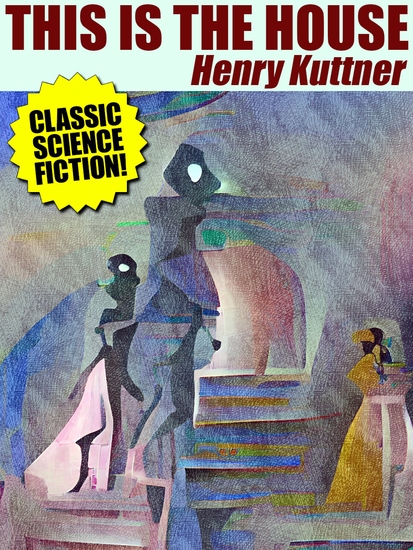
This is the House
Henry Kuttner
Editorial: Alien Ebooks
Sinopsis
A house, it has been said, is a machine for living. The house they bought from its previous occupant had, very definitely, been made just that. But—not for human living!
Editorial: Alien Ebooks
A house, it has been said, is a machine for living. The house they bought from its previous occupant had, very definitely, been made just that. But—not for human living!
Short stories have always been a sort of instant access into an author’s brain, their soul and heart. A few pages can lift our lives into locations, people and experiences with a sweep of landscape, narration, feelings and emotions that is difficult to achieve elsewhere. In this series we try to offer up tried and trusted ‘Top Tens’ across many different themes and authors. But any anthology will immediately throw up the questions – Why that story? Why that author? The theme itself will form the boundaries for our stories which range from well-known classics, newly told, to stories that modern times have overlooked but perfectly exemplify the theme. Throughout the volume our authors whether of instant recognition or new to you are all leviathans of literature. Some you may disagree with but they will get you thinking; about our choices and about those you would have made. If this volume takes you on a path to discover more of these miniature masterpieces then we have all gained something. Between the Russian Empire and Europe warily sits Ukraine. Her own history has been brush stroked either by periods of independence or under the oppressive yoke of other more powerful and belligerent neighbours. It’s authors, almost always cited as ‘Russian’, or from ‘Little Russia’ are diverse and brilliant. Some of them stayed, some moved to other lands but always their works harbour part of their Ukrainian souls despite the ever-changing territorial borders. 01 - The Top 10 - The Ukrainians - An Introduction 2 - The Nose by Nikolai Gogol 3 - The Shades, A Phantasy by Vladimir Korolenko 4 - Morphine by Mikhail Bulgakov 5 - A Witches Den by Helena Blavatsky 6 - The Informer by Joseph Conrad 7 - The Signal by Vsevolod Garshin 8 - The General's Will by Vera Jelihovsky 9 - The Blind Ones by Isaac Babel 10 - The Revolutionist by Mikhail Petrovich Artzybashev 11 - Dethroned by Ignaty PotapenkoVer libro
Frankenstein tells the story of Victor Frankenstein, a young scientist who creates a sapient creature in an unorthodox scientific experiment. Shelley started writing the story when she was 18, and the first edition was published anonymously in London on 1 January 1818, when she was 20. Her name first appeared in the second edition, which was published in Paris in 1821.Shelley travelled through Europe in 1815, moving along the river Rhine in Germany, and stopping in Gernsheim, 17 kilometres (11 mi) away from Frankenstein Castle, where, two centuries before, an alchemist had engaged in experiments.[note She then journeyed to the region of Geneva, Switzerland, where much of the story takes place. Galvanism and occult ideas were topics of conversation for her companions, particularly for her lover and future husband Percy B. Shelley. In 1816 Mary, Percy and Lord Byron had a competition to see who could write the best horror story. After thinking for days, Shelley was inspired to write Frankenstein after imagining a scientist who created life and was horrified by what he had made.Though Frankenstein is infused with elements of the Gothic novel and the Romantic movement, Brian Aldiss has argued for regarding it as the first true science-fiction story. In contrast to previous stories with fantastical elements resembling those of later science fiction, Aldiss states, the central character "makes a deliberate decision" and "turns to modern experiments in the laboratory" to achieve fantastic results. The novel has had a considerable influence on literature and on popular culture; it has spawned a complete genre of horror stories, films, and plays.Since the publication of the novel, the name "Frankenstein" has often been used, erroneously, to refer to the monster, rather than to his creator/father.Ver libro
Sir Anthony Hope Hawkins was born on 9th February 1863 in Clapton, London. He was educated at St John's School, Leatherhead, Marlborough College and Balliol College, Oxford. Hope trained as a lawyer and barrister and was called to the Bar by the Middle Temple in 1887. Despite what was thought to be a promising legal career he had literary ambitions and wrote in his spare time. His early works appeared in various periodicals of the day but for his first book ‘A Man of Mark’ (1890), with no publisher interested, he published with his own resources. More novels and short stories followed, including the mildly successful ‘Mr Witt's Widow’ in 1892. Hope even found time to run as the Liberal candidate for Wycombe in the election that same year but was unsuccessful. His first major literary success came with ‘The Dolly Dialogues’, a collection of previously published magazine pieces followed very quickly by his instant classic, ‘The Prisoner of Zenda’. He now gave up the vestiges of his legal career to pursue writing full-time. Despite never again reaching the same pinnacle of success he was popular and wrote prolifically across novels, plays and of course, short stories though his writing output rapidly diminished after the war. In 1918 he was knighted for his contribution to propaganda efforts during World War I. His short stories are delicate, mannered and often surprising with their wit, humour and interplay of characters who say one thing and usually mean another. He was very definitely a writer of escapist rather than serious fare but they are no less enjoyable for that. Anthony Hope died of throat cancer on 8th July 1933 at his country home, Heath Farm at Walton-on-the-Hill in Surrey. He was 70.Ver libro
Short stories have always been a sort of instant access into an author’s brain, their soul and heart. A few pages can lift our lives into locations, people and experiences with a sweep of landscape, narration, feelings and emotions that is difficult to achieve elsewhere. In this series we try to offer up tried and trusted ‘Top Tens’ across many different themes and authors. But any anthology will immediately throw up the questions – Why that story? Why that author? The theme itself will form the boundaries for our stories which range from well-known classics, newly told, to stories that modern times have overlooked but perfectly exemplify the theme. Throughout the volume our authors whether of instant recognition or new to you are all leviathans of literature. Some you may disagree with but they will get you thinking; about our choices and about those you would have made. If this volume takes you on a path to discover more of these miniature masterpieces then we have all gained something. Among the canon of American talents few can stand as tall or are as revered as Nathaniel Hawthorne, a true master of prose and purpose. These stories merely confirm that Hawthorne was a literary phenomenon. 01 - The Top 10 - Nathaniel Hawthorne - An Introduction 02 - The Devil In Manuscript by Nathaniel Hawthorne 03 - The Artist of the Beautiful by Nathaniel Hawthorne 04 - The Shaker Bridal by Nathaniel Hawthorne 05 - Rappaccini's Daughter by Nathaniel Hawthorne 06 - The Wedding Knell By Nathaniel Hawthorne 07 - The Birthmark by Nathaniel Hawthorne 08 - Roger Malvin's Burial by Nathaniel Hawthorne 09 - Doctor Heidegger's Experiment by Nathaniel Hawthorne 10 - David Swan By Nathaniel Hawthorne 11 - Young Goodman Brown by Nathaniel HawthorneVer libro
There is something about the number 3. The Ancient Greeks believed 3 was the perfect number, and in China 3 has always been a lucky number, and they know a thing or two. Most religions also have 3 this and 3 that and, of course, in these more modern times, three’s a crowd may be too many, except when it’s a ménage à trois. It seems good things usually come in threes. Whatever history and culture says WE think 3, a hat-trick of stories, is a great number to explore themes and literary avenues that classic authors were so adept at creating. From their pens to your your ears.Ver libro
Jesse McDermitt discovers an environmental nightmare of deception and greed taking place in Central America. A cartel is branching into smuggling things other than drugs. And they’re doing it quite effectively. The Honduran rain forests and its inhabitants are at peril. The cartel needs hidden places to grow coca, used in the manufacture of cocaine. The exotic and endangered hardwood trees are cut and sold on the black market, along with any creature found dwelling deep in the humid jungle. Environmental activists in the area who try to intercede are swiftly dealt with in the manner the cartel deals with anyone who stands between them and the almighty dollar—with a sharp machete. Having so many moving parts and numerous smuggling routes, can Jesse and the crew of Ambrosia, on a dive vacation in the Bay Islands of Honduras, be able to make a difference? Or will the beautiful reef surrounding the island of Utila be Ambrosia’s grave?Ver libro