¡Acompáñanos a viajar por el mundo de los libros!
Añadir este libro a la estantería
Grey
Escribe un nuevo comentario Default profile 50px
Grey
Suscríbete para leer el libro completo o lee las primeras páginas gratis.
All characters reduced
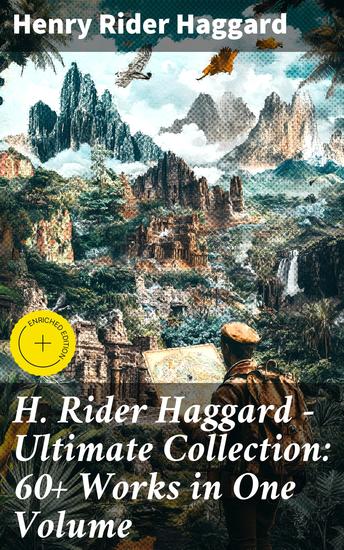
H Rider Haggard - Ultimate Collection: 60+ Works in One Volume - Enriched edition Adventure Novels Lost World Mysteries Historical Books Essays & Memoirs - cover

H Rider Haggard - Ultimate Collection: 60+ Works in One Volume - Enriched edition Adventure Novels Lost World Mysteries Historical Books Essays & Memoirs

Henry Haggard

Editorial: Good Press

  • 0
  • 0
  • 0

Sinopsis

H. Rider Haggard - Ultimate Collection: 60+ Works in One Volume compiles the prolific output of one of the most significant adventure novelists of the late 19th century. This comprehensive anthology not only showcases Haggard's thrilling tales of exploration and discovery, from the enigmatic realms of lost civilizations to dangerous quests in exotic locales, but also highlights his unique narrative style that fuses vivid descriptions with a compelling, cinematic pace. Written during a time of heightened colonial interest and imperial expansion, Haggard's works often reflect the cultural anxieties and fascinations of his era, grappling with themes of civilization versus savagery and the clash of the known and the unknown. Henry Rider Haggard, born in 1856, was deeply influenced by his experiences in South Africa, which inspired many of his legendary stories such as "King Solomon's Mines". His background in agriculture and law, along with his connections to the British Empire, allowed him to weave rich tapestries of adventure that resonate with authenticity. Haggard's innovative imagination helped lay the groundwork for the modern fantasy and adventure genres, propelling him to fame that has endured for generations. This ultimate collection is essential for readers seeking to immerse themselves in Haggard's captivating world of adventure and exploration. Offering a full spectrum of his creative genius, this anthology not only serves as an introduction to the author's remarkable narrative prowess but also provides seasoned readers a chance to revisit the beloved exploits of characters that have come to define the genre. Enter the realms of adventure and imagination with Haggard's works, where the thrill of discovery awaits.

In this enriched edition, we have carefully created added value for your reading experience:
- A comprehensive Introduction outlines these selected works' unifying features, themes, or stylistic evolutions.
- The Author Biography highlights personal milestones and literary influences that shape the entire body of writing.
- A Historical Context section situates the works in their broader era—social currents, cultural trends, and key events that underpin their creation.
- A concise Synopsis (Selection) offers an accessible overview of the included texts, helping readers navigate plotlines and main ideas without revealing critical twists.
- A unified Analysis examines recurring motifs and stylistic hallmarks across the collection, tying the stories together while spotlighting the different work's strengths.
- Reflection questions inspire deeper contemplation of the author's overarching message, inviting readers to draw connections among different texts and relate them to modern contexts.
- Lastly, our hand‐picked Memorable Quotes distill pivotal lines and turning points, serving as touchstones for the collection's central themes.
Disponible desde: 06/12/2023.
Longitud de impresión: 13710 páginas.
Otros libros que te pueden interesar

  • A Piece of Steak - American author of The Call Of The Wild & White Fang brings a biting story about a poverty stricken aging boxer and his plight - cover

    A Piece of Steak - American...

    Jack London

    • 0
    • 0
    • 0
    John Griffith Chaney was born on January 12th, 1876 in San Francisco.   
     
    His father, William Chaney, was living with Flora Wellman when she became pregnant.  Chaney insisted she have an abortion.  Flora's response was to turn a gun on herself.  Although her wounds were not severe the trauma made her temporarily deranged. 
     
    In late 1876 his mother married John London and the young child was brought to live with them as they moved around the Bay area, eventually settling in Oakland where now, calling himself Jack, he completed grade school. 
     
    Jack worked hard at several jobs, sometimes 12-18 hours a day, but his dream was university.  He studied hard and borrowed the money to enrol in the summer of 1896 at the University of California in Berkeley. 
     
    In 1897, at 21, Jack searched out newspaper accounts of his mother's suicide attempt and for the name of his biological father. He wrote to Chaney, then living in Chicago, who claimed he could not be Jack’s father because he was impotent and casually asserted that London's mother had relations with other men.  Jack, devastated by the response, quit Berkeley and went to the Klondike. Other accounts suggest that his dire finances presented Jack with the excuse he needed to leave. 
     
    In the Klondike Jack began to gather material for his writing but also accumulated many health problems, including scurvy, which together with hip and leg problems he would carry for the rest of his life. 
     
    During the late 1890's Jack was regularly publishing short stories and by the turn of the century full blown novels. 
     
    By 1904 Jack had married, fathered two children and was now in the process of divorcing.  A stint as a reporter on the Russo-Japanese war of 1904 was equal amounts trouble and experience. But that experience was always put to good use in a continuing and remarkable output of work. 
     
    In 1905 he married Charmian Kittredge who at last was a soul and companion who brought him some semblance of peace despite his advancing alcoholism and his incurable wanderlust. 
     
    Twelve years later Jack had amassed both wealth and a literary reputation through such classics as ‘The Call of the Wild’, ‘White Fang’ and many others. He had a reputation as a social activist and was a tireless friend of the workers.   
     
    Jack London died suffering from dysentery, late-stage alcoholism and uremia, aged only 40, on November 22nd 1916 at his property in Glen Elen in California 
     
    In ‘A piece of Steak’ an ageing prizefighter seeks one last win. Not for glory, or to revisit fame, but simply to put food on the table and keep his family together.  But to do that he must beat a highly rated up and coming adversary.
    Ver libro
  • Rupert of Hentzau - cover

    Rupert of Hentzau

    Anthony Hope

    • 0
    • 0
    • 0
    In the realm of classic adventure literature, few novels have achieved the enduring charm and timeless appeal of Anthony Hope's "Rupert of Hentzau." Originally published in 1898 as a sequel to "The Prisoner of Zenda," this captivating tale of political intrigue, romance, and daring escapades has cemented its place as a literary gem. 
    Head Stories Audio presents Rupert of Hentzau, narrated by Simon Hester.  With original music.
    Ver libro
  • Christmas Carol A - A Multi-Voice Audio Experience - cover

    Christmas Carol A - A...

    Resonant Narratives

    • 0
    • 0
    • 0
    Experience Charles Dickens's immortal tale as never before with our groundbreaking multi-voice production. This isn't just another audiobook - it's a fully immersive audio experience featuring 19 distinct character voices, each brought to life by professional voice talent. 
    Journey through Victorian London as Ebenezer Scrooge's transformation unfolds in crystal-clear audio quality, with each character given their unique voice and personality:Scrooge's journey from bitter miser to joyful benefactorBob Cratchit's humble optimismThe haunting presence of Jacob MarleyThe wisdom of the three Christmas SpiritsThe heartwarming Cratchit familyThe lively streets of Victorian London 
    Recorded in pristine audio quality with carefully crafted sound design, this production maintains the authenticity of Dickens' original text while creating an immersive listening experience that vividly brings every character and scene to life. 
    Perfect for longtime fans and newcomers to this timeless story of redemption, our multi-voice production adds new depth and dimension to this beloved holiday classic. 
    Let the spirits of Christmas Past, Present, and Future guide you through this unforgettable journey of transformation and redemption.
    Ver libro
  • About Love - From their pens to your ears genius in every story - cover

    About Love - From their pens to...

    Anton Chekhov

    • 0
    • 0
    • 0
    Anton Pavlovich Chekhov was born on 29th January 1860 in Taganrog, on the south coast of Russia.  
    His family life was difficult; his father was strict and over-bearing but his mother was a passionate story-teller, a subject Chekhov warmed to. As he later said; ‘our talents we got from our father, but our soul from our mother’.  
    At school Chekhov was distinctly average. At 16 his father mis-managed his finances and was declared bankrupt. His family fled to Moscow. Chekhov remained and eked out a living by various means, including writing and selling short sketches to newspapers, to finish his schooling. That completed and with a scholarship to Moscow University obtained he rejoined his family. 
    He was able to help support them by selling satirical sketches and vignettes of Russian lifestyles and gradually obtained further commissions. In 1884, he qualified as a physician and, although it earned him little, he often treated the poor for free, he was fond of saying ‘Medicine is my lawful wife, and literature is my mistress.’ 
    His own health was now an issue as he began to cough up blood, a symptom of tuberculosis.  Despite this his writing success enabled him to move the family into more comfortable accommodation.  
    Chekhov wrote over 500 short stories which included many, many classics including ‘The Kiss’ and ‘The Lady with a Dog’.  His collection ‘At Dusk’ won him the coveted Pushkin Prize when was only 26.  
    He was also a major playwright beginning with the huge success of ‘Ivanov’ in 1887.   
    In 1892 Chekhov bought a country estate north of Moscow. Here his medical skills and money helped the peasants tackle outbreaks of cholera and bouts of famine. He also built three schools, a fire station and a clinic.  It left him with less time for writing but the interactions with real people gained him detailed knowledge about the peasantry and their living conditions for his stories.  
    His most famous work, ‘The Seagull’ was received disastrously at its premiere in St Petersburg. It was later restaged in Moscow to highlight its psychological aspects and was a huge success. It led to ‘Uncle Vanya’, ‘The Three Sisters’ and ‘The Cherry Orchard’.  
    Chekhov suffered a major lung hemorrhage in 1897 while visiting Moscow. A formal diagnosis confirmed tuberculosis and the doctors ordered changes to his lifestyle.  
    Despite a dread of weddings the elusive literary bachelor quietly married the actress Olga Knipper, whom he had met at rehearsals for ‘The Seagull’, on 25th May 1901. 
    By May 1904 with his tuberculosis worsening and death imminent he set off for the German town of Badenweiler writing cheerful, witty letters to his family and assuring them his health was improving.  
    On 15th July 1904 Anton Chekhov died at Badenweiler.  He was 44.
    Ver libro
  • Through a Window (Unabridged) - cover

    Through a Window (Unabridged)

    H. G. Wells

    • 0
    • 0
    • 0
    Herbert George Wells (21 September 1866 - 13 August 1946) was an English writer. Prolific in many genres, he wrote dozens of novels, short stories, and works of social commentary, history, satire, biography and autobiography. His work also included two books on recreational war games. Wells is now best remembered for his science fiction novels and is often called the "father of science fiction", along with Jules Verne and the publisher Hugo Gernsback.
    THROUGH A WINDOW: After his legs were set, they carried Bailey into the study and put him on a couch before the open window. There he lay, a live-even a feverish man down to the loins, and below that a double-barrelled mummy swathed in white wrappings.
    Ver libro
  • The Million Pound Note - This hilarious story set in Victorian London is about two rich brothers performing a rather cruel social experiment on someone for their own amusement a la the movie Trading Places but written a century earlier - cover

    The Million Pound Note - This...

    Mark Twain

    • 0
    • 0
    • 0
    Samuel Langhorne Clemens was born in Florida, Missouri on the 30th November 1835 and is far better known by his pen name of Mark Twain.  An American writer and humorist of the first order he is perhaps best known for his novels ‘The Adventures of Tom Sawyer’ and its sequel ‘The Adventures of Huckleberry Finn’ which are often described with that mythic line The Great American Novel. 
     
    Twain grew up in Hannibal, Missouri which would later provide the backdrop to these great novels.  Apprenticed to a printer he also became a typesetter and then a master riverboat pilot on the Mississippi.  Later, heading west with his brother Orion to make his fortune, he failed at gold mining and instead turned to journalism and thence his true calling as a writer of humorous stories where his wit and humor sparkled from every paragraph, his craft evident with every page and punctured target. 
     
    A staunch supporter of copyright protections this helped him keep much of the wealth his writing created, though much money was also lost on investments that he pursued in his love for science and technology as well as investing in his own inventions. 
      
    Twain was born during a visit by Halley’s comet, and he predicted that he would go out with it as well.  He died the day after its subsequent return on 21st April 1910, at his house, Stormfield, located in Redding, Connecticut.   
     
    In this story Twain proposed that coming into possession of a million pound note should solve all of life’s problems, both big and small.  And he’s right.  For a time it does.  But…. Yes, with Twain, there is always a but.
    Ver libro