¡Acompáñanos a viajar por el mundo de los libros!
Añadir este libro a la estantería
Grey
Escribe un nuevo comentario Default profile 50px
Grey
Suscríbete para leer el libro completo o lee las primeras páginas gratis.
All characters reduced
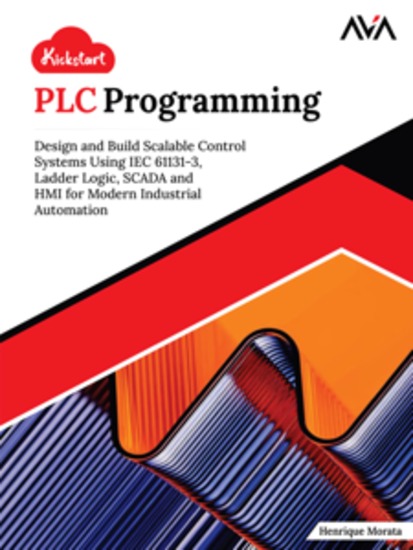
Kickstart PLC Programming: Design and Build Scalable Control Systems Using IEC 61131-3 Ladder Logic SCADA and HMI for Modern Industrial Automation - cover

Kickstart PLC Programming: Design and Build Scalable Control Systems Using IEC 61131-3 Ladder Logic SCADA and HMI for Modern Industrial Automation

Henrique Morata

Editorial: Orange Education Pvt Ltd

  • 0
  • 0
  • 0

Sinopsis

Your Fast-Track Guide to PLCs, SCADA, and Smart Control.Key Features● Learn core IEC 61131-3 PLC languages like Ladder, ST, and FBD in depth.● Design scalable control systems with reusable, modular logic.● Integrate PLCs with HMI, SCADA, and modern industrial networks.Book DescriptionEmbark on a structured, hands-on journey into the world of PLC Programming and Machine Automation. This comprehensive guide takes you from the fundamentals of IEC 61131-3 programming languages, ​​such as Ladder Logic, Structured Text, and Function Blocks to the advanced techniques required to build reliable and scalable automation systems.Start by understanding how software environments interact with PLC hardware, and the field devices they control. Explore the inner workings of industrial networks, the role of standardization in system design, and how to ensure seamless communication and interoperability using protocols, such as Modbus, Profinet, and OPCs.As the chapters progress, you will gain practical insights into modular software design, integration with HMI and SCADA systems, and how to architect automation projects for small machines as well as complex processes. You will also learn how to future-proof your solutions through robust network topologies, version control practices, and building a solid foundation for modern, connected, and intelligent industrial control systems.What you will learn● Master the intricacies of PLC programming with IEC 61131-3 standards.● Effectively structure control logic, using Ladder, ST, and FBD languages.● Establish robust communication with field devices and remote systems.● Integrate PLCs seamlessly with HMI, SCADA, and industrial protocols.● Develop modular and scalable control architectures for complex processes.● Perfect the design of standardized, maintainable, and optimized PLC software.● Understand how emerging technologies like IIoT and AI connect with PLCs.
Disponible desde: 16/08/2025.
Longitud de impresión: 336 páginas.


Otros libros que te pueden interesar

  • Concepts of Modern Physics - An Introduction to the Latest Developments in Physics - cover

    Concepts of Modern Physics - An...

    Mark Hedges

    • 0
    • 0
    • 0
    Modern physics is the study of the fundamental principles that govern the universe, focusing on concepts that emerged in the 20th and 21st centuries. Unlike classical physics, which describes motion, forces, and energy using Newtonian mechanics and Maxwell’s equations, modern physics delves into the nature of reality at both the smallest and largest scales. It is driven by two major revolutions: relativity and quantum mechanics. These theories challenged classical assumptions, revealing new insights into space, time, and the fundamental particles that make up the universe. 
    One of the key differences between classical and modern physics lies in their domains of applicability. Classical physics works well for everyday experiences, from planetary motion to the mechanics of machines. However, when dealing with extreme conditions—such as objects moving at speeds close to the speed of light, microscopic particles, or immense gravitational fields—classical theories fail. Modern physics was developed to address these limitations, providing a more complete framework for understanding nature. Albert Einstein’s theory of relativity and the development of quantum mechanics by pioneers like Max Planck, Niels Bohr, and Erwin Schrödinger revolutionized scientific thought. 
    Several key experiments shaped the foundation of modern physics. The Michelson-Morley experiment in 1887 provided strong evidence against the existence of the "luminiferous aether," leading to the development of special relativity. Einstein’s 1905 theory redefined space and time, demonstrating that they are not absolute but rather interwoven in a four-dimensional continuum. His general theory of relativity later provided a new understanding of gravity, showing that massive objects warp space-time, a concept confirmed by astronomical observations, such as the bending of starlight during a solar eclipse.
    Ver libro
  • Atomic Hide-and-Seek - The Ongoing Quest for a Concealed Weapon of Mass Destruction - cover

    Atomic Hide-and-Seek - The...

    John Harpoon

    • 0
    • 0
    • 0
    In the annals of modern history, few inventions have cast as long and dark a shadow as the atomic bomb. Its birth marked a seismic shift in human capability, wielding the power to obliterate entire cities and reshape geopolitical landscapes. Yet, from its inception, the atom's power has not merely been a matter of spectacle but of concealment. Beneath the publicized detonations and treaty negotiations lies a quieter, more insidious game—one where nations and non-state actors seek to hide their most devastating weapons in plain sight. 
    This hidden game began almost as soon as the atomic bomb was developed. During the Manhattan Project, secrecy was paramount, not just to protect scientific progress but to ensure strategic advantage. The veil of secrecy surrounding nuclear weapons set the stage for an enduring tradition of concealment. As the technology proliferated, so too did the techniques for hiding these weapons: underground silos, mobile launchers, and entire programs buried under bureaucratic misdirection. The Cold War, in particular, saw the emergence of elaborate strategies of obfuscation, where intelligence agencies and military powers engaged in a high-stakes game of hide-and-seek. 
    At the heart of this game lies a paradox. The destructive potential of nuclear weapons is unparalleled, yet their true power is magnified when shrouded in uncertainty. A hidden arsenal not only evades preemptive strikes but also exerts a psychological toll on adversaries, forcing them to account for every possibility. This uncertainty has become a tool of diplomacy, coercion, and deterrence, embedding itself deeply into the fabric of international relations.
    Ver libro
  • Inconvenient Apocalypse An - Environmental Collapse Climate Crisis and the Fate of Humanity - cover

    Inconvenient Apocalypse An -...

    Wes Jackson, Robert Jensen

    • 0
    • 0
    • 0
    For decades, our world has understood that we are on the brink of an apocalypse—yet the only implemented solutions have been small and convenient, feel-good initiatives that avoid unpleasant truths about the root causes of our impending disaster. Wes Jackson and Robert Jensen argue that we must reconsider the origins of the consumption crisis and the challenges we face in creating a survivable future. Longstanding assumptions about economic growth and technological progress—the dream of a future of endless bounty—are no longer tenable. The climate crisis has already progressed beyond nondisruptive solutions. The end result will be apocalyptic; the only question now is how bad it will be. 


    Jackson and Jensen examine how geographic determinism shaped our past and led to today's social injustice, consumerist culture, and high-energy/high-technology dystopias. The solution requires addressing today's systemic failures and confronting human nature by recognizing the limits of our ability to predict how those failures will play out over time. Though these massive challenges can feel overwhelming, the coauthors weave a secular reading of theological concepts—the prophetic, the apocalyptic, a saving remnant, and grace—to chart a realistic path for humanity not only to survive our apocalypse but also to emerge with a renewed appreciation of the larger living world.
    Ver libro
  • Interactive Web Development with Threejs and A-Frame - Create Captivating Visualizations and Projects in Immersive Creative Technology for 3D WebAR and WebVR Using Threejs and A-Frame - cover

    Interactive Web Development with...

    Alessandro Straccia

    • 0
    • 0
    • 0
    Build rich Creative Technology projects using 3D, AR, and VR
    Book Description
    Embark on an amazing journey into the world of Creative Development with this comprehensive guide. From the basics of Three.js and A-Frame, each chapter adds more knowledge and techniques to empower creative developers to navigate the world of Creative Development. Readers will learn to build games and commercial applications using advanced technologies such as AR and VR. The book explores the key aspects of Creative Development for the web, delving into in-depth themes such as dealing with 3D files, setting up materials and textures, interacting with 3D objects, and understanding the concepts of animation loop and real-time rendering.
    Next, it moves on to navigate the main aspects of webAR and webVR, introducing readers to the fantastic 3D framework A-Frame. Readers will dive deep into the A-Frame workflow, learning tips and tricks to build and manage components, ultimately enabling them to deliver professional quality AR and VR experiences. In the final chapter, readers will be presented with Creative Development best practices and several real-world project templates, ready to be used and adapted for their own projects.
    Table of Contents
    1. Getting Started with Three.js
    2. Our First Scene
    3. Interacting with Our Scene
    4. Adding Some Realism
    5. Post Processing
    6. Introduction to WebAR and WebVR
    7. Creating Your First WebAR Experience
    8. Creating Your First WebVR Experience
    9. Useful Boilerplates to Start Your Projects      
    Index
    Ver libro
  • Securing the Digital Frontier: Protecting Data in Cyberspace - Building Strong Defenses Against Digital Intrusions - cover

    Securing the Digital Frontier:...

    Emily Harding

    • 0
    • 0
    • 0
    "Securing the Digital Frontier: Protecting Data in Cyberspace: Building Strong Defenses Against Digital Intrusions," the general guidebook, is for anyone interested in understanding the changing landscape of threats in today's digital world and, where possible, neutralizing them.  
    This is more critical because strong cybersecurity has never been needed with the continuous growth of sophistication in cyberattacks. This book talks about basic concepts concerning cybersecurity and equips readers at the same time with some handy recommendations on how to strengthen their barriers against all sorts of online attacks. 
    The book will provide a comprehensive and detailed view of the methodologies and technologies that are required for sensitive information to be protected in network security, data encryption, application security, incident response, risk management, awareness training, and organizational security culture.  
    Readers will further gain insight into how to manage today's complex cybersecurity landscape through professional-level analyses combined with real-world case studies. 
    "Securing the Digital Frontier" discusses with the IT expert, the corporate executive, and the layperson information that shall help in the detection of potential threats while proposing ways and means to circumvent these threats.  
    The book shall arm readers with a myriad of ways to take charge of digital security by fusing technical advice with useful tips while crafting cohesive defenses against a swell of cyberattacks.
    Ver libro
  • Particle Physics - A Very Short Introduction: An Overview of Particle Physics - cover

    Particle Physics - A Very Short...

    Mark Hedges

    • 0
    • 0
    • 0
    Particle physics is the branch of physics that explores the fundamental particles that constitute matter and the forces that govern their interactions. At its core, particle physics aims to understand the building blocks of the universe, which are invisible to the naked eye but form the essence of everything around us. This field of study delves into the smallest scale of nature, where particles like quarks, leptons, and bosons interact in ways that determine the structure and behavior of all matter. 
    The development of particle physics began with the early studies of atoms, but as scientific knowledge advanced, it became clear that atoms themselves were not indivisible. The discovery of the electron in the late 19th century marked the beginning of this journey. Subsequent advancements led to the identification of other subatomic particles, such as protons and neutrons, which make up the atomic nucleus. These findings, however, were only the beginning, and as technology advanced, especially with the creation of particle accelerators, scientists began probing even deeper into the atomic structure. 
    A pivotal moment in particle physics came with the formulation of the Standard Model, a comprehensive theory that describes the electromagnetic, weak, and strong forces and classifies all known elementary particles. According to the Standard Model, all matter is made up of fundamental particles, and their interactions are mediated by force-carrier particles called bosons. This model successfully explains the behavior of particles in a wide range of experiments, and it has been verified by numerous experiments, such as those conducted at large particle accelerators like the Large Hadron Collider (LHC). The discovery of the Higgs boson at CERN in 2012 provided strong experimental confirmation of the Standard Model and earned the physicists involved the Nobel Prize.
    Ver libro