¡Acompáñanos a viajar por el mundo de los libros!
Añadir este libro a la estantería
Grey
Escribe un nuevo comentario Default profile 50px
Grey
Suscríbete para leer el libro completo o lee las primeras páginas gratis.
All characters reduced
Ancient Man: The Beginning of Civilizations - cover

Ancient Man: The Beginning of Civilizations

Hendrik Willem van Loon

Editorial: DigiCat

  • 0
  • 0
  • 0

Sinopsis

In "Ancient Man: The Beginning of Civilizations," Hendrik Willem Van Loon presents a comprehensive exploration of the dawn of human societies through a captivating narrative imbued with rich illustrations and engaging anecdotes. The book is notable for its conversational style, making complex historical concepts accessible to a broad audience. Van Loon meticulously chronicles the evolution of civilization from prehistoric times to the rise of significant ancient civilizations, probing into the social, political, and cultural developments that shaped humanity. The fluid prose and thoughtful organization of content reflect the author's intent to educate while also entertaining, situating the work within the broader context of early 20th-century historical analysis that favored inclusivity and narrative over dry facts. Hendrik Willem Van Loon, a Dutch-American author and historian, was profoundly influenced by his background in art and literature, which seeped into his storytelling approach. His experiences traveling through Europe and witnessing the remnants of ancient civilizations fueled his passion for history. The interplay between artistic expression and historical inquiry is evident throughout his works, with "Ancient Man" standing out as a manifestation of his belief in the importance of understanding our past to navigate the present. This book is an essential read for anyone interested in the genesis of human civilization, merging history with artful narrative. Van Loon's engaging treatment of complex themes invites readers of all backgrounds to delve deeper into the roots of modern society. Whether you are a history aficionado or a casual reader, "Ancient Man" provides a thought-provoking journey that enhances our understanding of the timeless human experience.
Disponible desde: 15/08/2022.
Longitud de impresión: 85 páginas.

Otros libros que te pueden interesar

  • Mao's Army Goes to Sea - The Island Campaigns and the Founding of China's Navy - cover

    Mao's Army Goes to Sea - The...

    Toshi Yoshihara

    • 0
    • 0
    • 0
    From 1949 to 1950, the People's Liberation Army (PLA) made crucial decisions to establish a navy and secure China's periphery. The civil war had been fought with a peasant army, yet in order to capture key offshore islands from the Nationalist rival, Mao Zedong needed to develop maritime capabilities. Mao's Army Goes to Sea is a ground-breaking history of the founding of the Chinese navy and Communist China's earliest island-seizing campaigns. 


    In this definitive account of a critical moment in China's naval history, Toshi Yoshihara shows that Chinese leaders refashioned the stratagems and tactics honed over decades of revolutionary struggle on land for nautical purposes. Despite significant challenges, the PLA ultimately scored important victories over its Nationalist foes as it captured offshore islands to secure its position. 


    Drawing extensively from newly available Chinese-language sources, this book reveals how the navy-building process, sea battles, and contested offshore landings had a lasting influence on the PLA. Even today, the institution's identity, strategy, doctrine, and structure are conditioned by these early experiences and myths. This book will help US policymakers and scholars place China's recent maritime achievements in proper historical context—and provide insight into how its navy may act in the future.
    Ver libro
  • Bruce's Timeline Of Our World - cover

    Bruce's Timeline Of Our World

    Bruce Tapping

    • 0
    • 0
    • 0
    Have you ever wondered where Attila the Hun and the Goths fit into History? When was the Renaissance, and the Restoration, and the Reformation, and were they related? Who fought the English Civil War, and why? What were the US Civil War and War of Independence all about? All these questions are answered in this brilliantly simple timeline.
    Ver libro
  • The Leader's Guide to Speaking with Presence - How to Project Confidence Conviction and Authority - cover

    The Leader's Guide to Speaking...

    John Baldoni

    • 0
    • 0
    • 0
    Whether in a meeting or a presentation, a watercooler conversation or a formal speech, a leader’s most important job is to. 
    Your idea may be groundbreaking. The potential profits might be exhilarating. The time to act may be right now, but if you’re not able to craft and deliver a clear message that doesn’t lead the audience to gain your perspective, that can be the difference between your pitch being transformational and becoming forgettable. 
    Executive coach and leadership expert John Baldoni provides this concise tool kit containing more than 100 practical tips for creating and communicating meaningful messages with presence and authority. 
    In The Leader's Guide to Speaking with Presence, you will discover how to:Present their ideas clearly and provide contextRadiate confidence and put the audience at easeRefine their deliveryUse stories to inform, involve, and inspireLeverage the energy of any roomConvey optimism tempered with reality to gain buy-inTurn PowerPoint presentations into performances 
    When a leader learns to own the room with an authentic and persuasive speech, the audience will become putty in their hands. The Leader's Guide to Speaking with Presence helps leaders achieve the kind of genuine presence that evolves into lasting trust and quantifiable influence.
    Ver libro
  • A Brief Global History of the Left - cover

    A Brief Global History of the Left

    Shlomo Sand

    • 0
    • 0
    • 0
    The Left seems to be dying a slow death. While many commenters have predicted its demise, the Left has always defied these bleak prognoses and risen from the ashes in the most unexpected ways. Nevertheless, we are witnessing today a global decline in organized movements on the Left, and while social struggles and rebellious citizens continue to challenge dominant political regimes, these efforts do not translate into support for traditional left parties or into the creation of dynamic movements on the left. 


    Bestselling historian Shlomo Sand argues that the global decline of the Left is linked to the waning of the idea of equality that has united citizens in the past and inspired them to engage in collective action. Sand retraces the evolution of this idea in a wide-ranging account that includes seventeenth-century England, the French Revolution, the birth of anarchism and Marxism, the decolonial, feminist, and civil rights revolts, and the left populism of our time. In piecing together the thinkers and movements that built the Left, Sand illuminates the global and transnational dynamics which pushed them forward, often picking up the gauntlets their predecessors had laid down. He outlines how they shaped the notion of equality, while also analyzing how they were confronted by its material reality, and the lessons that they did—or did not—draw from this.
    Ver libro
  • Islands - Searching for truth on the shoreline - cover

    Islands - Searching for truth on...

    Mark Aston

    • 0
    • 0
    • 0
    "A spellbinding serial voyage in which encounters with islands across time are gathered, displayed and reburnished. Memoir becomes morality, as the oldest human myths challenge present neglect and political malfunction." – Iain Sinclair
    "Illuminating, incisive and beautifully written." – Kirsty Young
    "From ancient Crete to modern Canvey, this is a fascinating voyage around island identity, exploring isolation and imagination through a wealth of stories from around the world." – Martha Kearney
    "A timely and original exploration of the liminalities of islands and the waters that envelop them: by turns beguiling, enchanting and ultimately affirming." – Sir Anthony Seldon
    "This is a huge theme which Mark Easton pursues with vigorous and beautifully clear prose. His archipelagic fascination is contagious. Read this and the maps in your mind will never be quite the same again." – Peter Hennessy
    ***
    No man is an island, wrote John Donne. BBC Home Editor Mark Easton argues the opposite: that we are all islands, and it is upon the contradictory shoreline where isolation meets connectedness, where 'us' meets 'them', that we find out who we truly are.
    Suggesting that a continental bias has blinded us, Easton chronicles a sweep of 250 million years of island history: from Pangaea (the supercontinent mother of all islands) to the first intrepid islanders pointing their canoes over the horizon, from exploration to occupation, exploitation to liberation, a hopeful journey to paradise and a chastening reminder of our planet's fragility.
    But that is only half of this mesmerising book: aided by the muse he names Pangaea, Easton also interweaves reflections on what he calls 'the psychological islands that form the great archipelago of humankind'. Taking readers on an enchanting adventure, he illustrates how understanding islands and island syndrome might help humanity get closer to the truth about itself.
    Brave, intelligent and haunting, Islands is a deep dive into geography, myth, literature, politics and philosophy that reveals nothing less than a map of the human heart.
    Ver libro
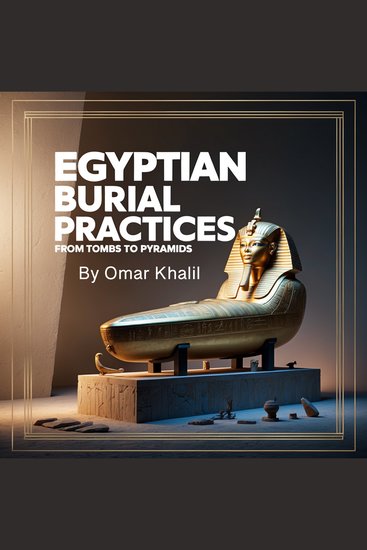
  • Egyptian Burial Practices - From Tombs to Pyramids - cover

    Egyptian Burial Practices - From...

    Omar Khalil

    • 0
    • 0
    • 0
    The burial practices of ancient Egypt evolved significantly over millennia, reflecting changes in religious beliefs, social structures, and technological advancements. These practices were rooted in the belief in an afterlife, where the preservation of the body and the provision of necessary items were vital. From simple pit burials to grand pyramid constructions, the evolution of Egyptian burial customs offers valuable insights into the cultural and spiritual life of the civilization. 
    In the Predynastic period, burial customs were relatively simple, consisting of shallow pits in the desert sand. The dry, arid environment naturally mummified the bodies, preserving them for millennia. These early graves often contained personal belongings, such as pottery, jewelry, and tools, indicating a belief in a life beyond death. The positioning of the bodies, typically in a fetal position, also suggests a symbolic return to the womb, possibly signifying rebirth. 
    As Egypt unified and entered the Early Dynastic period, burial practices became more elaborate. The development of mastabas marked a significant shift in tomb architecture. These rectangular structures, made of mudbrick or stone, featured underground burial chambers and an above-ground offering chapel. Mastabas were primarily used by the elite, symbolizing their status and wealth. The inclusion of false doors and serdab chambers, which housed statues of the deceased, reflected the belief that the soul could interact with the living through offerings and rituals.
    Ver libro