Join us on a literary world trip!
Add this book to bookshelf
Grey
Write a new comment Default profile 50px
Grey
Subscribe to read the full book or read the first pages for free!
All characters reduced
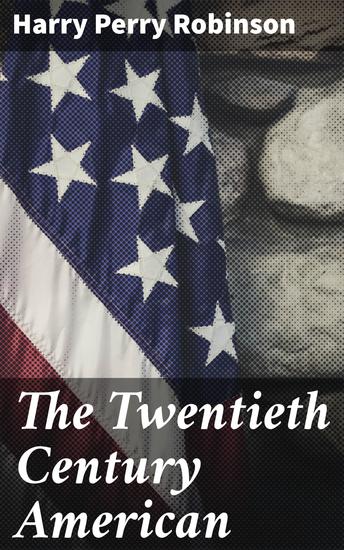
The Twentieth Century American - Being a Comparative Study of the Peoples of the Two Great Anglo-Saxon Nations - cover

The Twentieth Century American - Being a Comparative Study of the Peoples of the Two Great Anglo-Saxon Nations

Harry Perry Robinson

Publisher: Good Press

  • 0
  • 0
  • 0

Summary

In "The Twentieth Century American," Harry Perry Robinson embarks on an intricate exploration of the sociopolitical landscape of America throughout the 1900s. Through a deft combination of vivid narrative and incisive analysis, Robinson intertwines personal anecdotes with broader historical events, crafting a compelling tapestry that captures the essence of American identity. The book stands out for its unique literary style, which melds elements of memoir and scholarly research, providing readers with both an intimate and academically substantial perspective on the tumultuous century marked by wars, civil rights movements, and cultural revolutions. Harry Perry Robinson, a keen observer of American culture, draws from his own experiences as a historian and educator to inform his writing. His deep-seated commitment to understanding the complexities of American society is evident in this work, which reflects both his personal journey and the collective narrative of a nation. Robinson's background in sociology and history enables him to analyze the decade's significant events with both clarity and empathy. This book is a must-read for anyone seeking to comprehend the multifaceted nature of the American experience in the twentieth century. Robinson'Äôs articulate prose not only engages the reader but also invites critical reflection on the past, making it an essential contribution to American literature and historiography.
Available since: 10/04/2023.
Print length: 336 pages.

Other books that might interest you

  • How to Win Friends and Influence People: Book summary & analysis - cover

    How to Win Friends and Influence...

    Briefly Summaries

    • 0
    • 0
    • 0
    This is a concise summary and analysis of How to Win Friends and Influence People, by Dale Carnegie. It is not the original book and is not affiliated with or endorsed by Dale Carnegie. Ideal those seeking a quick and insightful overview
     
    Dive into the transformative principles of "How to Win Friends and Influence People", a timeless guide that has empowered millions to unlock their full potential in personal and professional relationships. This audiobook takes you on a dynamic journey through practical techniques to handle people effectively, make lasting connections, win others to your way of thinking, and cultivate impactful leadership skills.
     
    Through engaging chapters filled with actionable insights and real-world examples, you'll discover how to foster trust, enhance communication, and inspire others with empathy and authenticity. Perfect for anyone eager to improve their productivity, influence, and emotional intelligence, this audiobook offers a powerful roadmap to meaningful and successful human interactions.
     
    With its motivational tone and fluid narration, this audiobook is designed to resonate deeply with listeners, making it an invaluable resource for professionals, leaders, and anyone seeking self-improvement. Get ready to transform your approach to relationships and achieve extraordinary results!
    Show book
  • The Shocking Truth about Virtual Reality - cover

    The Shocking Truth about Virtual...

    Zoey Fraisers

    • 0
    • 0
    • 0
    Virtual reality (VR) has long been a concept of science fiction, but today, it is a rapidly evolving technology shaping industries, entertainment, and even human interactions. From its early beginnings as a theoretical concept to the sophisticated headsets and immersive environments of today, VR has transformed from a novelty into a powerful tool that influences the way people work, learn, and socialize. While the promise of virtual worlds seems limitless, there are also significant concerns about its long-term effects on society, privacy, and even human psychology.  
    The origins of VR date back further than most people realize. The idea of creating artificial environments that simulate reality can be traced back to the early 20th century. Flight simulators in the 1920s provided the first taste of what would later become VR training programs. In the 1960s, innovators such as Ivan Sutherland and Morton Heilig developed early prototypes of head-mounted displays and immersive cinema experiences. However, technological limitations prevented these early experiments from reaching mainstream adoption. It wasn’t until the late 20th and early 21st centuries that computing power, graphics capabilities, and internet connectivity made VR a viable and widely accessible technology.  
    Breakthroughs in VR hardware and software have enabled increasingly realistic and engaging experiences. High-resolution headsets, motion tracking, and artificial intelligence now allow users to step into digital environments that respond dynamically to their movements and actions. Industries ranging from gaming and entertainment to healthcare and education have embraced VR as a revolutionary tool. Doctors use VR to simulate surgeries, businesses conduct remote meetings in virtual spaces, and educators transport students to historical landmarks without ever leaving the classroom.
    Show book
  • The Forbidden Knowledge of the Book of Enoch - The Watchers Nephilim Fallen Angels and the End of the World - cover

    The Forbidden Knowledge of the...

    Harold Roth

    • 0
    • 0
    • 0
    “Lore of the Watcher angels is an important and often overlooked part of Jewish and Christian traditions that exerts a strong influence on Western magic and occultism. Harold Roth tackles complicated texts like the books of Enoch and Jubilees alongside traditions like Merkavah mysticism and Christian demonology and, in plain language, gives the clearest and best examination of the Watchers and the Nephilim that I have come across yet.” —Jason Miller, author of Consorting with Spirits and other books   The Book of Enoch has captured and commanded interest for the past two thousand years. Sometimes part of religious canon and doctrine, and sometimes outright banned, the Book of Enoch is more popular today than ever. Still many questions remain. Who was Enoch? Who—or what—were the Watchers, and what knowledge did they bring? What became of their wives and their children, the rapacious half-man, half-angel giants, the Nephilim?   From Renaissance magic of Dr. John Dee and early Christian apocalyptic texts, to contemporary conspiracy theories and modern magical angelology, the Book of Enoch has been influential in many spiritual and religious traditions. What has been missing from the various approaches to the Book of Enoch are any real attempts to find not only what is at the center of these stories but also their connections to magic. The Forbidden Knowledge of the Book of Enoch identifies and elucidates those connections.
    Show book
  • The Plot Module - The Ultimate Chapter-by-Chapter Guide on How to Write a Novel Outline - cover

    The Plot Module - The Ultimate...

    Jason Hamilton

    • 0
    • 0
    • 0
    Looking for an easy, step-by-step solution to plot your novel from start to finish? 
    Jason Hamilton—overnight YouTube success and practicing fantasy author—introduces The Plot Module, a groundbreaking guide that simplifies novel plotting like never before. This comprehensive 40-chapter roadmap tells you exactly what to include in each chapter, bridging the gaps most story structure books leave behind. 
    Discover:A Detailed 40-Chapter Blueprint: Know precisely what happens in every chapter.Adaptable Methods for Any Novel Length: Customize the module for shorter or longer works.Seamless Integration of Subplots and Viewpoints: Effortlessly manage multiple narratives.Proven Techniques from an Active Author: Apply strategies Jason uses in his own writing.Harnessing Technology for Writing: Enhance creativity and efficiency with modern tools. 
    With clear instructions and practical advice, The Plot Module empowers you to turn your ideas into a compelling, well-structured novel without the guesswork. Say goodbye to plot struggles and hello to a clear path forward. 
    Join writers who have unlocked their creative potential with The Plot Module. Now it's your turn to bring your story to life.
    Show book
  • Misogynies - cover

    Misogynies

    Joan Smith

    • 0
    • 1
    • 0
    Misogynies is one of the most celebrated feminist texts by a British author. First published in 1989, it created shock waves with its analyses of history, literature and popular culture. Joan Smith drew on her own experience as one of the few women reporting the Yorkshire Ripper murders and looked at novels, slasher movies, Page Three and Princess Diana, teasing out the attitudes that brought them together. A feminist classic, Smith's exploration of fear and hatred of women resonates to this day.
    Show book
  • Winning French Minds - Radio Propaganda in Occupied France 1940–42 - cover

    Winning French Minds - Radio...

    Denis Courtois

    • 0
    • 0
    • 0
    "...every chapter of Winning French Minds delivered something new, not only because French language radio being a less-frequented area of study, but also due to the author's ability to tie these radio efforts to events surrounding the French people and events unfolding on the European geopolitical stage." — World War II DatabaseWorld War II was very much a war of the radios. A relatively new technology, radio as a tool was exploited by all of the participants of the war to win the hearts and minds of the people and to steer public opinion.  The period 1940 to 1942 was the most volatile of the war, with the Nazis capturing large parts of western Europe and dominating on the Eastern front. At this time France was separated into two nominally independent zones, and public opinion could easily have been swayed in favor of the New German Order. This could have had potentially disastrous consequences for any future Allied attempt to liberate Europe, and so the battle for French minds was launched using the new technology of radio.  This narrative of that campaign develops chronologically through a series of topics including major military incidents, youth, food, family, psychological warfare, sports and work, as presented by different radio stations – in particular Radiodiffusion, controlled by Vichy France; Radio Paris, controlled by the Nazis; and the BBC – offering a systematic comparative analysis of radio propaganda messages and building a vivid picture of the evolution of broadcasts in the context of the complex political and social impact of the war on the French population.  Using original primary sources from archives in Britain and France, broadcast recordings, radio magazines, and interviews conducted by British Intelligence with those arriving from France during the war, this is a fascinating and unique insight into wartime radio propaganda from 1940 to 1942.
    Show book