Junte-se a nós em uma viagem ao mundo dos livros!
Adicionar este livro à prateleira
Grey
Deixe um novo comentário Default profile 50px
Grey
Assine para ler o livro completo ou leia as primeiras páginas de graça!
All characters reduced
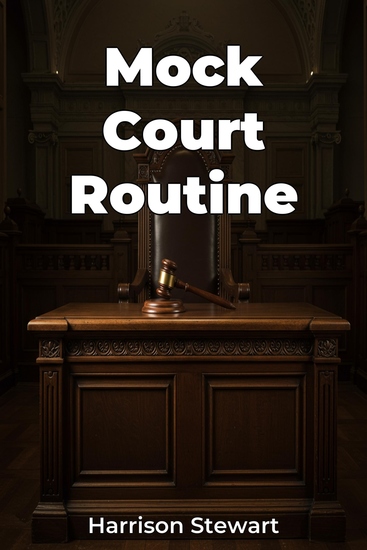
Mock Court Routine - cover
LER

Mock Court Routine

Harrison Stewart

Tradutor A AI

Editora: Publifye

  • 0
  • 0
  • 0

Sinopse

Mock Court Routine offers a deep dive into the world of mock court exercises, emphasizing their crucial role in legal education for students in legal studies and political science. The book explores how these simulations not only help translate legal theory into practice, but also cultivate essential courtroom skills and courtroom confidence.

 
It traces the evolution of mock trials, highlighting their importance in fostering critical thinking and public speaking abilities. One key insight is that mock court provides a safe space for students to learn from mistakes, bridging the gap between academic knowledge and real-world application.

 
The book progresses logically, starting with fundamental concepts and different types of mock court exercises. Chapters are dedicated to developing skills like case analysis, legal writing, and oral advocacy. It uniquely addresses common pitfalls in mock court design, offering practical solutions for creating engaging and pedagogically sound experiences.

 
The approach is academic yet accessible, blending rigorous analysis with practical advice. This textbook is particularly valuable for law students, pre-law students, legal educators, and mock trial coaches. It serves as a comprehensive guide to understanding, implementing, and improving mock court exercises, ultimately impacting career readiness and professional development within the justice system.
Disponível desde: 07/04/2025.
Comprimento de impressão: 95 páginas.
Outros livros que poderiam interessá-lo

  • Herbal Antivirals - Natural Remedies for Emerging & Resistant Viral Infections - cover

    Herbal Antivirals - Natural...

    Stephen Harrod Buhner

    • 0
    • 0
    • 0
    Viruses are smart, mutating and becoming resistant to antiviral pharmaceuticals. Global crises such as COVID-19, SARS, and dengue fever spread more quickly than we can develop medicines to fight them. Herbalist and bestselling author Stephen Harrod Buhner has studied the antiviral properties of plants for many years. In this comprehensive guide, he profiles the plants that have proven most effective in fighting viral infections and provides in-depth instructions for preparing and using formulations to address the most common infections and strengthen immunity, safely and naturally. This updated second edition includes an expanded guide to COVID-19, including a review of the most up-to-date medical research and the plant medicines that have been found to be most potent in preventing infection, lessening the impact of the virus on the body, and addressing longer-term effects and co-infections.
    Ver livro
  • The Student Loaners Are You A Winner Or A Loser? - cover

    The Student Loaners Are You A...

    Charles Adam Chadwick Jr.

    • 0
    • 0
    • 0
    Life is often compared to a game—and in The Student Loaners: Are You A Winner or a Loser?, Charles A. Chadwick Jr. proves it. Drawing powerful parallels between basketball and college, Charles uses his passion for the game to coach students through one of life’s biggest financial challenges: student loan debt. 
    From the first quarter of freshman year to the final buzzer of repayment, Charles equips listeners with the tools they need to manage, reduce, and ultimately conquer their debt. This audiobook breaks down key strategies for playing offense (aggressive repayment) and defense (smart saving), helping you stay ahead of the game and take control of your financial future. 
    You’ll meet the “Student Loaners”—a team made up of every student who ever signed on the dotted line—and discover how to play smarter, not harder, when it comes to college finances. Whether you’re still in school or years into repayment, this is your playbook to turn student loan struggles into slam-dunk successes.
    Ver livro
  • Defiant Children - cover

    Defiant Children

    Brittany Forrester

    • 0
    • 0
    • 0
    Learning to communicate and manage frustration is part of growing up. But some children don’t master those skills. Suppose their frequent angry outbursts and aggressive behaviors interfere with family life, making friends, or school performance. In that case, they may have the oppositional defiant disorder (ODD), which, by some estimates, affects up to 16 percent of school-age children. Though no statistics are available for younger children, experts say that most children with ODD show signs of the disorder in the preschool years.Oppositional defiant disorder describes a pattern of angry/irritable mood, argumentative/defiant behavior, and/or spitefulness that lasts at least six months in multiple settings. It occurs almost daily in children younger than 5 and at least once a week in older children. (By 6 or 7, most children have learned to express anger in productive, socially acceptable ways.)Examples of anger and irritable mood include frequent loss of temper and being easily annoyed or resentful. Argumentative and defiant behavior includes refusing to obey rules, continually challenging authority, being deliberately annoying to others, and/or blaming others for mistakes or bad behavior.He says that many children with ODD have other mental health challenges, such as anxiety, mood disorders, and language and learning disorders. Trauma, parenting, styles, and other environmental issues may also contribute.As with many mental health conditions, ODD occurs on a continuum. Children with mild ODD may show symptoms only at home or only at school. Moderate ODD may be the diagnosis when a child’s ODD behaviors happen in two settings. ODD is classified as severe when the acting out is seen in three or more locations.
    Ver livro
  • HowExpert Guide to Becoming a Math Teacher - 101 Tips to Discover How to Become a Math Teacher Teach Mathematics and Help Students Learn Math - cover

    HowExpert Guide to Becoming a...

    HowExpert, Jennifer Schneid

    • 0
    • 0
    • 0
    If you want to discover how to become a math teacher, teach mathematics, and help students learn math, then checkout HowExpert Guide to Becoming a Math Teacher. 
    Whether you’re a math tutor, a newly minted math teacher about to start your first job, or a seasoned educator who has already been in the classroom a while, those who desire to become effective mathematics educators would benefit from this guide. Even teachers of other disciplines could learn some new information and techniques. With helpful tips and tricks from a math educator who taught in a community college for seventeen years and tutored math for over twenty years to students from kindergarten up to college undergraduate level, you will gain new knowledge to help you reach your students better, get them to be more cooperative, and make your job easier and more fun! You will learn some new information and techniques that will help you engage your students better and simplify your own tasks so that you have more time for them and your own life. 
    HowExpert Guide to Becoming a Math Teacher encourages you to get to know your students, your resources, your standards, and your technology before you ever design your lessons. It helps you to understand what topics need further research and what is important to prioritize. It also provides many helpful websites and strategies to use right away to resolve problems that may arise or save you time by providing something helpful for you to use. It is not all-inclusive, but it gives you a great place to start to get your teaching career off the ground or improve what it already is. 
    Check out HowExpert Guide to Becoming a Math Teacher to discover how to become a math teacher, teach mathematics, and help students learn math. 
    HowExpert publishes quick how to guides on all topics from A to Z by everyday experts.
    Ver livro
  • Lawfare - Law as a Weapon of War - cover

    Lawfare - Law as a Weapon of War

    Orde F. Kittrie

    • 0
    • 0
    • 0
    In this book, author Orde Kittrie draws on his experiences as a lawfare practitioner, US State Department attorney, and international law scholar in analyzing the theory and practice of lawfare. Kittrie explains how factors including the increased reach of international laws and tribunals and the rise of economic globalization and information technology have fueled lawfare's increasing power and prevalence. The book includes case studies of recent offensive and defensive lawfare by the United States, China, all sides of the Israeli-Palestinian conflict, and several non-governmental organizations and individuals. Kittrie asserts that much of the United States' most effective and creative lawfare today is being waged by private sector or other non-governmental attorneys. He analyzes why this is the case, and describes how such attorneys' expertise and experience can contribute even more to US national security. Kittrie also explains that lawfare, deployed more systematically and adeptly by the US government, could likely reduce US and foreign casualties, and save US taxpayer dollars, by supplementing or replacing the use of armed force as a tool for achieving some significant US national security objectives. Understanding this alternative to armed force has never been more important.
    Ver livro
  • Agency and Cognitive Development - cover

    Agency and Cognitive Development

    Michael Tomasello

    • 0
    • 0
    • 0
    Children of different ages live in different worlds. This is partly due to learning: as children learn more and more about the world they experience it in different ways. But learning cannot be the whole story or else children could learn anything at any age—which they cannot. 


    Michael Tomasello argues that children of different ages live and learn in different worlds because their capacities to cognitively represent and operate on their experience change in significant ways over the first years of life. These capacities change because they are elements in a maturing cognitive architecture evolved for agentive decision making and action, including in shared agencies in which individuals must mentally coordinate with others. The developmental proposal is that from birth infants are goal-directed agents who cognitively represent and learn about actualities; at 9-12 months toddlers become intentional (and joint) agents who also imaginatively and perspectively represent and learn about possibilities; and at 3-4 years children become metacognitive (and collective) agents who also metacognitively represent and learn about objective/normative necessities. These developing agentive architectures—originally evolved in humans' evolutionary ancestors for particular types of decision making and action—help to explain why children learn what they do when they do.
    Ver livro