Junte-se a nós em uma viagem ao mundo dos livros!
Adicionar este livro à prateleira
Grey
Deixe um novo comentário Default profile 50px
Grey
Assine para ler o livro completo ou leia as primeiras páginas de graça!
All characters reduced
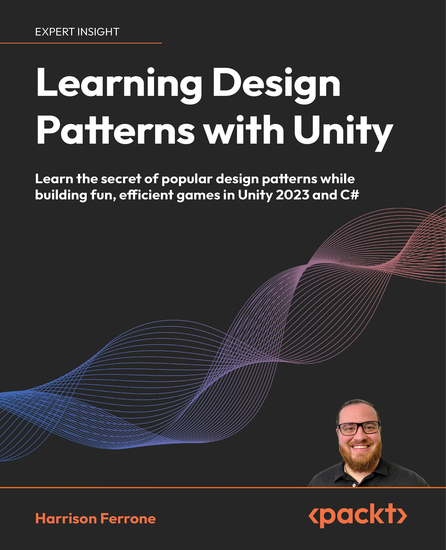
Learning Design Patterns with Unity - Learn the secret of popular design patterns while building fun efficient games in Unity 2023 and C# - cover
LER

Learning Design Patterns with Unity - Learn the secret of popular design patterns while building fun efficient games in Unity 2023 and C#

Harrison Ferrone

Editora: Packt Publishing

  • 0
  • 0
  • 0

Sinopse

Struggling to write maintainable and clean code for your Unity games? Look no further! Learning Design Patterns with Unity empowers you to harness the fullest potential of popular design patterns while building exciting Unity projects. Through hands-on game development, you'll master creational patterns like Prototype to efficiently spawn enemies and delve into behavioral patterns like Observer to create reactive game mechanics. As you progress, you'll also identify the negative impacts of bad architectural decisions and understand how to overcome them with simple but effective practices. 
 
By the end of this Unity 2023 book, the way you develop Unity games will change. You'll emerge not just as a more skilled Unity developer, but as a well-rounded software engineer equipped with industry-leading design patterns.
Disponível desde: 31/05/2024.
Comprimento de impressão: 676 páginas.


Outros livros que poderiam interessá-lo

  • The Illusionist Brain - The Neuroscience of Magic - cover

    The Illusionist Brain - The...

    Jordi Cami, Luis M. Martinez

    • 0
    • 0
    • 0
    How do magicians make us see the impossible? The Illusionist Brain takes you on an unforgettable journey through the inner workings of the human mind, revealing how magicians achieve their spectacular and seemingly impossible effects by interfering with your cognitive processes. Along the way, this lively and informative book provides a guided tour of modern neuroscience, using magic as a lens for understanding the unconscious and automatic functioning of our brains. 


    We construct reality from the information stored in our memories and received through our senses, and our brains are remarkably adept at tricking us into believing that our experience is continuous. In fact, our minds create our perception of reality by elaborating meanings and continuities from incomplete information, and while this strategy carries clear benefits for survival, it comes with blind spots that magicians know how to exploit. Jordi Camí and Luis Martínez explore the many different ways illusionists manipulate our attention and take advantage of our individual predispositions and fragile memories. 


    The Illusionist Brain draws on the latest findings in neuroscience to explain how magic deceives us, surprises us, and amazes us, and demonstrates how illusionists skillfully "hack" our brains to alter how we perceive things and influence what we imagine.
    Ver livro
  • The Internet Con - How to Seize the Means of Computation - cover

    The Internet Con - How to Seize...

    Cory Doctorow

    • 0
    • 0
    • 0
    When the tech platforms promised a future of "connection," they were lying. They said their "walled gardens" would keep us safe, but those were prison walls. 
    The platforms locked us into their systems and made us easy pickings, ripe for extaction. Twitter, Facebook and other Big Tech platforms hard to leave by design. They hold hostage the people we love, the communities that matter to us, the audiences and customers we rely on. The impossibility of staying connected to these people after you delete your account has nothing to do with technological limitations: it's a business strategy in service to commodifying your personal life and relationships. 
    We can - we must - dismantle the tech platforms. In The Internet Con, Cory Doctorow explains how to seize the means of computation, by forcing Silicon Valley to do the thing it fears most: interoperate. Interoperability will tear down the walls between technologies, allowing users leave platforms, remix their media, and reconfigure their devices without corporate permission. 
    Interoperability is the only route to the rapid and enduring annihilation of the platforms. The Internet Con is the disassembly manual we need to take back our internet.
    Ver livro
  • Information Technology - Essentials and Management of Information Systems - cover

    Information Technology -...

    Phil Gilberts

    • 0
    • 0
    • 0
    Information Technology (IT) refers to the use of computers, software, and networks to manage, process, store, and communicate information. It encompasses a broad range of activities and applications, including hardware and software development, network design and management, data storage and analysis, and cybersecurity. 
      
    At the core of IT are several key components. Hardware consists of the physical components of computers and related devices, such as servers, desktops, laptops, smartphones, and networking equipment like routers and switches. Software refers to the programs and applications that run on this hardware, which can be categorized into system software, like operating systems, and application software, like word processors and database management systems. Networks are systems that connect computers and other devices to share resources and information, including local area networks (LANs), wide area networks (WANs), and the internet. Data management involves the processes and technologies used to collect, store, and analyze data, encompassing databases, data warehouses, and big data analytics. Cybersecurity is the practice of protecting IT systems and data from cyber threats through measures like firewalls, encryption, and intrusion detection systems. Additionally, IT services support the use and maintenance of IT systems through technical support, IT consulting, and managed services.
    Ver livro
  • Cosmos: Book Summary & Analysis - cover

    Cosmos: Book Summary & Analysis

    Briefly Summaries

    • 0
    • 0
    • 0
    This is a concise summary and analysis of Cosmos, by Carl Sagan. It is not the original book and is not affiliated with or endorsed by Carl Sagan. Ideal for those seeking a quick and insightful overview.
     
    An awe-inspiring journey through space and time, this book explores the vastness of the universe and humanity's place within it. Blending science, history, and philosophy, it traces the evolution of life, the mysteries of the cosmos, and the power of scientific inquiry. With poetic prose and profound insights, it invites readers to contemplate the grandeur of the universe and the responsibility we hold as stewards of our fragile planet.
    Ver livro
  • Malaria is spread by mosquitos? - cover

    Malaria is spread by mosquitos?

    Ulick Stafford

    • 0
    • 0
    • 0
    We all know that malaria is an infectious disease spread by mosquitos. Female Anopheles mosquitos spread the infection, a microorganism called a plasmodium, when taking a blood meal. But as the quotation often attributed to Mark Twain says “What gets us into trouble is not what we don’t know. It’s what we know for sure that just ain’t so”. 
    Malaria remains a serious illness in many parts of the world, blamed for 600,000 deaths per year. In this book Ulick Stafford investigates evidence about the mosquito-plasmodium hypothesis for its transmission and other potential causes or contributory factors. He looks at the early history of the illness. He reports on the early research of Laveran, Ross and Grassi who developed the accepted transmission story. The potential collateral damage caused by current treatment and prevention programmes are discussed. The contributory  effects of other factors, in particular malnutrition are introduced.
    Ver livro
  • Pytorch - Building AI Models with Ease and Flexibility - cover

    Pytorch - Building AI Models...

    James Henry

    • 0
    • 0
    • 0
    Unlock the power of PyTorch, one of the most dynamic and flexible deep learning frameworks in the world of artificial intelligence. PyTorch: Building AI Models with Ease and Flexibility is a comprehensive guide that takes readers on a journey from the fundamentals of PyTorch to advanced applications in AI research and industry. 
    Designed for AI enthusiasts, researchers, and professionals alike, this book offers a hands-on, practical approach to learning PyTorch. Starting with the basics of tensor operations and automatic differentiation, readers will quickly grasp how to build, train, and optimize deep learning models. Each chapter introduces progressively complex concepts, including convolutional neural networks (CNNs), recurrent neural networks (RNNs), and advanced techniques like transfer learning, GANs, and reinforcement learning. 
    Key highlights include:Step-by-step tutorials for building neural networks from scratchIn-depth explanations of PyTorch's dynamic computation graph and AutogradAdvanced topics in model deployment, distributed training, and reinforcement learningReal-world applications in NLP, computer vision, and AI researchBest practices for optimizing PyTorch models and enhancing performance 
    PyTorch: Building AI Models with Ease and Flexibility is not just about learning a framework—it's about understanding how to apply PyTorch effectively to solve complex problems, innovate in AI research, and take your machine learning projects to the next level. Whether you are a beginner or an experienced AI practitioner, this book is your essential companion in mastering PyTorch and building cutting-edge AI models.
    Ver livro