Begleiten Sie uns auf eine literarische Weltreise!
Buch zum Bücherregal hinzufügen
Grey
Einen neuen Kommentar schreiben Default profile 50px
Grey
Jetzt das ganze Buch im Abo oder die ersten Seiten gratis lesen!
All characters reduced
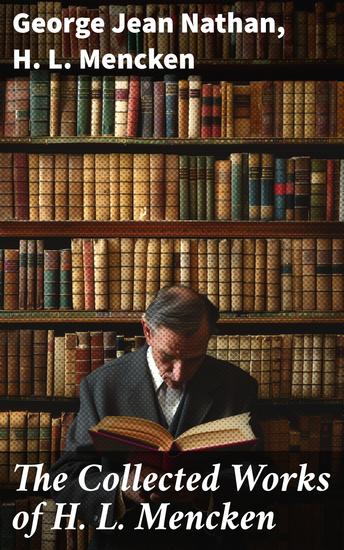
The Collected Works of H L Mencken - The American Language The American Credo The Philosophy Of Friedrich Nietzsche - cover

The Collected Works of H L Mencken - The American Language The American Credo The Philosophy Of Friedrich Nietzsche

H. L. Mencken, George Jean Nathan

Verlag: Good Press

  • 0
  • 0
  • 0

Beschreibung

The Collected Works of H. L. Mencken offers a sweeping exploration of the early 20th-century American landscape through the incisive and often provocative lens of its renowned authors, George Jean Nathan and H. L. Mencken. The anthology covers a wide array of themes, from cultural criticism and socio-political discourse to literary analysis and philosophy, capturing the complex zeitgeist of their time. Notably, the works traverse several literary styles, oscillating between sharp wit and stern critique, inviting readers to not only reflect but also engage critically with the subjects addressed. This collection, thus, becomes quintessential in understanding the transformative nature of this time, highlighted by standout essays that continue to resonate today. The included works feature a diverse array of perspectives, unified by the dynamic voices of Mencken and Nathan, whose works are emblematic of the Cultural Modernism movement. Known for his forthright critiques, Mencken's works are complemented by Nathan's illuminating insights into theatre and media. Together, they capture the uncertainties and ideologies that gripped their era, creating a rich dialogue within their essays that challenges contemporary readers to reassess the cultural and ideological foundations of their own times. Recommended for anyone seeking to delve into early Modernist critique, this anthology presents a unique opportunity to experience the era's cultural and ideological ferment through a medley of authoritative voices. It invites readers to engage with its rich tapestry of essays, thus gaining a deeper understanding of the socio-cultural shifts enabled by Mencken and Nathan's articulate dissections. Whether for academic purposes or intellectual curiosity, The Collected Works promises a rewarding confrontation with history through the dynamic exchanges of its eminent authors.
Verfügbar seit: 20.12.2023.
Drucklänge: 1368 Seiten.

Weitere Bücher, die Sie mögen werden

  • Betty Brown the St Giles Orange Girl - From their pens to your ears genius in every story - cover

    Betty Brown the St Giles Orange...

    Hannah More

    • 0
    • 0
    • 0
    Hannah More was born on February 2nd, 1745 at Fishponds in the parish of Stapleton, near Bristol. She was the fourth of five daughters. 
    The City of Bristol, at that time, was a centre for slave-trading and Hannah would, over time, become one of its staunchest critics.  
    She was keen to learn, possessed a sharp intellect and was assiduous in studying.  Hannah first wrote in 1762 with The Search after Happiness (by the mid-1780s some 10,000 copies had been sold). 
    In 1767 Hannah became engaged to William Turner.  After six years, with no wedding in sight, the engagement was broken off.  Turner then bestowed upon her an annual annuity of £200.  This was enough to meet her needs and set her free to pursue a literary career.   
    Her first play, The Inflexible Captive, was staged at Bath in 1775. The famous David Garrick himself produced her next play, Percy, in 1777 as well as writing both the Prologue and Epilogue for it.  It was a great success when performed at Covent Garden in December of that year.  
    Hannah turned to religious writing with Sacred Dramas in 1782; it rapidly ran through nineteen editions. These and the poems Bas-Bleu and Florio (1786) mark her gradual transition to a more serious and considered view of life. 
    Hannah contributed much to the newly-founded Abolition Society including, in February 1788, her publication of Slavery, a Poem recognised as one of the most important of the abolition period.   
    Her work now became more evangelical.  In the 1790s she wrote several Cheap Repository Tracts which covered moral, religious and political topics and were both for sale or distributed to literate poor people.  The most famous is, perhaps, The Shepherd of Salisbury Plain, describing a family of incredible frugality and contentment. Two million copies of these were circulated, in one year. 
    In 1789, she purchased a small house at Cowslip Green in Somerset. She was instrumental in setting up twelve schools in the area by 1800. 
    She continued to oppose slavery throughout her life, but at the time of the Abolition Bill of 1807, her health did not permit her to take as active a role in the movement as she had done in the late 1780s, although she maintained a correspondence with Wilberforce and others.  
    In July 1833, the Bill to abolish slavery throughout the British Empire passed in the House of Commons, followed by the House of Lords on August 1st. 
    Hannah More died on September 7th, 1833.
    Zum Buch
  • Steppenwolf - cover

    Steppenwolf

    Herman Hesse

    • 0
    • 0
    • 0
    Steppenwolf by Hermann Hesse is a profound exploration of the human psyche, delving into themes of identity, duality, and existential crisis. The novel follows Harry Haller, a solitary and introspective man who sees himself as divided between his human side and his wild, wolf-like instincts. As he navigates a surreal and mystical journey, Haller confronts the contradictions within himself and the societal norms that alienate him. Blending philosophy, spirituality, and psychological depth, Steppenwolf is a timeless masterpiece that challenges readers to reflect on their own inner struggles and the search for meaning in an ever-changing world.
    Zum Buch
  • Gabriel-Ernest - From their pens to your ears genius in every story - cover

    Gabriel-Ernest - From their pens...

    Saki Saki

    • 0
    • 0
    • 0
    Hector Hugh Munro, more familiarly known by his pen-name ‘Saki’ was born in what was then Akyab in British Burma on 18th December 1870. His father was an Inspector General for the Indian Imperial Police, and his mother the daughter of a Rear Admiral. 
    When he was 2 his mother died and he and his siblings were sent back to England to be raised by their grandmother and paternal maiden aunts in a strict, puritanical household near Barnstaple, Devon. Educated by governesses Saki used many of these women as character models for his later writing. 
    At 17 his father retried and returned to England and then embarked on a series of European travels with Saki and his siblings. 
    After a short stint working in Burma with the Indian Imperial Police Saki decided to move to London to make a living as a writer. Initially he wrote as a journalist for a number of newspapers and magazines before attempting an historical study, ‘The Rise of the Russian Empire’, whose real value lay in directing him to writing short stories instead, the first of which, ‘Dogged’, he published in 1899. 
    From here it was a short stab of the pen to writing political satire before in 1902 he became the foreign correspondent for The Morning Post, first in the Balkans, then Russia, Paris and back to London in 1908, where 'the agreeable life of a man of letters with a brilliant reputation awaited him.'  
    Collections of his short stories full of witty, mischievous and often macabre stories that satirized Edwardian society and two novels now appeared in the years up to the Great War.  At its’ outbreak he was 43 but managed to join as an ordinary trooper. More than once he returned to the battlefield when officially too sick or injured.  
    On 14th November 1916 Hector Hugh Munro was sheltering in crater during the Battle of the Ancre, when he was shot and killed by a German sniper. According to several sources, his last words were "Put that bloody cigarette out!"
    Zum Buch
  • The Amazing Life of Betty White - 99 Years in the Making - cover

    The Amazing Life of Betty White...

    Newbury Publishing

    • 0
    • 0
    • 0
    Betty White was a widely recognized, hugely popular, American celebrity - best known as a sitcom actress and comedian, but also known for her work as an angling actress, game show contestant and host, author, and as an advocate for animal welfare.  
    Betty White was born on January 17, 1922, and was swiftly approaching her much anticipated 100th birthday celebration, when she passed away on December 31, 2021. White was one of America’s most recognized and beloved public figures; and she remained an active and impactful part of the entertainment community for over eight decades. 
    In 2011, a Reuters poll found Betty White to be the “most trusted celebrity”, and the “most popular” among Americans, beating out icons such as Tom Hanks and Denzel Washington.
    Zum Buch
  • Jean-Jacques Rousseau - The Social Contract and Natural Man - cover

    Jean-Jacques Rousseau - The...

    Hector Davidson

    • 0
    • 0
    • 0
    Jean-Jacques Rousseau, one of the most influential philosophers of the 18th century, reshaped the landscape of political and social theory. His ideas, particularly those outlined in The Social Contract and Discourse on the Origin and Basis of Inequality Among Men, have had a profound impact on modern thought, influencing the French Revolution, the development of democratic ideals, and the evolution of social theory. Rousseau's philosophy is a reflection of his deep concern with the relationship between individuals and society, the nature of human freedom, and the consequences of civilization. 
    At the heart of Rousseau’s thought is his concept of the "state of nature," a condition in which humans existed before the corrupting influence of society. In this natural state, Rousseau argued, humans were free, equal, and solitary. Their basic needs were limited, and they acted primarily on instinct, guided by compassion and self-preservation. However, with the rise of private property, inequality began to emerge, leading to the social contract—a mechanism through which individuals could unite to form a collective body politic, agreeing to follow the “general will” for the common good. This social contract was Rousseau's answer to the problem of how to create a just society that respects both individual liberty and collective harmony. 
    Rousseau rejected the view that human beings are inherently selfish, as suggested by other philosophers like Hobbes. Instead, he believed that while civilization introduced inequality and competition, it also created the potential for true human freedom, which could only be realized in a political community that was based on the collective will of its people. Rousseau’s idea of the general will is central to his political theory. The general will is not simply the sum of individual desires but represents the collective interests that transcend personal ambitions, aiming for the common good.
    Zum Buch
  • My Father’s Story - The Murder of the Best Man I’ve Ever Known - cover

    My Father’s Story - The Murder...

    Eric Johnson

    • 0
    • 0
    • 0
    Discover the captivating story within the pages of "My Father's Story: The Murder of the Best Man I've Ever Known" by Eric Johnson. The story unfolds when Eric delves into the life and tragic death of his father, Bill Johnson, who was brutally murdered by his ex-girlfriend in his own home, taking not only his life but also that of his beloved dog. In Eric's account of the story, you will witness first hand how profoundly an act of violence can change lives forever. Eric entangles his readers in a captivating journey toward truth and justice with surreal court hearings, fit for a horror movie, that puts his dad’s ex-girlfriend's mental health at the epicenter of her defense. As you flip through the pages, you'll be enthralled by each distressing twist and turn. Embark on this inside look into loss, heartache, and a brutal quest for truth that lies within "My Father's Story: The Murder of the Best Man I've Ever Known."
    Zum Buch