Join us on a literary world trip!
Add this book to bookshelf
Grey
Write a new comment Default profile 50px
Grey
Subscribe to read the full book or read the first pages for free!
All characters reduced
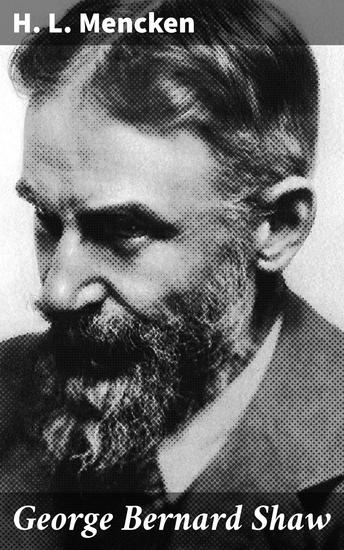
George Bernard Shaw - His Plays - cover

George Bernard Shaw - His Plays

H. L. Mencken

Publisher: Good Press

  • 0
  • 0
  • 0

Summary

In "George Bernard Shaw," H. L. Mencken delivers a penetrating examination of one of the most significant playwrights and social critics of the 20th century. Mencken employs a distinctive blend of incisive critique and admiration, employing a witty and provocative literary style that mirrors Shaw's own sharpness. This biographical study contextualizes Shaw within the broader tapestry of modern drama, highlighting his role as an advocate for social reform and his innovative contributions to the theatrical landscape. An exploration of Shaw's major works and philosophical underpinnings reveals the interplay between his art and his fervent humanism, making this work a fundamental analysis for both scholars and enthusiasts alike. H. L. Mencken, a prominent figure in American literature and journalism, is known for his rigorous intellect and unyielding criticism of societal norms. His admiration for Shaw'Äôs intellect and artistry stemmed from a shared disdain for mediocrity, as well as his experiences in the tumultuous landscape of early 20th-century America. Mencken's unique perspective as a cultural commentator allows him to draw illuminating parallels between Shaw's works and the societal issues of their time, enriching the reader'Äôs understanding of both men. "George Bernard Shaw" is a must-read for anyone seeking to delve deeper into the mind of a literary giant and the contexts that shaped their work. Mencken'Äôs insightful prose invites readers to reconsider Shaw's influence on modern theater and society, making this book an essential addition to the library of any lover of literature or theater history.
Available since: 08/21/2022.
Print length: 83 pages.

Other books that might interest you

  • The Roman Empire and Byzantine Empire - The History and Legacy of Europe’s Most Important Empire and Its Successor - cover

    The Roman Empire and Byzantine...

    Charles River Editors

    • 0
    • 0
    • 0
    For the people of the ancient Mediterranean and beyond, the city of Rome had been a symbol of power for centuries, and entering the early 5th century CE, the Eternal City hadn’t been taken by an enemy force since the Gauls had done it about 800 years earlier, an unheard of period of tranquility in a world wracked with almost constant warfare. 
    Thus, when the Visigoths, whom the Romans considered uncultured and inferior, took the city of Rome and sacked it in 410, the world was stunned. It made theologians of the newly Christianized empire question God’s plan on Earth, and it encouraged many leading Romans to look east to Constantinople for their future. Indeed, the Western Roman Empire would completely collapse in the late 5th century, less than 70 years after the Visigoths sacked Rome, and just how it went from being a superpower to a poorly led, weak, and vulnerable shadow of its former self has preoccupied historians for centuries. 
    To this day, it remains difficult to trace just when the decline began, but it’s fair to say that the sack of Rome was the result of a number of factors that had been coalescing for many years. In the end, the fall of the Roman Empire was not a tale of cataclysmic events that shattered the sprawling power, but the culmination of centuries of internal dissent and decay, combined with growing external threats that led to gradual decline and eventually to the empire’s final destruction.  
    In terms of geopolitics, perhaps the most seminal event of the Middle Ages was the successful Ottoman siege of Constantinople in 1453. The city had been an imperial capital as far back as the 4th century, when Constantine the Great shifted the power center of the Roman Empire there, effectively establishing two almost equally powerful halves of antiquity’s greatest empire. Constantinople would continue to serve as the capital of the Byzantine Empire even after the Western half of the Roman Empire collapsed.
    Show book
  • The Birmingham Book - Lessons in urban education leadership and policy from the Trojan Horse affair - cover

    The Birmingham Book - Lessons in...

    Colin Diamond CBE

    • 0
    • 0
    • 0
    The Trojan Horse affair sent shock waves across England's education system in 2014. The affair centred around an anonymous letter that contained instructions on how to take over schools with a majority Muslim population by influencing their governing bodies and undermining head teachers. The authenticity of the letter remains hotly disputed, yet its publication generated huge turbulence - not only in Birmingham's schools and communities, but also in both Parliament and the national news.
    The book offers fresh perspectives based on unique access to information from within the city, written by respected educationalists who have worked successfully in Birmingham for many years both during the Trojan Horse era and since. It explains what led to the publication of the letter, its profound consequences for education in Birmingham, and how it influenced events in the city since.
    Crucially the book also opens up an informed discussion around the issues raised during Trojan Horse, such as delivering a well-rounded curriculum suitable for a diverse school community, developing working partnerships in the local area, and boosting the attainment and aspirations of children from disadvantaged backgrounds.
    Colin shares case studies of school improvement in local and national MATs in tough, multicultural urban environments, and how schools worked to develop pupils' social capital. The Birmingham Book reveals how the Trojan Horse affair was handled by the Department for Education as their academies and free schools policies underwent their first major stress tests. Furthermore, the book provides an up-to-date appraisal of the interrelationship between education in England's schools and the cultural and religious practice of the local communities the schools serve - and of the underachievement levels of the different ethnic groups in Birmingham.
    Suitable for teachers, school leaders, governors and policymakers.
    Show book
  • Confident Pluralism - Surviving and Thriving through Deep Difference - cover

    Confident Pluralism - Surviving...

    John D. Inazu

    • 0
    • 0
    • 0
    The United States seems to become more dramatically polarized and divided with each passing month. There are seemingly irresolvable differences in the beliefs, values, and identities of citizens across the country that too often play out in our legal system in clashes on a range of topics such as the tensions between law enforcement and minority communities. How can we possibly argue for civic aspirations like tolerance, humility, and patience in our current moment? 
     
    In Confident Pluralism, John D. Inazu analyzes the current state of the country, orients the contemporary United States within its broader history, and explores the ways that Americans can—and must—strive to live together peaceably despite our deeply engrained differences. Pluralism is one of the founding creeds of the United States—yet America’s society and legal system continues to face deep, unsolved structural problems in dealing with differing cultural anxieties and differing viewpoints. Inazu not only argues that it is possible to cohabitate peacefully in this country, but also lays out realistic guidelines for our society and legal system to achieve the new American dream through civic practices that value toleration over protest, humility over defensiveness, and persuasion over coercion. 
     
    This new edition of Confident Pluralism is an essential clarion call during one of the most troubled times in US history. Inazu argues for institutions that can work to bring people together as well as political institutions that will defend the unprotected. Confident Pluralism offers a refreshing argument for how the legal system can protect peoples’ personal beliefs and differences and provides a path forward to a healthier future of tolerance, humility, and patience.
    Show book
  • Honor Loyalty and Merit - The Culture of the Contemporary Spanish Nobility - cover

    Honor Loyalty and Merit - The...

    Otto Federico von Feigenblatt

    • 0
    • 0
    • 0
    The Spanish nobility continues to be influential in the early 21st century in politics, academia, and the economy. The polarized socio-cultural environment in Spain in the early decades of the millennium is paralleled by an increasingly divisive political discourse and deadlock in terms of governance. Understanding the subcultures of the most influential socio-political groups is important to be able to interpret the political developments. A vast array of studies have been conducted about the rise of the extreme left but there is a dearth of studies dealing with the impact of the traditional nobility in contemporary Spain. The present study presents an emic model of elite culture through the application of a grounded theory approach to texts released by five of the main noble associations in Spain during the last ten years. An inductive approach focuses on the identification of important themes and concepts as expressed and understood by the participants. Traditional noble associations are the focus of the study, in particular, the associations under Royal patronage. The resulting emic model aims to map the mores, norms, and values of a highly visible social group about which there are very few sociological and anthropological studies.
    Show book
  • Wasted Education - How We Fail Our Graduates in Science Technology Engineering and Math - cover

    Wasted Education - How We Fail...

    John D. Skrentny

    • 0
    • 0
    • 0
    An urgent reality check for America’s blinkered fixation on STEM education. 
    We live in an era of STEM obsession. Not only do tech companies dominate American enterprise and economic growth while complaining of STEM shortages, but we also need scientific solutions to impending crises. As a society, we have poured enormous resources—including billions of dollars—into cultivating young minds for well-paid STEM careers. Yet despite it all, we are facing a worker exodus, with as many as 70% of STEM graduates opting out of STEM work. Sociologist John D. Skrentny investigates why, and the answer, he shows, is simple: the failure of STEM jobs. 
    Wasted Education reveals how STEM work drives away bright graduates as a result of “burn and churn” management practices, lack of job security, constant training for a neverending stream of new—and often socially harmful—technologies, and the exclusion of women, people of color, and older workers. Wasted Education shows that if we have any hope of improving the return on our STEM education investments, we have to change the way we’re treating the workers on whom our future depends.
    Show book
  • Pierre Bourdieu - Fieldwork in Culture - cover

    Pierre Bourdieu - Fieldwork in...

    Nicholas Brown, Imre Szeman

    • 0
    • 0
    • 0
    “The wide range of subjects . . . provides a glimpse of the extent to which Bourdieu’s theories of culture have gained widespread currency in the humanities.” —David Eick, SubStance   The work of Pierre Bourdieu, one of the most influential French intellectuals of the twentieth century, has had an enormous impact on research in fields as diverse as aesthetics, education, anthropology, and sociology. Pierre Bourdieu: Fieldwork in Culture is the first collection of essays to focus specifically on the contribution of Bourdieu’s thought to the study of cultural production. Though Bourdieu’s own work has illuminated diverse cultural phenomena, the essays in this volume extend to new cultural forms and to national situations outside France. Far from simply applying Bourdieu’s concepts and theoretical tools to these new contexts, the essays in this volume consider both the possibility and limits of Bourdieu’s sociology for the study of culture.  “Worth the attention of those who seek to become familiar with Bourdieu or to engage with a more well-rounded familiarity with the usefulness of his social theory.” —Christopher Lindsay Turner, MFS Modern Fiction Studies  “This sparkling and unusually coherent collection of essays emphasizes the American reception and adaptation of Bourdieu’s work. It shows how Bourdieu has been resisted and embraced and discusses how his terms and methods might be both used and modified by American academics. Theoretical reflections are productively complemented by empirical investigations of non-canonical and popular artistic expressions and by discussions of the position of women in Bourdieu’s thought.” —Marshall Brown, University of Washington
    Show book