¡Acompáñanos a viajar por el mundo de los libros!
Añadir este libro a la estantería
Grey
Escribe un nuevo comentario Default profile 50px
Grey
Suscríbete para leer el libro completo o lee las primeras páginas gratis.
All characters reduced
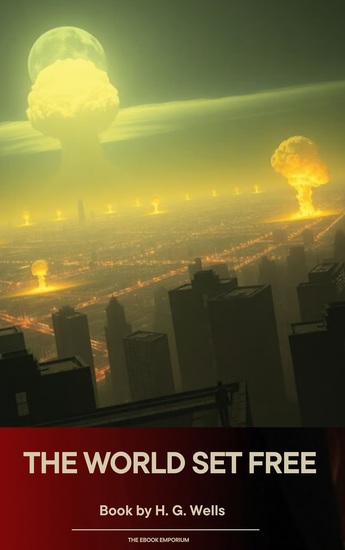
The World Set Free - cover

The World Set Free

H. G. Wells

Editorial: The Ebook Emporium

  • 0
  • 0
  • 0

Sinopsis

"Man's soul has always been a battleground; now the battlefield is the atom itself."

Written on the eve of WWI, this startlingly prophetic novel famously predicted the invention of "Atomic Bombs." Wells imagines a world where the discovery of a radioactive element, Carolinum, grants humanity limitless power—and the means for total destruction.

The Nuclear Prophecy: Decades before the Manhattan Project, Wells described bombs dropped from "aeroplanes" that created "continuous" radioactive explosions, rendering cities uninhabitable.

From Ruin to Utopia: After a devastating "Last War," survivors gather to dismantle nationalism and currency, forging a unified World State fueled by clean atomic energy.

A Modern Warning: A profound meditation on whether human political structures can survive the immense power of our own technology.

Witness the birth of the atomic age. Purchase "The World Set Free" today.
Disponible desde: 08/01/2026.
Longitud de impresión: 211 páginas.
Otros libros que te pueden interesar

  • The Bell-Tower - cover

    The Bell-Tower

    Herman Melville

    • 0
    • 0
    • 0
    "The Bell-Tower" appeared in 1855 in Putnam's Monthly Magazine no. 32 (August).
    In the south of Europe, nigh a once frescoed capital, now with dank mould cankering its bloom, central in a plain, stands what, at distance, seems the black mossed stump of some immeasurable pine, fallen, in forgotten days, with Anak and the Titan.
    Ver libro
  • The Great Gatsby - The Deluxe 1925 Edition - cover

    The Great Gatsby - The Deluxe...

    Francis Scott Fitzgerald

    • 0
    • 0
    • 0
    “Gatsby believed in the green light, the orgastic future that year by year recedes before us.” 
    Step into the glittering yet hollow world of the 1920s—a realm of champagne, jazz, and restless ambition. In The Great Gatsby, F. Scott Fitzgerald peers beyond the shimmer of the American Dream, revealing the illusions and disillusionment at its core. 
    The novel unfolds in the summer of 1922 through the eyes of Nick Carraway, a Yale graduate and World War I veteran who rents a modest home in West Egg, Long Island. His enigmatic neighbor, Jay Gatsby, is a self-made millionaire famed for extravagant parties but haunted by a singular obsession: to reclaim Daisy Buchanan, the woman he once loved. Daisy, trapped in wealth and a loveless marriage, becomes both the object of Gatsby’s dream and a symbol of its emptiness. 
    At its heart, The Great Gatsby is a meditation on illusion, identity, and the cost of desire. It is both a tragic love story and a sharp critique of the American Dream—its promises, its failures, and its corruption. 
    Written in the Jazz Age, Fitzgerald’s lyrical prose captures a generation intoxicated by success yet shadowed by disillusionment. A century later, the novel endures because it speaks to the dreamer in us all, chasing a light always just out of reach.
    Ver libro
  • A Perplexing Case - From their pens to your ears genius in every story - cover

    A Perplexing Case - From their...

    H D Everett

    • 0
    • 0
    • 0
    Henrietta Dorothy Huskisson was born in January 1851 in Gillingham, Kent. 
    Little reliable information on her life is available and almost nothing on her early life.   
    The first concrete information concerns her marriage at age 18 to the solicitor Isaac Edward Everett. 
    It was only at the age of 44 that she began her literary career under the pseudonym of Theo Douglas, a popular device in a society that still frowned upon women writing for income. 
    During her lifetime she was a popular author and wrote 22 books and those were published by 17 different publishers. 
    Although she wrote some historical novels her main output was centered on fantasy and supernatural themes. 
    Henrietta Dorothy Everett died in Weston-on-Trent in Derbyshire in September 1923.
    Ver libro
  • Our First Whale (Unabridged) - cover

    Our First Whale (Unabridged)

    Frank Thomas Bullen

    • 0
    • 0
    • 0
    Frank Thomas Bullen (April 5 1857 - March 1 1915), British author and novelist, was born of poor parents in Paddington, London, on 5 April 1857, and was educated for a few years at a dame school and Westbourne school, Paddington. At the age of 9, his aunt, who was his guardian, died. He then left school and took up work as an errand boy. In 1869 he went to sea and travelled to all parts of the world in various capacities including that of second mate of the Harbinger and chief mate of the Day Dawn, under Capt. John R. H. Ward jun in 1879 when she was dismasted and disabled.
    OUR FIRST WHALE: Simultaneous ideas occurring to several people, or thought transference, whatever one likes to call the phenomenon, is too frequent an occurrence in most of our experience to occasion much surprise.
    Ver libro
  • Robin Hood - cover

    Robin Hood

    Paul Creswick

    • 0
    • 0
    • 0
    The adventures of legendary Robin Hood, a heroic outlaw who chooses to rob from the rich to help the poor. He lives with his band of merry men in Sherwood Forest, in Nottinghamshire. Robin Hood is known for his mastery of archery as well as his talent for disguising himself.
    Ver libro
  • The Mystery of Edwin Drood - cover

    The Mystery of Edwin Drood

    Charles Dickens

    • 0
    • 0
    • 0
    The Mystery of Edwin Drood is the final novel by Charles Dickens, originally published in 1870.
    Though the novel is named after the character Edwin Drood, it focuses more on Drood's uncle, John Jasper, a precentor, choirmaster and opium addict, who is lusting after his pupil, Rosa Bud. Miss Bud, Edwin Drood's fiancée, has also caught the eye of the high-spirited and hot-tempered Neville Landless. Landless and Edwin Drood take an instant dislike to each other. Later Drood disappears under mysterious circumstances. The story is set in Cloisterham, a lightly disguised Rochester.
    Upon the death of Dickens on 9 June 1870, the novel was left unfinished, only six of a planned twelve instalments having been written. He left no detailed plan for the remaining instalments or solution to the novel's mystery, and many later adaptations and continuations by other writers have attempted to complete the story.
    Ver libro