Join us on a literary world trip!
Add this book to bookshelf
Grey
Write a new comment Default profile 50px
Grey
Subscribe to read the full book or read the first pages for free!
All characters reduced
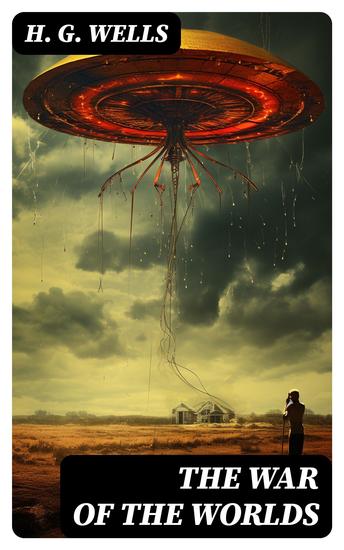
The war of the worlds - cover

The war of the worlds

H. G. Wells

Publisher: DigiCat

  • 0
  • 0
  • 0

Summary

H. G. Wells' seminal work, "The War of the Worlds," intertwines elements of science fiction with profound social criticism, reflecting the anxieties of late Victorian society. Through its vivid depiction of a Martian invasion, Wells employs a first-person narrative that draws readers into a harrowing exploration of survival and societal collapse. The novel's innovative use of unreliable narrators and intense imagery illustrates not only the terror of extraterrestrial encounters but also serves as an allegory for imperialism, colonialism, and the fragility of human civilization in the face of seemingly insurmountable forces. H. G. Wells, often hailed as the father of science fiction, was deeply influenced by the scientific advancements of his era, alongside his interest in social evolution. His background in biology and his progressive political beliefs informed his literary pursuits, leading him to challenge the status quo of his time. "The War of the Worlds" emerged in 1898 amidst a burgeoning fascination with science and technology, capturing the zeitgeist of an age teetering on the brink of modernity while grappling with its darker implications. This timeless novel is essential reading for those intrigued by the intersections of science, society, and human resilience. Whether you are a devoted science fiction enthusiast or a reader seeking profound philosophical reflections, Wells' harrowing tale will compel you to confront the very essence of humanity amid the unknown.
Available since: 07/20/2022.
Print length: 177 pages.

Other books that might interest you

  • Bullet-proof - From their pens to your ears genius in every story - cover

    Bullet-proof - From their pens...

    Bernard Capes

    • 0
    • 0
    • 0
    Bernard Edward Joseph Capes was born on the 30th August 1854 in London.  He was one of 11 children. 
    His early work was as a journalist and this developed into writing many short stories for the periodicals of the time including Blackwood's, Cassell's, Cornhill Magazine, Illustrated London News, Macmillan's Magazine, Mall Magazine, Pearson's Magazine, The Idler, and The Queen. 
    It took him many years to decide that writing full-time could be a sustainable career path.  His initial success came with ‘The Mill of Silence’.  As well as being published it garnered second prize at a competition sponsored by the Chicago Record.  He exceeded that by winning it the following year with ‘The Lake of Wine’.   
    Capes quickly became both prolific and popular.  As well as his stories and articles for the periodicals he wrote around 40 volumes across novels, poetry, history as well as romance and mystery novels. 
    Bernard Capes died on 2nd November 1918 in the flu epidemic.
    Show book
  • War and Peace - Audiobook - cover

    War and Peace - Audiobook

    Leo Tolstoy, Classic Audiobooks,...

    • 0
    • 0
    • 0
    War and Peace by Leo Tolstoy is a monumental novel that intertwines the lives of aristocratic families with the sweeping events of the Napoleonic Wars. Spanning years of political upheaval, personal transformation, and moral reflection, the novel explores the tension between individual freedom and historical inevitability. Through the eyes of unforgettable characters like Pierre Bezukhov, Prince Andrei Bolkonsky, and Natasha Rostova, Tolstoy presents an epic portrait of Russian society in one of its most turbulent eras.At once a love story, a philosophical inquiry, and a historical chronicle, War and Peace challenges the very meaning of fate, power, and human agency. With its powerful psychological depth and richly detailed narrative, the novel remains one of the greatest achievements in world literature, offering timeless insights into the human condition.
    Show book
  • A Thing That Glistened - From their pens to your ears genius in every story - cover

    A Thing That Glistened - From...

    Frank R. Stockton

    • 0
    • 0
    • 0
    Frank Richard Stockton was born in Philadelphia on 5th April 1834.  
    His father, a Methodist minister, discouraged Stockton’s literary career from an early age.  Feeling unable to go against those wishes it was for many years that Stockton’s income was maintained as a wood engraver.   
    His first work was published in 1867 and his first collection only appeared in 1870.  Despite this late arrival Stockton’s innovative and often far-fetched stories, with a gentle ‘poking fun’ humour were very popular.  Like his contemporary Mark Twain he avoided the scolding, hectoring and moral tones of many other authors and instead gently teased and cajoled his reader to open their eyes to the ills, the greed and the ambitions of the world around them.  His sci-fi stories in particular were far-seeing and inventive including a tale of negative gravity and a bloodless Anglo-US war won by technological feats.  
    Perhaps his most enduring tale though is ‘The Lady, or the Tiger?’ from 1882.  A condemned man is given a choice of being eaten alive or marrying his princess lover.  But he has to choose which door each is behind. 
    Frank R Stockton died in Washington, DC, on 20th April 1902, of a cerebral haemorrhage.  He is buried at The Woodlands in Philadelphia.
    Show book
  • A Chameleon - From their pens to your ears genius in every story - cover

    A Chameleon - From their pens to...

    Anton Chekhov

    • 0
    • 0
    • 0
    Anton Pavlovich Chekhov was born on 29th January 1860 in Taganrog, on the south coast of Russia.  
    His family life was difficult; his father was strict and over-bearing but his mother was a passionate story-teller, a subject Chekhov warmed to. As he later said; ‘our talents we got from our father, but our soul from our mother’.  
    At school Chekhov was distinctly average. At 16 his father mis-managed his finances and was declared bankrupt. His family fled to Moscow. Chekhov remained and eked out a living by various means, including writing and selling short sketches to newspapers, to finish his schooling. That completed and with a scholarship to Moscow University obtained he rejoined his family. 
    He was able to help support them by selling satirical sketches and vignettes of Russian lifestyles and gradually obtained further commissions. In 1884, he qualified as a physician and, although it earned him little, he often treated the poor for free, he was fond of saying ‘Medicine is my lawful wife, and literature is my mistress.’ 
    His own health was now an issue as he began to cough up blood, a symptom of tuberculosis.  Despite this his writing success enabled him to move the family into more comfortable accommodation.  
    Chekhov wrote over 500 short stories which included many, many classics including ‘The Kiss’ and ‘The Lady with a Dog’.  His collection ‘At Dusk’ won him the coveted Pushkin Prize when was only 26.  
    He was also a major playwright beginning with the huge success of ‘Ivanov’ in 1887.   
    In 1892 Chekhov bought a country estate north of Moscow. Here his medical skills and money helped the peasants tackle outbreaks of cholera and bouts of famine. He also built three schools, a fire station and a clinic.  It left him with less time for writing but the interactions with real people gained him detailed knowledge about the peasantry and their living conditions for his stories.  
    His most famous work, ‘The Seagull’ was received disastrously at its premiere in St Petersburg. It was later restaged in Moscow to highlight its psychological aspects and was a huge success. It led to ‘Uncle Vanya’, ‘The Three Sisters’ and ‘The Cherry Orchard’.  
    Chekhov suffered a major lung hemorrhage in 1897 while visiting Moscow. A formal diagnosis confirmed tuberculosis and the doctors ordered changes to his lifestyle.  
    Despite a dread of weddings the elusive literary bachelor quietly married the actress Olga Knipper, whom he had met at rehearsals for ‘The Seagull’, on 25th May 1901. 
    By May 1904 with his tuberculosis worsening and death imminent he set off for the German town of Badenweiler writing cheerful, witty letters to his family and assuring them his health was improving.  
    On 15th July 1904 Anton Chekhov died at Badenweiler.  He was 44.
    Show book
  • Dracula - cover

    Dracula

    Bram Stoker

    • 0
    • 0
    • 0
    “There are darknesses in life and there are lights, and you are one of the lights, the light of all lights.” ― Bram Stoker, Dracula 
    Dracula is an 1897 Gothic horror novel by Irish author Bram Stoker. Famous for introducing the character of the vampire Count Dracula, the novel tells the story of Dracula's attempt to move from Transylvania to England so he may find new blood and spread undead curse, and the battle between Dracula and a small group of men and women led by Professor Abraham Van Helsing. 
    Dracula has been assigned to many literary genres including vampire literature, horror fiction, the gothic novel and invasion literature. The novel touches on themes such as the role of women in Victorian culture, sexual conventions, immigration, colonialism, and post-colonialism. 
    Although Stoker did not invent the vampire, he defined its modern form, and the novel has spawned numerous theatrical, film and television interpretations.
    Show book
  • The Murders in the Rue Morgue - cover

    The Murders in the Rue Morgue

    Sampi Books, Edgar Allan Poe

    • 0
    • 0
    • 0
    "The Rue Morgue Murders" is a pioneering tale in the mystery genre, in which detective Auguste Dupin uses his acute observation and logic to solve a brutal double murder in Paris, revealing a surprising and unusual outcome.
    Show book