Junte-se a nós em uma viagem ao mundo dos livros!
Adicionar este livro à prateleira
Grey
Deixe um novo comentário Default profile 50px
Grey
Assine para ler o livro completo ou leia as primeiras páginas de graça!
All characters reduced
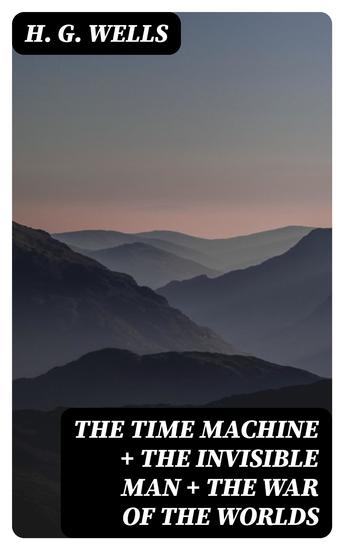
The Time Machine + The Invisible Man + The War of the Worlds - cover
LER

The Time Machine + The Invisible Man + The War of the Worlds

H. G. Wells

Editora: DigiCat

  • 0
  • 0
  • 0

Sinopse

H. G. Wells's trilogy, comprising *The Time Machine*, *The Invisible Man*, and *The War of the Worlds*, offers a rich tapestry of speculative fiction that interrogates the human condition through the lens of science and morality. Each narrative is a masterclass in literary style, blending vivid storytelling with sharp social commentary, showcasing Wells's deft command of the genre. *The Time Machine* explores the consequences of social stratification in a future world, while *The Invisible Man* delves into themes of isolation and the perils of unchecked ambition. *The War of the Worlds* serves as a poignant reflection on imperialism and human survival amidst extraterrestrial chaos, employing an exciting yet disquieting prose that remains resonant in contemporary discussions of technology and society. H. G. Wells, often revered as the father of science fiction, was influenced by the tumultuous socio-political landscape of the late 19th and early 20th centuries. An education in biology and economics underpinned his writing, infusing his works with a critical examination of science, progress, and their implications for humanity. His visionary ideas were not only prescient but also aimed at provoking thought on ethical dimensions of scientific advancements during his era. This collection is essential for readers who seek to understand the roots of modern science fiction. Wells's ability to weave complex themes within thrilling narratives invites readers to ponder deeper questions about society, humanity, and progress. Engaging and thought-provoking, this anthology is a must-read for anyone interested in the intersections of literature, science, and philosophy.
Disponível desde: 11/10/2022.
Comprimento de impressão: 1200 páginas.

Outros livros que poderiam interessá-lo

  • The Affair At Coulter's Creek - From their pens to your ears genius in every story - cover

    The Affair At Coulter's Creek -...

    Ambrose Bierce

    • 0
    • 0
    • 0
    Ambrose Gwinnett Bierce was born on 24th June 1842 at Horse Cave Creek in Meigs County, Ohio. His parents were poor but they introduced him to literature at an early age, instilling in him a deep appreciation of books, the written word and the elegance of language.  
    Growing up in Koscuisko County, Indiana poverty and religion were defining features of his childhood, and he would later describe his parents as “unwashed savages” and fanatically religious, showing him little affection but always quick to punish. He came to resent religion, and his introduction to literature appears to be their only positive effect. 
    At age 15 Bierce left home to become a printer’s devil, mixing ink and fetching type at The Northern Indian, a small Ohio paper. Falsely accused of theft he returned to his farm and spent time sending out work in the hopes of being published. 
    His Uncle Lucius advised he be sent to the Kentucky Military Institute. A year later he was commissioned as an Officer.  As the Civil War started Bierce enlisted in the 9th Indiana Infantry Regiment.  
    In April 1862 Bierce fought at the Battle of Shiloh, an experience which, though terrifying, became the source of several short stories. Two years later he sustained a serious head wound and was off duty for several months. He was discharged in early 1865.  
    A later expedition to inspect military outposts across the Great Plains took him all the way to San Francisco. He remained there to become involved with publishing and editing and to marry, Mary Ellen on Christmas Day 1871.  They had a child, Day, the following year.  
    In 1872 the family moved to England for 3 years where he wrote for Fun magazine. His son, Leigh, was born, and first book, ‘The Fiend’s Delight’, was published.  
    They returned to San Francisco and to work for a number of papers where he gained admiration for his crime reporting. In 1887 he began a column at the William Randolph Hearst’s San Francisco Examiner.  
    Bierce’s marriage fell apart when he discovered compromising letters to his wife from a secret admirer. The following year, 1889 his son Day committed suicide, depressed by romantic rejection. 
    In 1891 Bierce wrote and published the collection of 26 short stories which included ‘An Occurrence at Owl Creek Bridge’.  Success and further works including poetry followed.  
    Bierce with Hearst’s resources helped uncover a financial plot by a railroad to turn 130 million dollars of loans into a handout. Confronted by the railroad and asked to name his price Bierce answered “my price is $130 million dollars. If, when you are ready to pay, I happen to be out of town, you may hand it over to my friend, the Treasurer of the United States”.  
    He now began his first foray as a fabulist, publishing ‘Fantastic Fables’ in 1899.  But tragedy again struck two years later when his second son Leigh died of pneumonia relating to his alcoholism.  
    He continued to write short stories and poetry and also published ‘The Devil’s Dictionary’.  
    At the age of 71, in 1913 Bierce departed from Washington, D.C., for a tour of the battlefields where he had fought during the civil war. At the city of Chihuahua he wrote his last known communication, a letter to a friend. It’s closing words were “as to me, I leave here tomorrow for an unknown destination,” Ambrose Bierce then vanished without trace.
    Ver livro
  • Sheridan Le Fanu - Six of the Best - Their legacy in 6 classic stories - cover

    Sheridan Le Fanu - Six of the...

    Sheridan Le Fanu

    • 0
    • 0
    • 0
    Six has always been a number we group things around – Six of the best, six of one half a dozen of another, six feet under, six pack, six degrees of separation and a sixth sense are but a few of the ways we use this number. 
     
    Such is its popularity that we thought it is also a very good way of challenging and investigating an author’s work to give width, brevity, humour and depth across six of their very best. 
     
    In this series we gather together authors whose short stories both rivet the attention and inspire the imagination to visit their gems in a series of six, to roam across an author’s legacy in a few short hours and gain a greater understanding of their writing and, of course, to be lavishly entertained by their ideas, their narrative and their way with words. 
     
    These stories can be surprising and sometimes at a tangent to what we expected, but each is fully formed and a marvellous adventure into the world and words of a literary master.
    Ver livro
  • Dracula – Chapter 3: Jonathan Harker’s Journal (continued) - A Chapter-by-Chapter Reading of Bram Stoker’s Classic - cover

    Dracula – Chapter 3: Jonathan...

    Bram Stoker

    • 0
    • 0
    • 0
    As Jonathan Harker continues his stay at Count Dracula’s castle, the sense of unease deepens. Strange occurrences and the eerie atmosphere of the ancient stronghold begin to unsettle him. The young solicitor realizes that the Count is no ordinary man, and the true nature of his host becomes ever more terrifying. 
    This is Chapter 3 of Bram Stoker’s Dracula, narrated by Amazon bestselling horror author Jonathan Dunne — part of a full chapter-by-chapter audiobook series that brings the classic Gothic nightmare to life with chilling clarity. 
    Experience the mounting suspense, the creeping horror, and the sense of inescapable dread that have made Dracula a timeless tale of Gothic terror. 
    📖 Public domain text. Original publication: 1897.
    Ver livro
  • Just So Stories - cover

    Just So Stories

    Rudyard Kipling

    • 0
    • 0
    • 0
    "Just So Stories" by Rudyard Kipling is a whimsical collection of imaginative tales that explain the origins of animals and natural phenomena. Written with playful language and rhythmic prose, the stories explore how the leopard got its spots, the camel its hump, and the elephant its trunk, blending creativity with curiosity. Kipling’s narrative style invites readers into a world of wonder, where animals and nature are shaped by quirky adventures and lessons in adaptation. Each story carries a moral or insight, encouraging reflection on the interconnectedness of life. Filled with charm and humor, this timeless classic captivates both children and adults, celebrating the joy of storytelling and the magic of discovery in the natural world.
    Ver livro
  • Mansfield Park - cover

    Mansfield Park

    Jane Austen

    • 0
    • 0
    • 0
    In "Mansfield Park," Jane Austen crafts the tale of Fanny Price, a modest young girl sent to live with her wealthy relatives, the Bertrams, at their grand estate. Fanny's quiet strength and moral steadfastness set her apart as she navigates the complexities of family tensions, love triangles, and social expectations. Amidst the arrival of the enchanting Crawfords, her deep affection for her cousin Edmund faces trials that test her principles. Austen's intricate storytelling offers a profound exploration of virtue, class, and human emotions.
    Ver livro
  • Antony and Cleopatra - cover

    Antony and Cleopatra

    William Shakespeare

    • 0
    • 0
    • 0
    Antony and Cleopatra (First Folio title: The Tragedie of Anthonie, and Cleopatra) is a tragedy by William Shakespeare. The play was first performed, by the King's Men, at either the Blackfriars Theatre or the Globe Theatre in around 1607; its first appearance in print was in the Folio of 1623.
    The plot is based on Thomas North's 1579 English translation of Plutarch's Lives (in Ancient Greek) and follows the relationship between Cleopatra and Mark Antony from the time of the Sicilian revolt to Cleopatra's suicide during the Final War of the Roman Republic. The major antagonist is Octavius Caesar, one of Antony's fellow triumvirs of the Second Triumvirate and the first emperor of the Roman Empire. The tragedy is mainly set in the Roman Republic and Ptolemaic Egypt and is characterized by swift shifts in geographical location and linguistic register as it alternates between sensual, imaginative Alexandria and a more pragmatic, austere Rome.
    Many consider Shakespeare's Cleopatra, whom Enobarbus describes as having "infinite variety", as one of the most complex and fully developed female characters in the playwright's body of work. She is frequently vain and histrionic enough to provoke an audience almost to scorn; at the same time, Shakespeare invests her and Antony with tragic grandeur. These contradictory features have led to famously divided critical responses. It is difficult to classify Antony and Cleopatra as belonging to a single genre. It can be described as a history play (though it does not completely adhere to historical accounts), as a tragedy (though not completely in Aristotelian terms), as a comedy, as a romance, and according to some critics, such as McCarter, a problem play. All that can be said with certainty is that it is a Roman play, and perhaps even a sequel to another of Shakespeare's tragedies, Julius Caesar.
    Among the most significant works William Shakespeare: Hamlet, Othello, King Lear, Macbeth, Orpheus, Romeo and Juliet, Julius Caesar, Troilus and Cressida, The Tempest, Venus and Adonis, Antony and Cleopatra, Measure for Measure, The Winter's Tale and many more.
    Ver livro