¡Acompáñanos a viajar por el mundo de los libros!
Añadir este libro a la estantería
Grey
Escribe un nuevo comentario Default profile 50px
Grey
Suscríbete para leer el libro completo o lee las primeras páginas gratis.
All characters reduced
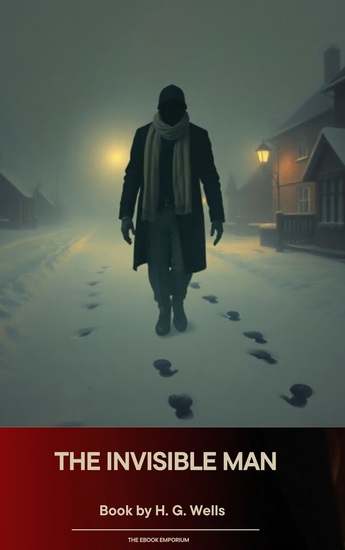
The Invisible Man - cover

The Invisible Man

H. G. Wells

Editorial: The Ebook Emporium

  • 0
  • 0
  • 0

Sinopsis

"I am all men—and I am no man. I am the Invisible Man."

In the dead of winter, a mysterious stranger arrives at a quiet inn in the village of Iping, his face swathed in bandages and his eyes hidden behind dark goggles. This is Griffin, a brilliant scientist who has discovered the secret to making human tissue transparent. But his breakthrough is his undoing. Trapped in a state of invisibility and hunted by a world that fears what it cannot see, Griffin's initial dream of power curdles into a violent obsession. As he attempts to establish a "Reign of Terror," the story becomes a pulse-pounding race against a man who can strike from nowhere.

The Anatomy of an Anti-Hero: Griffin is not your typical Victorian protagonist. He is irritable, brilliant, and increasingly sociopathic. Wells uses invisibility as a metaphor for the ultimate freedom from social accountability. Without a face to recognize or a body to imprison, Griffin believes he is above morality, leading to a chilling study of how absolute power (or the illusion of it) corrupts the soul.

A Village Under Siege: The novel masterfully shifts from the "weird tale" atmosphere of the Iping countryside to a high-stakes manhunt across England. Through the characters of the bumbling tramp Thomas Marvel and the rational Dr. Kemp, Wells explores the societal reaction to the "invisible threat." The tension builds to a climactic confrontation that remains one of the most memorable endings in the history of science fiction.

Witness the terror of the unseen. Purchase "The Invisible Man" today and confront the darkness of the human heart.
Disponible desde: 08/01/2026.
Longitud de impresión: 142 páginas.
Otros libros que te pueden interesar

  • Raven The - Story Time Episode 45 (Unabridged) - cover

    Raven The - Story Time Episode...

    Brothers Grimm

    • 0
    • 0
    • 0
    In the forest, a man heard a raven tell him she was an enchanted princess, and he could deliver her if he went to a certain cottage and accepted no food from the old woman there. The raven would drive by in a carriage every day for three days. If he remained awake, he would break the spell.
    Ver libro
  • The Alchemist - cover

    The Alchemist

    Ben Jonson

    • 0
    • 0
    • 0
    An outbreak of plague in London forces a gentleman, Lovewit, to flee temporarily to the country, leaving his house under the sole charge of his butler, Jeremy. Jeremy uses the opportunity given to him to use the house as the headquarters for fraudulent acts. He transforms himself into 'Captain Face', and enlists the aid of Subtle, a fellow conman and Dol Common, a prostitute. In The Alchemist, Jonson unashamedly satirizes the follies, vanities and vices of mankind, most notably greed-induced credulity. People of all social classes are subject to Jonson's ruthless, satirical wit. He mocks human weakness and gullibility to advertising and to "miracle cures" with the character of Sir Epicure Mammon, who dreams of drinking the elixir of youth and enjoying fantastic sexual conquests. The Alchemist focuses on what happens when one human being seeks advantage over another. In a big city like London, this process of advantage-seeking is rife. The trio of con-artists - Subtle, Face and Dol - are self-deluding small-timers, ultimately undone by the same human weaknesses they exploit in their victims.Benjamin Jonson was an English playwright and poet. Jonson's artistry exerted a lasting influence upon English poetry and stage comedy.
    Ver libro
  • The Voyage - cover

    The Voyage

    Katherine Mansfield

    • 0
    • 0
    • 0
    The Voyage is a 1921 short story by Katherine Mansfield. It was first published in The Sphere on 24 December 1921, and later reprinted in The Garden Party and Other Stories.
    At the harbour Fenella and her grandmother say goodbye to Fenella's father and board the Picton boat; a number of everyday situations are described during the journey, which highlight a degree of tension between the rather religious grandmother and staff on the boat. At Picton they are met by Mr Penreddy with a carriage. They arrive at the grandparents's house and meet Fenella's grandfather. It becomes apparent slowly as the story develops that Fenella's mother has recently died, and she is being taken to live in Picton for an unknown length of time.
    Ver libro
  • A Christmas Carol - cover

    A Christmas Carol

    Charles Dickens

    • 0
    • 0
    • 0
    This is a brand new recording of Charles Dickens’ timeless story, A Christmas Carol. 
     Ebenezer Scrooge is mean and unpleasant. He dislikes people and Christmas especially but on this particular Christmas Eve he’s visited by the ghost of his business partner Jacob Marley and the spirits of Christmas Past, Present, and Yet to Come. As Ebenezer sees the effects he’s had on people’s lives, he is transformed.  
    Ver libro
  • Vainity Faiyr - cover

    Vainity Faiyr

    William Makepeace Thackeray

    • 0
    • 0
    • 0
    "Vanity Fair" is a novel by English author William Makepeace Thackeray, first published as a serial from 1847 to 1848. The novel is a satirical and panoramic look at early 19th-century British society, particularly focusing on the lives of two women, Becky Sharp and Amelia Sedley, as they navigate the complexities of love, ambition, and social climbing. Thackeray's work is known for its wit, sharp social commentary, and memorable characters.
    Ver libro
  • Dispatches From The Ruhr - cover

    Dispatches From The Ruhr

    Ernest Hemingway

    • 0
    • 0
    • 0
    Before finding celebrity as an author, including his 1954 Nobel Prize, Ernest M. Hemingway honed his craft as a journeyman reporter. In the spring of 1923, as a special correspondent for the Toronto Star, he travelled to the occupied Ruhr Valley where he produced a series of 10 articles, collected here as Dispatches from the Ruhr. In them, he explores the French political system and its role in the decision to occupy the Ruhr Valley militarily, in an effort to collect on unsustainable war reparations. In addition, he examines the suffering of its ordinary citizens, as conditions there led to a progressive loss of confidence in the Wiemar Republic; its economic collapse under the weight of hyper-inflation; and, ultimately, to the rise of Nazism. It is worth reading as both a case study on the unintended consequences of military occupation and a master class in the development of Hemingway’s characteristic prose style.
    Ver libro