¡Acompáñanos a viajar por el mundo de los libros!
Añadir este libro a la estantería
Grey
Escribe un nuevo comentario Default profile 50px
Grey
Suscríbete para leer el libro completo o lee las primeras páginas gratis.
All characters reduced
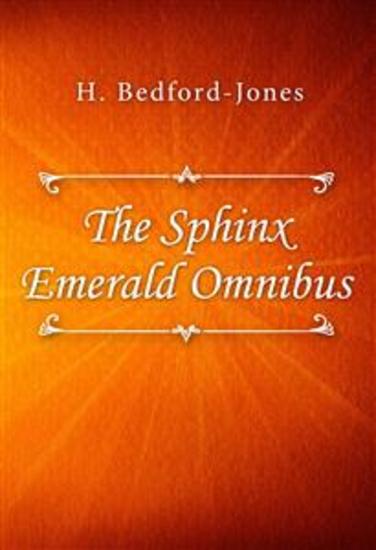
The Sphinx Emerald Omnibus - cover

The Sphinx Emerald Omnibus

H. Bedford-Jones

Editorial: Classica Libris

  • 0
  • 0
  • 0

Sinopsis

Collection of stories: “The Sphinx Emerald,” “Red Sky Over Thebe,” “The Last Pharaoh,” “Master of the World,” “The Son of Julius Caesar,” “The Eye of the Sun,” “Assassination at Christmas,” “The Justice of Amru,” “Swordsmen of Saladin,” “Leopards Are For England,” “The King’s Jewel,” “A Task for Leonardo,” “The Reward of Nostradamus,” “Richelieu Raids a Tomb,” “Jewels Have a Long Life,” “Lady in Chain Mail,” “The Bride of the Sphinx” and “The Passing of the Sphinx Emerald.”
A strange jewel that wrought mischief and magic as it passed from hand to hand down the ages starts its strange eventful dramatic history here in Ancient Egypt…
The Sphinx Emerald passed into other hands—to reappear centuries later when conquering Cambyses came storming into Egypt with his Persian legions…
That strange bewitching jewel, the Sphinx Emerald, plays another part in world drama when a Mata Hari betrays the Egyptians, and Artaxerxes of Persia storms up the Nile to take over the ancient kingdom of the Pharaohs…
Alexander of Macedon had conquered most of the world, and his legions were rolling toward Carthage when—a wily little priest strangely presented to him the Sphinx Emerald…
Steel clashed and bugles blared in the Antioch of December 362… and the strange Sphinx Emerald flashed again to potent life…
Fanatic followers of Mohammed stormed out of Arabia in the seventh century to slaughter the Greek troops of the Great Eastern Empire and conquer Egypt… and again the strange Sphinx Emerald came to the scene to play its part in the unrolling historic drama…
In the Twelfth Century an intrigue at the court of the great Sultan Saladin brings forth the Sphinx Emerald to play its strange magic role…
That malign and magic jewel the Sphinx Emerald comes on the scene to play its part in a stirring drama of the Crusades…
The strange Sphinx Emerald which Richard had brought home to England from the Crusades was the property of Edward III in this year 1349—a year of triumph because of victory; of terror because of pestilence. And when a beautiful woman coveted the jewel, its tragic power came again to life…
The incomparable Leonardo da Vinci had great plans for the magic Sphinx Emerald—but though the King of France was his friend, he had also made a bitter enemy…
Catherine de Medici coveted the Sphinx Emerald. And when the King gave it as a reward to his physician, Doctor Nôtredame rode in dire peril of his life…
The malign magic of the Sphinx Emerald works its spell anew in one of the famous dramas of history…
Are the things we love ever ours? The old Moor thought not: “I bought them! They were given me! They are mine!” he mocked. “Yet when you die—what? They are just so much gravel to you, then.”
From the hand of a dead Mameluke after the battle of the Pyramids, a civilian scientist with Napoleon’s army took the Sphinx Emerald… and though the Mameluke’s militant daughter offered to buy back the gem at a price high indeed, swift tragedy followed…
Now almost in our own day the Sphinx Emerald turns up in Cairo to work its malign magic in a memorable drama…
In Santa Fe, the story of this malign and magic jewel, which began in Ancient Egypt, comes to its strange conclusion.
Disponible desde: 25/09/2022.


Otros libros que te pueden interesar

  • After London - cover

    After London

    Richard Jefferies

    • 0
    • 0
    • 0
    Jefferies' novel can be seen as an early example of "post-apocalyptic fiction." After some sudden and unspecified catastrophe has depopulated England, the countryside reverts to nature, and the few survivors to a quasi-medieval way of life.The first part of the book, "The Relapse into Barbarism", is the account by some later historian of the fall of civilisation and its consequences, with a loving description of nature reclaiming England. The second part, "Wild England", is an adventure set many years later in the wild landscape and society.The book is not without its flaws (notably the abrupt and unsatisfying ending) but is redeemed by the quality of the writing, particularly the unnervingly prophetic descriptions of the post-apocalyptic city and countryside
    Ver libro
  • The Woman in White - cover

    The Woman in White

    Wilkie Collins

    • 0
    • 0
    • 0
    "The Woman in White" is a novel by Wilkie Collins, first published in 1859. It is considered one of the earliest examples of the mystery and detective genres. The story unfolds through multiple narrators and involves complex plots and subplots, centering around the mysterious figure of a woman dressed entirely in white. As the characters delve into her identity and circumstances, they become embroiled in a tale of love, betrayal, and nefarious schemes. The novel was revolutionary in its use of the "sensation" genre and remains a classic in mystery and detective fiction.
    Ver libro
  • The Casebook of Sherlock Holmes - cover

    The Casebook of Sherlock Holmes

    Sir Aarthur Conan Doyl

    • 0
    • 0
    • 0
    Originally published in 1927, these short stories represent the fifth and final collection of Arthur Conan Doyle's tales featuring Sherlock Holmes. Included are the following stories, originally published in Strand Magazine beginning in 1921 and stretching through 1927: The Adventure of the Illustrious Client The Adventure of the Blanched Solider The Adventure of the Mazarin Stone The Adventure of the Three Gables The Adventure of the Sussex Vampire The Adventure of the Three Garridebs The Problem of Thor Bridge The Adventure of the Creeping Man The Adventure of the Lion's Mane The Adventure of the Veiled Lodger The Adventure of Shoscombe Old Place The Adventure of the Retired Colourman Note: The original text contained wording and phrasing choices that represented outdated cultural beliefs related to race. Per the publisher's discretion, this audiobook edition makes minor edits to these instances to avoid perpetuating racial prejudice and stereotyping. With these texts now available in the public domain, listeners are free to view the original text via sources such as Project Gutenberg, Wikisource, or Faded Page.
    Ver libro
  • The Heart of a Dog - cover

    The Heart of a Dog

    Mikhail Bulgakov

    • 0
    • 0
    • 0
    A well-to-do professor working in Moscow strikes up an unlikely friendship with a stray dog and attempts a scientific first by transplanting the testicles and pituitary gland of a recently deceased man into the dog.
    
    With a wild, but alarmingly human animal on the loose, the professor's previously respectable life becomes a nightmare beyond his imagination. A suberp satirical novel, it is also a sharp and pointed criticism of Soviet society, especially the new rich that arose after the Bolshevik revolution.
    Ver libro
  • Christmas at Red Butte - From their pens to your ears genius in every story - cover

    Christmas at Red Butte - From...

    Lucy Ward Montgomery

    • 0
    • 0
    • 0
    The bookshelves of American literature are incredible collections that have gathered together centuries of very talented authors.  From this continent their fame spread and whilst among their number many are now forgotten or neglected their talents endure.  Among them is Lucy Ward Montgomery.
    Ver libro
  • The Call of Cthulhu - cover

    The Call of Cthulhu

    Howard Phillips Lovecraft

    • 0
    • 0
    • 0
    The Call of Cthulhu is a short story by American writer H. P. Lovecraft. Written in the summer of 1926, it was first published in the pulp magazine Weird Tales in February 1928.
    The story's narrator, Francis Wayland Thurston, recounts his discovery of various notes left behind by his great uncle, George Gammell Angell, a prominent professor of Semitic languages at Brown University in Providence, Rhode Island, who died during the winter of 1926, suspecting eldritch goings-on after being bumped into by a "nautical-looking negro".
    Ver libro