Join us on a literary world trip!
Add this book to bookshelf
Grey
Write a new comment Default profile 50px
Grey
Subscribe to read the full book or read the first pages for free!
All characters reduced
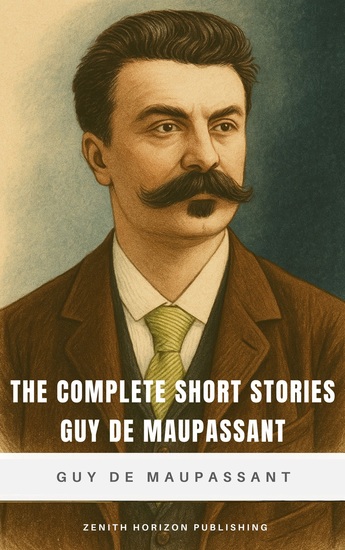
The Complete Short Stories of Guy de Maupassant - The Timeless Stories of Guy de Maupassant - cover

The Complete Short Stories of Guy de Maupassant - The Timeless Stories of Guy de Maupassant

Guy de Maupassant, Zenith Horizon Publishing

Publisher: Zenith Horizon Publishing

  • 0
  • 0
  • 0

Summary

Step into the masterful world of Guy de Maupassant, one of the greatest short story writers in literary history. This comprehensive collection brings together all of Maupassant's most acclaimed and unforgettable tales, showcasing his gift for portraying the complexities of human nature with elegance, wit, and irony.

From haunting psychological dramas to ironic social commentaries, Maupassant captures the essence of 19th-century France with timeless relevance. Perfect for readers who appreciate concise storytelling packed with emotional depth, intrigue, and insight. 💡📖

This edition is ideal for:

Lovers of classic European literature

Students and scholars of French realism and naturalism

Fans of Anton Chekhov and Edgar Allan Poe

📚 Features:

Complete short stories by Guy de Maupassant

Expertly formatted for Kindle

A must-have volume in any literary collection

Click Buy Now and immerse yourself in a world of poignant, powerful, and perfectly crafted storytelling.
Available since: 06/25/2025.
Print length: 1835 pages.

Other books that might interest you

  • The Christmas Tree - cover

    The Christmas Tree

    Charles Dickens

    • 0
    • 0
    • 0
    "The Christmas Tree" by Charles Dickens, narrated by Vincent Caruso, is a timeless holiday tale that takes listeners on a journey through the nostalgic warmth of a Victorian Christmas. In this beautifully crafted story, Dickens paints vivid images of Christmas traditions, from the dazzling glow of the decorated tree to the lively gatherings of family and friends. Vincent Caruso's narration brings the text to life with a rich and engaging voice that captures the essence of the story’s festive spirit, transporting listeners to a world filled with holiday cheer and reflection. 
    This heartwarming story centers around the memories and reflections of Christmases past, evoking both the joy of childhood wonder and the deep sentimental value of holiday traditions. Dickens weaves a narrative full of charm, magic, and the deeper meaning of Christmas, providing listeners with a sense of nostalgia for simpler times. Through the lens of the beautifully adorned Christmas tree, he explores the passage of time and the enduring spirit of the holiday season. 
    Whether you're revisiting this classic or discovering it for the first time, The Christmas Tree is sure to become a favorite addition to your holiday audiobook collection. Perfect for cozy evenings by the fire or as a background to holiday preparations, this audiobook offers an immersive experience of Christmas traditions and the timeless themes of joy, family, and giving.
    Show book
  • The Great Wall of China - cover

    The Great Wall of China

    Franz Kafka

    • 0
    • 0
    • 0
    "The Great Wall of China" is a short story by Franz Kafka. While written in 1917, it was not published until 1930, seven years after his death. Its first publication occurred in Der Morgen, a German literary magazine. A year later, Max Brod included it in Beim Bau der Chinesischen Mauer, the first posthumous collection of short stories by Franz Kafka.Contained within the story is a parable that was separately published as "A Message from the Emperor" ("Eine kaiserliche Botschaft") in 1919 in the collection Ein Landarzt (A Country Doctor). Some sub-themes of the story include why the wall was built piecemeal (in small sections in many different places), the relationship of the Chinese with the past and the present and the emperor's imperceptible presence. The story is told in the first person by an older man from a southern province.The first English translation, by Willa and Edwin Muir, was published by Martin Secker in London in 1933. It appeared in The Great Wall of China. Stories and Reflections (New York City: Schocken Books, 1946).
    Show book
  • Lord Peter Views the Body - The Lord Peter Wimsey Mysteries Book 4 - cover

    Lord Peter Views the Body - The...

    Dorothy L. Sayers

    • 0
    • 0
    • 0
    Step into the world of wit, sophistication, and intrigue with Lord Peter Views the Body, the fourth installment in Dorothy L. Sayers’ celebrated Lord Peter Wimsey Mysteries. This delightful collection of twelve short stories showcases Lord Peter at his finest—solving cases that range from the bizarre to the macabre, all with his trademark charm and intelligence. 
    From uncovering the truth behind a mysterious corpse found in an unusual location to unraveling a seemingly impossible crime, Lord Peter’s keen intellect and unrelenting curiosity lead him to uncover secrets hidden in plain sight. Each story is a masterclass in clever plotting and sharp characterization, making it a perfect introduction to one of literature’s most beloved amateur sleuths. 
    Whether you’re a longtime fan or new to the world of Lord Peter Wimsey, this audiobook promises an enthralling listening experience filled with humor, suspense, and the timeless allure of classic detective fiction.
    Show book
  • Olalla - cover

    Olalla

    Robert Louis Stevenson

    • 0
    • 0
    • 0
    "Olalla" is a short story by the Scottish novelist, poet, essayist, and travel writer Robert Louis Stevenson. It was first published in the Christmas 1885 issue of The Court and Society Review, then re-published in 1887 as part of the collection The Merry Men and Other Tales and Fables. It is set in Spain during the Peninsular War. 
     
    The story is based on a dream that Stevenson had and in his 1888 essay "A Chapter on Dreams" he describes the difficulties he had in fitting his vision into a narrative framework. Stevenson wrote the story at the same time as he was proofing "Strange Case of Dr. Jekyll and Mr. Hyde" (published 1886).
    Show book
  • The Criminal From Lost Honour - cover

    The Criminal From Lost Honour

    Frederick Schiller

    • 0
    • 0
    • 0
    Johann Christoph Friedrich Schiller was born on 10th November 1759, in Marbach, Württemberg, the sole son of six children, into a very religious family. 
     
    During his childhood his father was away, engaged in the Seven Years War and contact was sporadic until with the War’s end in 1763. His father became a recruiting officer and the family moved to Lorch. 
     
    It was here that Schiller received his early education, the quality of which was poor, not helped by the child’s frequent truancy.  His parents sought a clerical career for him and a local priest was engaged to teach him Latin and Greek. As a boy, Schiller was excited by the idea of becoming a cleric and often wore black robes and pretended to preach. 
     
    In 1766, the family left Lorch. Schiller's father had not been paid for three years, and the family’s savings were depleted, so his father Kaspar, joined the garrison in Ludwigsburg for the Duke of Württemberg. 
     
    There the boy Schiller came to the attention of the Duke. He entered the elite military academy, the Karlsschule Stuttgart, in 1773, and eventually studied medicine, which led him to frequently attempt cures for his various illnesses. 
     
    At the academy, he wrote his first play, ‘The Robbers’, which dramatizes the conflict between two aristocratic brothers. The play's themes of social corruption and proto-revolutionary republican ideals astounded its original audience. Schiller became an overnight sensation.  
     
    In 1780, he obtained a post as regimental doctor in Stuttgart. In order to attend the first performance of ‘The Robbers’ in Mannheim, Schiller left his regiment without permission. As a result, he was arrested, sentenced to 14 days imprisonment, and forbidden from publishing any further works. 
     
    He fled Stuttgart in 1782, going via Frankfurt, Mannheim, Leipzig, and Dresden to Weimar. Along this journey he had an affair with an army officer's wife, Charlotte von Kalb. She was at the centre of an intellectual circle and known for her cleverness and instability.  
     
    Schiller settled in Weimar in 1787. Two years later he was appointed professor of History and Philosophy in Jena, where he wrote only historical works. 
     
    On 22nd February 1790, he married Charlotte von Lengefeld who bore him two sons and two daughters. 
     
    Schiller returned with his family to Weimar from Jena in 1799. There Johann Wolfgang von Goethe convinced him to return to playwriting and together they founded the Weimar Theater, which led to a renaissance of drama now referred to as Weimar Classicism. They also worked together on Xenien, a collection of short satirical poems in which they challenged opponents of their philosophical vision. 
     
    For his achievements, Schiller was ennobled in 1802 by the Duke of Saxe-Weimar, adding the nobiliary particle ‘von’ to his name.  
     
    Schiller died on 9th May 1805, at age 45, from tuberculosis, at Weimar. 


    Although primarily admired for his plays Schiller also wrote histories, poetry and some notable translations.   
     
    In his short story ‘The Criminal from Lost Honour’ the layers of a man’s life are examined as perhaps only Schiller and his literary genius can.
    Show book
  • Marvelous Land of Oz The [The Wizard of Oz series #2] - cover

    Marvelous Land of Oz The [The...

    L. Frank Baum

    • 0
    • 0
    • 0
    First issued in 1904, L. Frank Baum's The Marvelous Land of Oz is the story of the wonderful adventures of the young boy named Tip as he travels throughout the many lands of Oz. Here he meets with our old friends the Scarecrow and Tin Woodman, as well as some new friends like Jack Pumpkinhead, the Wooden Sawhorse, the Highly Magnified Woggle-Bug, and the amazing Gump. How they thwart the wicked plans of the evil witch Mombi and overcome the rebellion of General Jinjur and her army of young women is a tale as exciting and endearing today as it was when first published over eighty years ago.
    Show book