Rejoignez-nous pour un voyage dans le monde des livres!
Ajouter ce livre à l'électronique
Grey
Ecrivez un nouveau commentaire Default profile 50px
Grey
Abonnez-vous pour lire le livre complet ou lisez les premières pages gratuitement!
All characters reduced
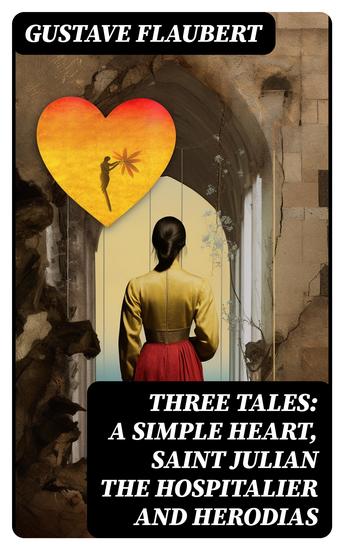
Three Tales: A Simple Heart Saint Julian the Hospitalier and Herodias - cover

Three Tales: A Simple Heart Saint Julian the Hospitalier and Herodias

Gustave Flaubert

Maison d'édition: DigiCat

  • 0
  • 0
  • 0

Synopsis

In "Three Tales," Gustave Flaubert crafts a compelling triptych that explores the intricate interplay between duty, faith, and human emotion through three distinct narratives: "A Simple Heart," "Saint Julian the Hospitalier," and "Herodias." The literary style is characterized by Flaubert's signature meticulous attention to detail, striking realism, and profound psychological insight, allowing readers to reflect upon the moral complexities and existential themes woven into the fabric of everyday life. Set against the backdrop of 19th-century France, these stories engage with both classical and folkloric traditions, elevating ordinary life to spheres of philosophical inquiry and spiritual contemplation. Gustave Flaubert, a master of literary modernization, has had a profound impact on narrative form and technique. His extensive life experiences, including his struggles with societal expectations and personal disillusionments, inform the moral and emotional undertones of the tales. Flaubert's own quest for authenticity in art is echoed in these stories, wherein he meticulously examines the characters' motivations and the societal constraints that shape their destinies. "Three Tales" is essential reading for those seeking a deeper understanding of human nature and the spiritual conflicts that define our existence. Flaubert's profound insights challenge readers to confront their own beliefs and assumptions, making these stories not only timeless but also relevant to contemporary discourse on morality and identity.
Disponible depuis: 04/12/2023.
Longueur d'impression: 144 pages.

D'autres livres qui pourraient vous intéresser

  • The Cask of Amontillado - cover

    The Cask of Amontillado

    SAMPI Books, Edgar Allan Poe

    • 0
    • 0
    • 0
    Edgar Allan Poe's "The Cask of Amontillado" is a short story that explores themes of revenge and deceit. The story follows Montresor, who is deeply offended by Fortunato. Montresor devises a meticulous plan under the guise of cordiality, promising Fortunato a taste of a rare wine, Amontillado, during the carnival. The story unfolds in a tense and mysterious atmosphere.
    Voir livre
  • A Hunger Artist - cover

    A Hunger Artist

    Franz Kafka

    • 0
    • 0
    • 0
    A Hunger Artist is a short story by Franz Kafka first published in 1922. The protagonist, a hunger artist who experiences the decline in appreciation of his craft, is typically Kafkaesque: an individual marginalized and victimized by society at large. A Hunger Artist explores themes such as death, art, isolation, asceticism, spiritual poverty, futility, personal failure and the corruption of human relationships.
    Voir livre
  • The Adventure Of The Speckled band - cover

    The Adventure Of The Speckled band

    Arthur Conan Doyle

    • 0
    • 0
    • 0
    The Adventure Of The Speckled band is the eighth short story and tenth (after A Study in Scarlet and The Sign Of Four) Sherlock Holmes story by British author Sir Arthur Conan Doyle. It is the eighth story in the collection Adventures Of Sherlock Holmes, it was published in Strand Magazine in February of 1892. The story tells of Helen Stoner, a soon to be married young woman who suspects her father may be trying to kill her in order to retain control of her inheritance. Convinced of her father's intentions, Helen turns to Holmes for help.Sherlock Holmes and Dr. Watson rise unusually early one morning to meet a young woman named Helen Stoner who fears that her life is being threatened by her stepfather, Dr. Grimesby Roylott. Roylott is a doctor who practiced in Calcutta, India and was married to Helen's late mother when she was a widow living there. He is also the impoverished last survivor of what was once a wealthy but violent, ill-tempered and amoral Anglo-Saxon aristocratic family of Surrey, and has already served a jail sentence for killing his Indian butler in a rage.Helen's twin sister had died almost two years earlier, shortly before she was to be married. Helen had heard her sister's dying words, "The speckled band!" but was unable to decode their meaning. Helen herself, troubled by the perplexing death of her sister, is now engaged, and she has begun to hear strange noises and observe strange activities around Stoke Moran, the impoverished and heavily mortgaged estate where she and her stepfather live.Famous works of the author Arthur Conan Doyle's: "A Study in Scarlet", "Silver Blaze", "The Hound of the Baskervilles", "The Yellow Face", "A Scandal in Bohemia", "The Red-Headed League", A Case of Identity", "The Boscombe Valley Mystery", "The Five Orange Pips", "The Man with the Twisted Lip", "The Blue Carbuncle", "The Speckled Band", "The Engineer's Thumb", "The Noble Bachelor", "The Beryl Coronet", "The Copper Beeches" and many more.
    Voir livre
  • The Demon Spell - cover

    The Demon Spell

    Hume Nisbet

    • 0
    • 0
    • 0
    Title: The Boarded Window 
    Author: Hume Nisbet 
    Narrator: Jonathan Dunne 
    Original Publication: 1902 
    Public Domain: Yes 
    Series Placement: Number 21 in the Timeless Terrors series 
    Description: 
    The Boarded Window by Hume Nisbet is a grimly atmospheric tale steeped in Gothic dread and the macabre. Set against the backdrop of a mysterious house with its single, shuttered window, the story reveals secrets of death, decay, and the lingering presence of the uncanny. Nisbet weaves a chilling exploration of isolation, superstition, and the spectral weight of things best left hidden. 
    Narrated by Amazon bestselling horror author Jonathan Dunne, this performance captures the story’s brooding suspense and eerie tension, merging gothic atmosphere with psychological horror. While the text is in the public domain, this narration is an original work and copyright © 2025 Jonathan Dunne. 
    This audiobook is part of Timeless Terrors, a series dedicated to resurrecting classic horror — works from masters of the macabre, retold in haunting new performances for a modern audience. 
    Listeners should be prepared for an unsettling encounter with shadows, silence, and the terrifying suggestion of what lies beyond the boarded window.
    Voir livre
  • Aloysha the Pot - From their pens to your ears genius in every story - cover

    Aloysha the Pot - From their...

    Leo Tolstoy

    • 0
    • 0
    • 0
    Leo Tolstoy was born in 1828 in the Russian province of Tula to a wealthy noble family. As a child, he had private tutors but he showed little interest in any formal education. When he went to the University of Kazan in 1843 to study oriental languages and law, he left without completing his courses.  Life now was relaxed and idle but with some writing also taking place.  Gambling debts forced an abrupt change of path and he joined the army to fight in the Crimean War.  He was commended for his bravery and promoted but was appalled at the brutality and loss of life.  He recorded these and other earlier experiences in his diaries which formed the basis of several of his works. 
    In 1852 ‘Childhood’ was published to immediate success and was followed by ‘Boyhood’ and ‘Youth’. 
    His experience in the army and the horrors he witnessed resulted in ‘The Cossacks’ in 1862 and the trilogy ‘Sevastopol Tales’. After the war he travelled around Europe, visiting London and Paris and meeting such luminaries as Victor Hugo and Charles Darwin.  
    It was now that Tolstoy began his masterpiece, ‘War and Peace’. Published in 1869 it was an epic work that changed literature. He quickly followed this with ‘Anna Karenina’.  
    These successes made Tolstoy rich and helped him accomplish many of his dreams but also brought problems as he grappled with his faith and the lot of the oppressed poor. These revolutionary views became so popular that the authorities now kept him under surveillance.  
    He led a life of asceticism and vegetarianism and put his socialist ideals into practice by establishing numerous schools for the poor and food programmes. He also believed in giving away his wealth, which caused much discord with his wife.  
    His writing continued to bring forth classics such as ‘The Death of Ivan Ilyich’ and many brilliant and incisive short stories such as ‘How Much Land Does A Man Need’.  
    In 1901 Tolstoy was excommunicated from the Church and controversially deselected for the Nobel Prize for Literature. 
    Whilst undertaking a pilgrimage by train in October 1910 with his daughter Aleksandra he caught pneumonia in the nearby town of Astapovo.  Leo Tolstoy died on November 9th, 1910, he was 82.
    Voir livre
  • What Will Pay? (Unabridged) - cover

    What Will Pay? (Unabridged)

    Booker T. Washington

    • 0
    • 0
    • 0
    Booker Taliaferro Washington (April 5, 1856 - November 14, 1915) was an American educator, author, orator, and adviser to several presidents of the United States. Between 1890 and 1915, Washington was the dominant leader in the African American community and of the contemporary black elite. Washington was from the last generation of black American leaders born into slavery and became the leading voice of the former slaves and their descendants. They were newly oppressed in the South by disenfranchisement and the Jim Crow discriminatory laws enacted in the post-Reconstruction Southern states in the late 19th and early 20th centuries.
    WHAT WILL PAY: I wish to talk with you for a few minutes upon a subject that is much discussed, especially by young people-What things pay in life? There is no question, perhaps, which is asked oftener by a person entering upon a career than this-What will pay? Will this course of action, or that, pay?
    Voir livre