Junte-se a nós em uma viagem ao mundo dos livros!
Adicionar este livro à prateleira
Grey
Deixe um novo comentário Default profile 50px
Grey
Assine para ler o livro completo ou leia as primeiras páginas de graça!
All characters reduced
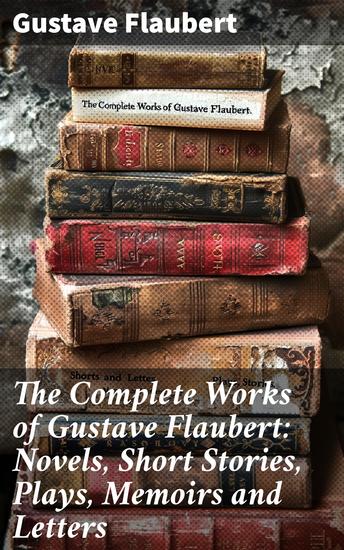
The Complete Works of Gustave Flaubert: Novels Short Stories Plays Memoirs and Letters - Masterful Realism in 19th-Century French Literature - cover
LER

The Complete Works of Gustave Flaubert: Novels Short Stories Plays Memoirs and Letters - Masterful Realism in 19th-Century French Literature

Gustave Flaubert

Tradutor Eleanor Marx Aveling

Editora: Good Press

  • 0
  • 0
  • 0

Sinopse

Gustave Flaubert's "The Complete Works of Gustave Flaubert: Novels, Short Stories, Plays, Memoirs and Letters" is an expansive anthology that encapsulates the author's literary vision and artistic evolution. Flaubert's distinctive prose style'Äîmarked by meticulous detail and psychological depth'Äîillustrates his relentless pursuit of artistic perfection and his commitment to realism. This collection not only presents his seminal works such as "Madame Bovary" and "A Simple Heart," but also provides insight into his creative process through personal letters, memoirs, and lesser-known short stories, offering a comprehensive view of his contributions to 19th-century literature within the context of burgeoning realism and modernism. Gustave Flaubert, a pioneer of literary realism, was born in 1821 in Rouen, France, a backdrop that heavily influenced his writings. His meticulous nature and dedication to crafting evocative narratives stem from his belief that a writer must engage deeply with their subject matter. Flaubert's tumultuous relationship with societal norms, his critiques of bourgeois morality, and his explorations of human passion and disillusionment underscore the profound themes embedded within this collection. This anthology is a must-read for scholars and literature enthusiasts alike, as it provides not only a complete overview of Flaubert'Äôs oeuvre but also an invaluable context for understanding the evolution of French literature. Through engaging with Flaubert'Äôs complete works, readers will discover the intricacies of human emotion and the transformative power of storytelling, confirming Flaubert's enduring legacy as one of literature's most influential figures.
Disponível desde: 06/01/2024.
Comprimento de impressão: 830 páginas.
Outros livros que poderiam interessá-lo

  • The Second History of Man - cover

    The Second History of Man

    MD John Bershof

    • 0
    • 0
    • 0
    In the spirit of medieval writer Chaucer, all human activity lies within the artist’s scope, the History of Man Series uses medicine as a jumping off point to explore precisely that, all history, all science, all human activity since the beginning of time. The jumping off style of writing takes the reader, the listener into worlds unknown, always returning to base, only to jump off again. History of Man are stories and tales of nearly everything. 
    The Second History of Man focuses mostly on bacteria and bacterial infections as the foundation, jumping off into Darwin and evolution, gin & tonics and the discovery of the first antibiotic to treat infection (and it wasn’t penicillin), visiting with those clever chaps who cook up drugs in the lab. We’ll call upon poets & poetry, celebrities like Frank Sinatra, the Rat Pack, and Bobby Darin, the classical music of Haydn, Mozart and Beethoven, the tragic story of World War II, Anne Frank and the Holocaust, tuberculosis, and a few of the rich & famous who suffered from TB, travelling back in time to the Black Death which wiped out 25 percent of humans on Earth, exploring the origins of a salon and a saloon, Columbus and the Age of Discovery, the lost generations of childhood, ending with the invention of the Internet.
    Ver livro
  • The American Experiment - A Study of Democracy in Action - cover

    The American Experiment - A...

    Harry Montgomery

    • 0
    • 0
    • 0
    American democracy did not emerge overnight but was built on centuries of ideas and experiences that shaped political thought and practice. Early influences came from the ancient Greeks, whose experiments with direct democracy in city-states demonstrated that citizens could participate in their government. The ancient model, however, was limited in scope and exclusive in nature, leaving out women, slaves, and non-citizens. These limitations sparked later thinkers to envision a more inclusive system in which all individuals might have a voice. 
    The influence of the Roman Republic was also significant. The Romans developed a system of representative government, incorporating checks and balances that would later be crucial in American political structure. Their ideas of civic duty, legal rights, and the importance of a written code of laws resonated with future leaders who saw the need for a balanced government where power was neither overly concentrated nor arbitrary. The Roman emphasis on civic responsibility established an early link between law and governance that would later inform the formation of the United States. 
    The enlightenment period ignited a profound transformation in political thinking. Philosophers such as John Locke, Montesquieu, and Rousseau wrote about natural rights, the separation of powers, and the social contract. Locke’s advocacy of life, liberty, and property laid the groundwork for the concept that governments exist to serve the people and that their authority is derived from the consent of the governed. Montesquieu’s writings on the separation of governmental power into branches to prevent tyranny became a key element in the design of the American political system. These ideas gained traction among colonial leaders, who saw in them the means to challenge the existing forms of monarchical and aristocratic rule.
    Ver livro
  • Tip of the Spear - German Armored Reconnaissance in Action in World War II - cover

    Tip of the Spear - German...

    Robert J Edwards, Michael H...

    • 0
    • 0
    • 0
    A comprehensive pictorial study of Germany’s armored reconnaissance operations across all WWII combat zones. From the invasions of Poland and France to the advances on the Eastern Front and in North Africa, German tank and infantry units unleashed brutal displays of power. But it was the German armored reconnaissance that laid the groundwork for these stunning victories. In Tip of the Spear, delves into German reconnaissance operations through firsthand accounts, after-action reports, and an extensive collection of wartime photographs.   The author of Scouts Out, the first extensive treatment of the subject in English, Edwards delves deeper into the subject of German reconnaissance with extensive analysis of everything from tactics and doctrine to vehicles and commanders.
    Ver livro
  • Education Imagination and Myth with James Hillman - cover

    Education Imagination and Myth...

    James Hillman

    • 0
    • 0
    • 0
    James Hillman is the father of Archetypal Psychology. This rare program focuses on Education, Imagination and Myth with James Hillman. Here is a transcribed excerpt: 
     
    "And it's very important for the teacher to allow these things to occur, to feel them, to experience them even to record them so that she or he feels comfortable with the strangeness of the imaginative world with the gods and the demons and the animals and the jungles and the territories that are the source of one's imaginative life. 
    Unless the teachers comfortable with that he or she will censor and repress or suppress the imaginative life of the pupil. It seems to me that everyone can be re-tread. ▪ We can all get a retread and you unlearn. 
    I mean, one of the basic things of learning is unlearning what you've learned, not just negative capability, but negative learning learning against what you've learned. 
    You have to learn the stuff and then you see through it and you unlearn it."
    Ver livro
  • How to Do the Right Thing - An Ancient Guide to Treating People Fairly - cover

    How to Do the Right Thing - An...

    Seneca, Robert A. Kaster

    • 0
    • 0
    • 0
    How ancient Stoicism can help teach us to treat others—and ourselves—more fairly and mercifully 


    There are times when we've all felt that we haven't been treated as we deserve—that we've been misjudged, shortchanged, or given a raw deal. And, at one time or another, other people have probably felt that we've treated them just as unfairly. How to Do the Right Thing draws on the principles of ancient Stoicism as articulated by the Roman statesman and philosopher Seneca to help listeners better navigate one of the most important practical questions of daily life—how to do right by others. 


    Starting from the virtue of magnanimity—the opposite of small-mindedness—How to Do the Right Thing draws together lessons from Seneca's writings that stress the importance of calm and clear thinking, of judging oneself fairly before judging others, and of cutting people slack, with a bias toward mercy—all delivered in crisp and lively new translations.
    Ver livro
  • Great Train Robber The: My Autobiography - The Inside Story of Britain's Most Notorious Heist - cover

    Great Train Robber The: My...

    Chris Pickard

    • 0
    • 0
    • 0
    What is it that fascinates so many people about Ronnie Biggs and makes him a household name sixty years on from the crime that made his name? Is it the man or the myth that makes Ron a latter-day Robin Hood, and the odd man out who is best remembered from a gang of sixteen who held up a mail train in August 1963?This book covers Ron's entire life including the Great Train Robbery, his conviction and subsequent escape from HMP Wandsworth. Ron tells how he managed to outrun and outthink the posse of law enforcement officers and the media that chased him around the world as one of its most wanted men. From his time in Australia, to his discovery and arrest in Brazil in 1974, it is all included here. It covers the two attempts to kidnap him, and his son Mike's rise to stardom.For the first time Ron tells exactly what has happened to him since the early 1990s to today, including his strokes, his attempted suicide, the death of his partner and friends, the extradition attempts, the Rio carnival tribute, his decision to come back to the UK, and his much publicised return in 2001 after 13,068 days on the run. It also covers his death in 2013 and the legacy he leaves behind.This is not only Ronald Biggs' autobiography; it is also the most complete biography of one of the most famous names in British life of the last 50 years. A brand new 10,000-word timeline covers not only the life and times of Ronald Biggs, but includes the most detailed timeline and facts ever published about the events surrounding the Great Train Robbery itself.This book will stand the test of time as the most complete telling of the life and times of the man who is Ronald Arthur Biggs, and his part in the Great Train Robbery.
    Ver livro