¡Acompáñanos a viajar por el mundo de los libros!
Añadir este libro a la estantería
Grey
Escribe un nuevo comentario Default profile 50px
Grey
Suscríbete para leer el libro completo o lee las primeras páginas gratis.
All characters reduced
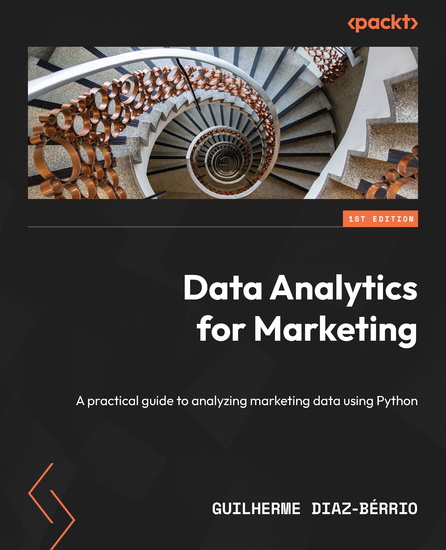
Data Analytics for Marketing - A practical guide to analyzing marketing data using Python - cover

Data Analytics for Marketing - A practical guide to analyzing marketing data using Python

Guilherme Diaz-Bérrio

Editorial: Packt Publishing

  • 0
  • 0
  • 0

Sinopsis

Most marketing professionals are familiar with various sources of customer data that promise insights for success. There are extensive sources of data, from customer surveys to digital marketing data. Moreover, there is an increasing variety of tools and techniques to shape data, from small to big data. However, having the right knowledge and understanding the context of how to use data and tools is crucial.In this book, you’ll learn how to give context to your data and turn it into useful information. You’ll understand how and where to use a tool or dataset for a specific question, exploring the "what and why questions" to provide real value to your stakeholders. Using Python, this book will delve into the basics of analytics and causal inference. Then, you’ll focus on visualization and presentation, followed by understanding guidelines on how to present and condense large amounts of information into KPIs. After learning how to plan ahead and forecast, you’ll delve into customer analytics and insights. Finally, you’ll measure the effectiveness of your marketing efforts and derive insights for data-driven decision-making.By the end of this book, you’ll understand the tools you need to use on specific datasets to provide context and shape your data, as well as to gain information to boost your marketing efforts.
Disponible desde: 10/05/2024.
Longitud de impresión: 452 páginas.

Otros libros que te pueden interesar

  • Build a SaaS Product with Claude Code and Zero Technical Skills - The $10K MRR Guide for Beginners and Entrepreneurs - cover

    Build a SaaS Product with Claude...

    Tom Anderson

    • 0
    • 0
    • 0
    This audiobook is narrated by an AI Voice.   
    Are you tired of watching developers build products while you sit on the sidelines with brilliant ideas? This comprehensive guide shows exactly how to build, launch, and scale a profitable SaaS business using AI-powered tools like Claude, Claude Code, and Cursor. 
    What Makes This Different: 
    Unlike no-code platforms that trap you in expensive ecosystems, this book teaches you to build real software assets you own completely. You will generate actual code, control your database, and create a product that scales without platform limitations. 
    Your Complete Roadmap to $10K MRR: 
    • Validate Before You Build: Find problems people already pay to solve using Reddit, forums, and niche communities • Master AI-Assisted Development: Control Claude Code and Cursor to write production-ready code through clear prompts • Build Professional Architecture: Set up Next.js, Supabase, Stripe, and Vercel without server management headaches 
    • Automate Payments and Growth: Create seamless user experiences that convert visitors into paying subscribers 
    • Scale Systematically: Reach 100-200 paying customers within 6-12 months using proven acquisition channels 
    Perfect For: 
    • Entrepreneurs with validated ideas who need to build the product 
    • Professionals who have spotted industry problems worth solving 
    • Former no-code users who have hit platform limitations 
    • Anyone with domain expertise but no programming background 
    Real-World Implementation: 
    Every chapter includes practical examples, prompt templates, and workflow patterns you can use immediately. Learn how to structure projects so AI understands your conventions, test features without technical knowledge, and debug problems through clear communication. 
    Setting up your development environment, writing specifications that guide AI code generation, implementing Stripe subscriptions and webhooks, deploying to production with Vercel, and iterating safely without breaking existing features.
    Ver libro
  • The Shock of Change that understanding the human condition brings - cover

    The Shock of Change that...

    Jeremy Griffith

    • 0
    • 0
    • 0
    As biologist Jeremy Griffith explains in THE Interview (which psychiatrist Professor Harry Prosen described as “the most important interview of all time”), while we humans lacked the explanation for our 2-million-year corrupted human condition we had no choice but to deny that our distant ape ancestors lived in a state of cooperative and loving innocence. But with the good reason for our corrupted condition now finally found, our species' original state of innocence can at last be admitted - and, as Griffith makes clear in his essay The Great Guilt, what that honesty finally allows us to see is the immense guilt and shame we humans have been carrying for corrupting our original instinctive self or soul. 
    Finding the redeeming understanding of our corrupted condition also means we no longer need to employ the artificial reinforcements we have been depending on to sustain our sense of self-worth of attacking, defying, and denying the implication that we are guilty, bad people. What this essay, The Shock Of Change that understanding the human condition brings, addresses is how to manage the great shock of change that inevitably occurs in this fabulous transformation from having to depend on our now obsoleted, artificial, angry, egocentric and alienating forms of reinforcement, to living free of them. 
    This booklet is supported by a very informative website at HumanCondition.com.
    Ver libro
  • Beyond Calories - The Science and Benefits of Popular Diets - cover

    Beyond Calories - The Science...

    Dr. Ferghal Armstrong

    • 0
    • 0
    • 0
    In an era overwhelmed with dietary advice and nutrition fads, making informed choices about what to eat can be challenging. "Beyond Calories: The Science and Benefits of Popular Diets" by Dr. Ferghal Armstrong provides a comprehensive, science-based exploration of various diets to help you navigate this complex landscape. 
    This enlightening book delves into the true impact of our dietary choices on health, moving past the simplistic notion of calorie counting to uncover the deeper relationship between food and overall well-being. Dr. Armstrong, a renowned specialist in addiction medicine and lifestyle health, offers insights into several popular and scientifically supported diets, presenting their historical backgrounds, core principles, benefits, and potential drawbacks. 
    Key Highlights: 
    Food Addiction and Binge Eating: Understand the complexities of food addiction and how it affects eating habits, supported by the latest diagnostic criteria and tools. 
    Fed and Fasted States: Gain insight into how our bodies process food and the importance of balancing nutrient intake for optimal health. 
    Dietary Choices for Health: Explore the science behind various diets, including the Mediterranean, DASH, Keto, Low Carb High Fat, Portfolio, and Intermittent Fasting diets, and how they can be tailored to meet your unique needs. 
    Chronic Disease Prevention: Learn how thoughtful dietary choices can help prevent and manage conditions such as diabetes, heart disease, and multiple sclerosis. 
    Lifestyle Medicine: Emphasize the six pillars of lifestyle medicine—exercise, diet, substance use, sleep, stress management, and socialization—to achieve sustained health and well-being. 
    Each chapter of "Beyond Calories" is dedicated to a specific diet, providing detailed explanations of their mechanisms, supported by landmark studies and practical tips for integration into daily life.
    Ver libro
  • Younger Dryas Period The: The History of the Earth’s Drastic Climate Change at the End of the Pleistocene Era - cover

    Younger Dryas Period The: The...

    Editors Charles River

    • 0
    • 0
    • 0
    From about 12,900 to 11,700 before present (BP), near Ice Age conditions returned to the Northern Hemisphere of the planet. It was a sudden shift from the warm temperatures that had prevailed for nearly 2,000 years. This period is referred to by archaeologists, geologists, and earth scientists as the Greenland Stadial, but it is more commonly known as the Younger Dryas. The Younger Dryas marked the end of the last glacial period, the end of the Pleistocene Era, and the beginning of the Holocene Era, which is the current era. It was a period of great change, when climate change happened quite quickly, directly affecting the flora, fauna, and humans of the Northern Hemisphere in the process. The impact on the human populations was perhaps most important because, in some places, it virtually destroyed emerging cultures, while in other places, it might have propelled humans to develop new survival traits and technologies later used to move humanity into the Neolithic era. Although scholars now know quite a bit about the Younger Dryas, many elements of it are still debated. Other aspects serve as a predictor of what humans can expect in the future. 
    	There is, however, still plenty of information about the Younger Dryas that remains unknown or open to debate. Not all scholars agree on the dates of the Younger Dryas or how long it lasted. Even more controversial are the alternate theories about what caused the Younger Dryas and the effect it had on the Northern Hemisphere’s bio-populations. This book examines the background of the Younger Dryas, its effects on bio-populations, and how it contributed to the emergence of the Neolithic Era. Alternative theories will be examined and compared to more standard ideas currently prevailing in academia.
    Ver libro
  • Data Warehousing and Business Intelligence - Empowering Organizations with Data-driven Intelligence - cover

    Data Warehousing and Business...

    Daniel Garfield

    • 0
    • 0
    • 0
    "Data Warehousing and Business Intelligence: Empowering Organizations with Data-driven Intelligence" 
    In today's data-driven world, organizations need to harness the power of their data to gain insights, make informed decisions, and drive strategic growth. "Data Warehousing and Business Intelligence: Empowering Organizations with Data-driven Intelligence" is a comprehensive guide that explores the fundamental concepts, best practices, and practical implementation strategies of data warehousing and business intelligence. 
    This book serves as a roadmap for organizations seeking to unlock the full potential of their data assets. Starting with the foundations of data warehousing, readers will gain a clear understanding of the architecture, data modeling, and data integration techniques required for successful implementation. They will explore the key components of a business intelligence ecosystem and learn how to leverage data visualization, reporting, and analytics tools to transform raw data into actionable insights. 
    The book delves into the practical aspects of data warehouse implementation, covering topics such as project management, technology selection, data extraction and transformation, and data loading. Readers will discover popular business intelligence tools and platforms, and learn how to build interactive dashboards and visualizations that facilitate data exploration and analysis. 
    Real-world case studies and examples from various industries illustrate the successful application of data warehousing and business intelligence in practice. The book also highlights the importance of data governance, compliance, and security, providing guidance on how to ensure data integrity and protect sensitive information. 
    Unlock the potential of your data. Empower your organization with data-driven intelligence. Get started with "Data Warehousing and Business Intelligence" today. 
     
    Ver libro
  • The New Empire of AI - The Future of Global Inequality - cover

    The New Empire of AI - The...

    Rachael Adams

    • 0
    • 0
    • 0
    As AI takes hold across the planet and wealthy nations seek to position themselves as global leaders of this new technology, the gap is widening between those who benefit from it and those who are subjugated by it. As Rachel Adams shows in this hard-hitting book, growing inequality is the single biggest threat to the transformative potential of AI. Not only is AI built on an unequal global system of power, it stands poised to entrench existing inequities, further consolidating a new age of empire. 


    AI's impact on inequality will not be experienced in poorer countries only: it will be felt everywhere. The effects will be seen in intensified international migration as opportunities become increasingly concentrated in wealthier nations; in heightened political instability and populist politics; and in climate-related disasters caused by an industry blind to its environmental impact across supply chains. 


    We need to act now to address these issues. Only if the current inequitable trajectory of AI is halted, the incentives changed, and the production and use of AI decentralized from wealthier nations will AI be able to deliver on its promise to build a better world for all.
    Ver libro