Junte-se a nós em uma viagem ao mundo dos livros!
Adicionar este livro à prateleira
Grey
Deixe um novo comentário Default profile 50px
Grey
Assine para ler o livro completo ou leia as primeiras páginas de graça!
All characters reduced
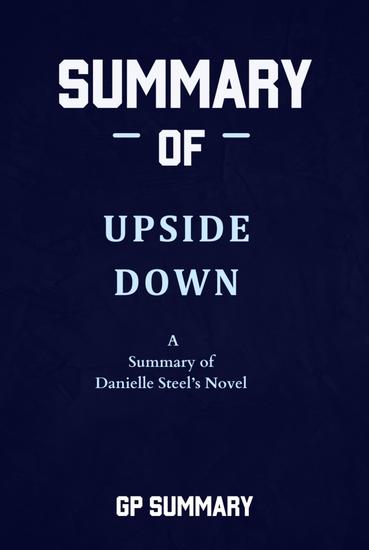
Summary of Upside Down a Novel by Danielle Steel - cover
LER

Summary of Upside Down a Novel by Danielle Steel

GP SUMMARY

Editora: BookRix

  • 0
  • 0
  • 0

Sinopse

DISCLAIMER
This book does not in any capacity mean to replace the original book but to serve as a vast summary of the original book.

Summary of Upside Down a Novel by Danielle Steel
 
IN THIS SUMMARIZED BOOK, YOU WILL GET:


- - Chapter astute outline of the main contents.
- - Fast & simple understanding of the content analysis.
- - Exceptionally summarized content that you may skip in the original book 
Danielle Steel's novel, Upside Down, follows the story of Hollywood icon Ardith Law and her daughter Morgan, who are struggling with their relationship. Ardith becomes a single mother after her unfaithful husband dies, and she hires a temporary personal assistant, Josh Gray, to help her navigate her new life. Morgan is swept off her feet by TV anchorman Ben Ryan, but a blackmail scheme threatens their relationship. As they navigate their unconventional romance, they must find a way to put aside their past for a new future.
Disponível desde: 06/01/2024.
Comprimento de impressão: 74 páginas.

Outros livros que poderiam interessá-lo

  • Reckoning of Power - Oppenheimer the Atomic Bomb & World War 2 - cover

    Reckoning of Power - Oppenheimer...

    History Brought Alive

    • 0
    • 0
    • 0
    Discover the untold story of the most terrifying invention in human historyThis audiobook explores the history of the Atomic Bomb in World War II, and uncovers Robert Oppenheimer's mysterious role as its visionary leader.As the world plunged into war, Oppenheimer found himself at the centre of a moral and scientific dilemma. Could science save humanity, or would it be its downfall?With gripping narratives and meticulous research, this book takes you on a riveting journey from the Manhattan Project to the Atomic Bombings at Hiroshima and Nagasaka, traversing the landscapes of WWII, and the nuclear age aftermath.Here are some of the highlights: 
    J. Robert Oppenheimer, the brilliant, but troubled physicist who played a key role in the development of the Atomic Bomb 
    Explore the turbulent backdrop of World War II, where global conflict ignited scientific innovation 
    Step into the shoes of some of the greatest scientific minds in history—Albert Einstein, Edward Teller, Leslie Groves, Niels Bohr, and Leo Szilárd 
    Witness the crucial moments and decisions that led to the dropping of the "Little Boy" and "Fat Man" Atomic Bombs on Hiroshima and Nagasaki 
    Discover the Manhattan Project, a top secret mission that assembled the world's brightest minds in a race against the sinister, Nazi Atomic Project 
    E = mc²: Unravel the mysteries of Einstein's groundbreaking equation that laid the foundation for atomic science 
    Explore the Cold War and the arms race, followed by a glimpse into the future of nuclear energy 
    All of this and much, much more….Whether you're a history enthusiast or new to the subject, this book tells all about Oppenheimer, the Atomic Bomb, World War II, and the Nuclear Age Aftermath.Grab your copy of this book today!
    Ver livro
  • Mr Vic’s X-Rated Television Murdoch Mysteries Dr Ogden With Dr Grace - cover

    Mr Vic’s X-Rated Television...

    VIC VITALE

    • 0
    • 0
    • 0
    Dr. Ogden is married to Detective William Murdoch. They are very happy together with a sex life that is extremely hot.  
    There is no logical reason for the straight doctor to take up with lesbian Dr. Grace in a girl on girl sexual affair, but she does, only to be caught in the licking act by a husband who takes full advantage of a golden opportunity.  
      
     
    Ver livro
  • French Revolution The: An Enthralling Guide to a Major Event in World History - cover

    French Revolution The: An...

    Billy Wellman

    • 0
    • 0
    • 0
    The French Revolution is incredibly complex and involves a lot of moving parts, from the monarchy to the political clubs, from the intelligentsia to the starving peasantry protesting in the streets. This audiobook breaks it down for you in simple terms. 
    It could be argued that the French Revolution is the perfect example of a social movement that began with the best of intentions yet somehow went wrong.  
    The ideologues of the French Revolution were seeking to create a better, more just society. Their eloquent and profound words about equality, freedom of religion, and sound representation became a great source of inspiration for many. French Enlightenment thinkers even influenced the American Revolution, which occurred prior to France’s revolution. 
    But while the American Revolution resulted in the founding of a nation based upon the principles of democracy and representative government, the French Revolution devolved into an utter nightmare, especially for those in the upper class. 
    The French Revolution witnessed mob violence of the worse kind. Practically no one was safe. The king and queen were killed by the guillotine, and so was the Jacobin architect of the “Great Terror,” Maximilien Robespierre. Then, in perhaps one of the greatest ironies of all, the French Revolution ended with the rise of Napoleon Bonaparte, who became a dictator. Many scholars refer to Napoleon as an “enlightened despot,” but he was a dictator all the same.  
    The French Revolution does indeed present itself as an incredibly perplexing paradox. What happened? What went wrong? Here in this audiobook, we explore the possibilities. 
    Scroll up and click the “add to cart” button to begin learning about the French Revolution!
    Ver livro
  • The Practice of Presence - Five Paths for Daily Life - cover

    The Practice of Presence - Five...

    Patty de Llosa

    • 0
    • 0
    • 0
    Listen as Patty de Llosa takes us on a journey of discovery through mind, body and spirit, encouraging us to practice presence. Each of the five spiritual paths she explores can lead to a more authentic, extraordinary life of daily awareness. You'll discover practical guidance on how to seek daily what we truly desire behind all the urgencies and obligations of our lives: contact with our own immediate inner truth.
    Ver livro
  • Anglo-Ashanti Wars and the Anglo-Zulu War The: The History of the British Empire’s Costliest Campaigns against Indigenous Africans - cover

    Anglo-Ashanti Wars and the...

    Editors Charles River

    • 0
    • 0
    • 0
    By the mid-19th century, other European powers became interested not only in the exploration of Africa but the exploitation of it, especially once the German Empire unified after the Franco-Prussian War. This began a rush, spearheaded mainly by European commercial interests in the form of chartered companies, to penetrate the African interior and woo its leadership with guns, trinkets and alcohol, and having thus obtained their marks or seals upon spurious treaties, begin establishing boundaries of future European colonies. The ease with which this was achieved was due to the fact that, at that point, traditional African leadership was disunited, and the people had just staggered back from centuries of concussion inflicted by the slave trade. Thus, to usurp authority, to intimidate an already broken society, and to play one leader against the other was a diplomatic task so simple, much of Africa would come under European influence in a short time.  
    	For almost a century, the British in West Africa were faced with a powerful and stubborn African opponent: the Ashanti Empire. The Ashanti were formed by alliance and the conquest of the Akan people in the rainforest zone between the West African coast and the Sahel country to the north. 	The Ashanti fought the British in five wars over the nineteenth century, and they were the only West African people inflicting more than one defeat on the British. War in tropical West Africa was different from most of the rest of the world. The prevalence of endemic diseases like malaria typically killed half of the Europeans posted there per year; it was called “The White Man’s Grave” for a reason. A second factor was the presence of the tsetse fly that carried a disease able to kill horses quickly. Military expeditions were left to move entirely on foot, carrying whatever drafted or hired laborers could carry. There were no carts, no wagons, no pack animals, and no cavalry. 
    Ver livro
  • Aztec Astronomy and Astrology: The History of the Aztec’s Measurements of the Planets and Stars - cover

    Aztec Astronomy and Astrology:...

    Editors Charles River

    • 0
    • 0
    • 0
    Nearly 500 years after the Spanish conquered their mighty empire, the Aztecs are often remembered today for their major capital, Tenochtitlan, as well as being fierce conquerors of the Valley of Mexico who often engaged in human sacrifice rituals. Unlike the Maya, the Aztecs are not widely viewed or remembered with nuance, in part because their own leader burned extant Aztec writings and rewrote a mythologized history explaining his empire’s dominance less than a century before the Spanish arrived. Naturally, Cortes and other Spaniards depicted the Aztecs as savages greatly in need of conversion to Catholicism. While the Maya are remembered for their astronomy, numeral system, and calendar, the Aztecs have primarily been remembered in a far narrower way, despite continuing to be a source of pride to Mexicans through the centuries. 
    	For the Aztec, astronomy was not a purely scientific pursuit but intimately linked to religious, mythological, and ideological elements that were of the highest importance. The celestial realm held a sacred nature, as did the many gods and goddesses that dwelt there, so for all Mesoamerican cultures, astronomy was a fundamental part of their daily lives. Thus, astronomy was present in their calendars, religion, and even agriculture, and in close relation to astronomy, the concept of time was also an essential part of their worldview. The Aztec recorded many of the astronomical events they observed in codices and hieroglyphic inscriptions, but the main evidence of their deep astronomical knowledge comes from their calendar system. This information was then used to plan the orientation of buildings and ceremonial centers, which were aligned to sunrises or sunsets corresponding to special dates, such as solstices or equinoxes. Observational calendars were also used to schedule agricultural activities, as well as rituals, festivals, and celebrations, on an annual cycle.
    Ver livro