Join us on a literary world trip!
Add this book to bookshelf
Grey
Write a new comment Default profile 50px
Grey
Subscribe to read the full book or read the first pages for free!
All characters reduced
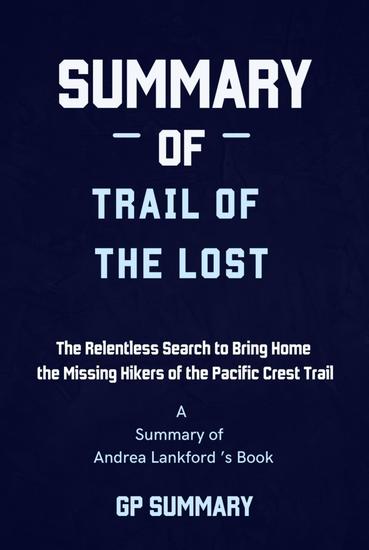
Summary of Trail of the Lost by Andrea Lankford - The Relentless Search to Bring Home the Missing Hikers of the Pacific Crest Trail - cover

Summary of Trail of the Lost by Andrea Lankford - The Relentless Search to Bring Home the Missing Hikers of the Pacific Crest Trail

GP SUMMARY

Publisher: BookRix

  • 0
  • 0
  • 0

Summary

DISCLAIMER
This book does not in any capacity mean to replace the original book but to serve as a vast summary of the original book.
 
Summary of Trail of the Lost by Andrea Lankford: The Relentless Search to Bring Home the Missing Hikers of the Pacific Crest Trail
 
IN THIS SUMMARIZED BOOK, YOU WILL GET:
 

- Chapter astute outline of the main contents.
- Fast & simple understanding of the content analysis.
- Exceptionally summarized content that you may skip in the original book 
Andrea Lankford, a former law enforcement park ranger and investigator, embarks on a quest to find missing hikers along the Pacific Crest Trail. After leaving the National Park Service after twelve years, she discovers three young men have vanished from the trail. She joins an eclectic team of amateurs, including a mother of the missing, a retired pharmacy manager, and a mapmaker. They track kidnappers, murderers, cults, psychics, and international fugitives. The search for the missing is a brutal psychological and physical test, but their hardships lead them to unexpected places and people. The book explores hiker culture, determination, generosity, and hope, and the vast and treacherous nature of the natural world.
Available since: 09/17/2023.
Print length: 101 pages.

Other books that might interest you

  • The Legends of the West Point Class of 1846 - cover

    The Legends of the West Point...

    Editors Charles River

    • 0
    • 0
    • 0
    West Point has long been America’s most famous military academy, but in the early 19th century, it was a highly unimpressive school consisting of a few ugly buildings facing a desolate, barren parade ground. Established with just five officers and ten cadets of the Corps of Engineers on March 16, 1802, the Academy was built on a spot just 50 miles north of New York City which had been a key Hudson River military fortress during the Revolutionary War. Cadets attending during the “Point's” first several decades were obliged to maintain their daily regimen knowing the school might shut down at any moment, as the U. S. government frequently questioned why it should provide free education. 
    As it turned out, West Point would become the foremost military academy in the nation, but none of the West Point classes became as famous as the Class of 1846, which boasted more than a dozen future Civil War generals. The Class of 1846 included a shy kid named Thomas Jonathan Jackson who made few friends and struggled with his studies, finishing 17th in his class 15 years before becoming Stonewall. Also in that class was A.P. Hill, who was already in love with the future wife of George McClellan, a young prodigy who finished second in the class of 1846. A popular and mischievous George Pickett would play hooky at the local bar and struggle just to finish last in the class, and the Class of 1846 also churned out critical Union generals like Jesse Reno, Darius Couch, and George Stoneman. 
    Before these men opposed each other on Civil War battlefields, they forged their own friendships and charted their future paths together at West Point and the Mexican-American War. 
    Show book
  • Essentials of Daoism - Including: The Sayings of Lao Tzu The Dao De Jing Zhuangzi Lieh Tzu and Sun Tzu on the Art of War - cover

    Essentials of Daoism -...

    James Legge, Lionel Giles, Lao...

    • 0
    • 0
    • 0
    This book comprises five classic works of Chinese mysticism. Culturally, these are the companion works to Confucius’ thoughts, as expanded by Mencius. Confucianism is very much the Apollonian side of Chinese culture. It focuses on matters of ethics, hierarchy, responsibility, and social obligation. Daoism is the other side of the coin, focused on abstraction and uncertainty. 
    The two translators included in this volume were very different men. While they wrote in the same period, their audiences were distinct from one another, and this comes through in their differing approaches to the original texts they are working with. One was a missionary, looking to ensure that his fellow spreaders of the word could understand as completely and correctly as possible the culture that they had come into. The other was a curator at the British Museum, who popularized the first English translations for a thoroughly domestic market.
    Show book
  • Learn Portuguese With Music - cover

    Learn Portuguese With Music

    Innovative Language Learning, ...

    • 0
    • 0
    • 0
    Can learning Portuguese be as simple as listening to music? 


    And as easy as remembering song lyrics?


    Just think. You remember song lyrics because lyrics are catchy, repeated throughout the song, and go with the music, right? Now, if you stuck in Portuguese, you’d easily learn Portuguese words and phrases the same way! 


    So, yes, learning Portuguese is as easy as listening to music… with the Learn Portuguese With Music Audiobook.


    Just press play, and you’ll hear Portuguese words and phrases repeated to the beat of upbeat and cheerful music. And… follow along!


    You’ll learn 180+ most common Portuguese words and phrases… while relaxing at home, or while driving to work.


    Learn Portuguese With Music is the easiest way to start learning Portuguese.. without getting overwhelmed by complicated explanations. Perfect for new learners with little to no language learning experience.


    What will you learn?
     
    180+ Words & Phrases Including...
     
    • Basic Greetings
     
    • Numbers
     
    • Common Questions and Answers
     
    • Parts of the Body & Talking About Your Wellbeing
     
    • Common Hobbies
     
    • And much more


    Learn Portuguese With Music includes...
     
    • 15 Songs/Lessons Inside (Each is about 7 minutes long)
     
    • Fast-Paced Review Section at the End of Each Lesson
     
    • 1 Hour 50 Minutes in Total
     
    • Accompanying PDF eBook with the Words, Phrases and Translations


    Download the PDF and read along
    Show book
  • Hoysala Empire - The Architectural Splendor of Southern India - cover

    Hoysala Empire - The...

    Rolf Hedger

    • 0
    • 0
    • 0
    The Hoysala Empire was one of the most influential dynasties in South Indian history, known for its patronage of art, culture, and architecture. Flourishing between the 10th and 14th centuries, the empire left an indelible mark on the Deccan region, particularly in present-day Karnataka. The Hoysalas emerged as a powerful force after the decline of the Western Chalukyas, establishing their capital first at Belur and later at Halebidu. Their rule was characterized by military conquests, administrative efficiency, and an enduring legacy of architectural splendor that continues to captivate historians and art enthusiasts. 
    The origins of the Hoysala dynasty are traced to a chieftain named Sala, who, according to legend, was instructed by a Jain monk to kill a tiger that was attacking them. This act of bravery led to the adoption of the royal emblem depicting a warrior slaying a tiger, symbolizing the valor of the Hoysala rulers. Over the centuries, the dynasty expanded its influence through strategic alliances and military campaigns, gaining control over vast territories in the Deccan. Prominent rulers such as Vishnuvardhana and Veera Ballala II played a crucial role in consolidating the empire and fostering a rich cultural heritage. 
    A significant aspect of Hoysala rule was its deep connection with religious and artistic traditions. The dynasty was known for its support of Hinduism, Jainism, and, to some extent, Buddhism, leading to the construction of numerous temples and religious institutions. These temples were not just places of worship but also centers of learning and artistic expression. The Hoysalas employed skilled artisans and sculptors who developed a distinctive architectural style, characterized by intricate carvings, star-shaped temple layouts, and finely detailed sculptures depicting gods, celestial beings, and mythological narratives.
    Show book
  • WIRED & TIRED - A Guide to Revitalize Your Life - cover

    WIRED & TIRED - A Guide to...

    Ira Israel

    • 0
    • 0
    • 0
    In addition to the twin epidemics of anxiety and depression plaguing our society, psychotherapist Ira Israel has observed a new wave of highly functional adults who don't technically suffer from the debilitating symptoms of clinical anxiety and depression yet feel wired & tired: consistently overworked, overstimulated, under-loved, and underappreciated—stressed out, yet unenthusiastic about their daily responsibilities. Wired & Tired provides scientifically proven tools to alleviate the pain of typical life-ruptures (divorces, firings, etc.) as well as critical analyses of transformational moments in our lives and practices to make us resilient and keep us at the high end of our happiness spectrums.
    Show book
  • On Privacy - Twenty Lessons to Live By - cover

    On Privacy - Twenty Lessons to...

    Lawrence Cappello

    • 0
    • 0
    • 0
    This short, powerful book provides practical advice on how to protect yourself in the information age. Living today means most of us must contend with things like workplace surveillance, cyberstalking, ransomware attacks, and facial recognition. But it's not too late to protect our privacy. Written in blunt, jargon-free prose, On Privacy defines today’s privacy landscape while also reminding readers of the joys of keeping things to ourselves—that privacy creates space for intimacy, is essential to mental health, and is a fundamental right in a free society.  Explored among the book's lessons are concepts like: .The Nothing-to-Hide Trap .How we become prisoners of our recorded past .The ways small data points about us can paint revealing pictures .How Big Brother is in fact real .Why we should insist on privacy by design .How to make ensuring privacy something that is profitable.  Each lesson ends with advice on how to talk about a given aspect of privacy and how to take actionable steps to safeguard yourself. On Privacy is small book with a big message about why privacy matters, who profits by invading it, and how best to defend yours in easy, everyday ways.
    Show book