Junte-se a nós em uma viagem ao mundo dos livros!
Adicionar este livro à prateleira
Grey
Deixe um novo comentário Default profile 50px
Grey
Assine para ler o livro completo ou leia as primeiras páginas de graça!
All characters reduced
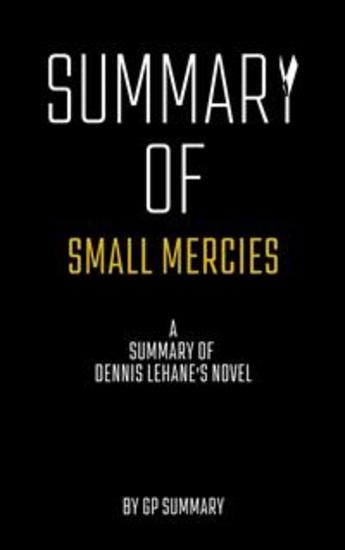
Summary of Small Mercies a Novel by Dennis Lehane - cover
LER

Summary of Small Mercies a Novel by Dennis Lehane

GP SUMMARY

Editora: BookRix

  • 0
  • 0
  • 0

Sinopse

DISCLAIMER 
  
This book does not in any capacity mean to replace the original book but to serve as a vast summary of the original book. 
  
Summary of Small Mercies a Novel by Dennis Lehane 
  
IN THIS SUMMARIZED BOOK, YOU WILL GET: 
 Chapter astute outline of the main contents.Fast & simple understanding of the content analysis.Exceptionally summarized content that you may skip in the original book  
  
Small Mercies is an all-consuming tale of revenge, family love, festering hate, and insidious power set against one of the most tumultuous episodes in Boston's history. Mary Pat Fennessy is trying to stay one step ahead of the bill collectors when her teenage daughter Jules stays out late and a young Black man is found dead. Mary Pat searches for her missing daughter and questions Marty Butler, chieftain of the Irish mob, and the men who work for him. It is a mesmerizing and wrenching work that only Dennis Lehane could write. 
 
Disponível desde: 21/12/2023.
Comprimento de impressão: 83 páginas.
Outros livros que poderiam interessá-lo

  • A Christmas Tree and A Wedding - Status Superficiality and the Chilling Cost of Social Climbing - cover

    A Christmas Tree and A Wedding -...

    Fyodor Dostoevsky, Tim Zengerink

    • 0
    • 0
    • 0
    Behind the tinsel and music... something sinister is unfolding. 
    In A Christmas Tree and A Wedding, Fyodor Dostoevsky blends holiday charm with psychological tension, revealing the disturbing realities hidden behind social events.  
    Through the keen eyes of a party guest, we witness ambition, greed, and an inappropriate obsession—all disguised as polite society. 
    This modern audiobook adaptation brings Dostoevsky’s unsettling short story to life with crisp narration and updated language, while preserving the emotional weight and social criticism that define the original. 
    What You’ll Hear in This Modern Translation: 
    •	A deceptively simple tale with dark psychological layers 
    •	Sharp observations on class, wealth, and twisted intentions 
    •	A chilling reflection on how easily society overlooks moral decay 
    Included in This Edition: 
    Modernized for clarity but faithful to its core message, this audiobook is perfect for fans of dark, thought-provoking fiction and classic literature with contemporary relevance. 
    Listen now—and see what’s hidden behind the party lights.
    Ver livro
  • Austerlitz or Death - cover

    Austerlitz or Death

    Auguste Vallois

    • 0
    • 0
    • 0
    "Austerlitz or Death" is an epic historical novel by Auguste Vallois, a captain of the Imperial Guard who recounts his memories from the battlefields of Europe to the solitude of inner exile. 
    From his revolutionary youth in Lyon to the Egyptian campaign, the victories in Italy, the glory at Austerlitz, the frozen hell of Russia, and the final tragedy at Waterloo, Auguste tells the story of the Napoleonic Empire in first person and with painful clarity—not from the pages of history books, but from the blood, mud, and soul of those who built it… and watched it fall. 
    Through these pages, the reader will march alongside a man who lost everything but his honor. You will witness how a soldier is forged, how faith fades, how a sword is held even on broken knees. Each chapter is filled with emotion, introspection, fire, and silence. Every victory bears the taste of sacrifice, and every defeat, the dignity of those who never surrendered. 
    Vallois's prose is both elegant and raw, intimate and epic, heir to the great traditions of war and memory literature such as All Quiet on the Western Front or The Disasters of War. This is not the official history of Napoleon, nor the tale of grand strategists. It is the story of the anonymous men who believed in something greater than themselves… and paid the price. 
    A novel that masterfully blends epic military drama, psychological depth, and historical tragedy. Ideal for readers of war literature, historical fiction, soldier memoirs, or explorations of the human condition in times of crisis. 
    "I served the Emperor. And I do not regret it." 
    — Auguste Vallois
    Ver livro
  • Egyptian myths and mysteries - cover

    Egyptian myths and mysteries

    Rudolph Steiner

    • 0
    • 0
    • 0
    If we ask ourselves what spiritual science should be for men, then presumably, out of all sorts of reactions and feelings that we have developed in the course of our work in this field, we will place the following answer before our souls: Spiritual science should be for us a path to the higher development of our humanity, of all that is human in us.
    Ver livro
  • A little philosophy of life - cover

    A little philosophy of life

    Robert J. Burdette

    • 0
    • 0
    • 0
    "A Little Philosophy of Life" by Robert J. Burdette is a delightful collection of essays that explore the beauty and meaning found in everyday moments. With a perfect blend of gentle humor and timeless wisdom, Burdette reflects on universal themes such as love, laughter, gratitude, and the joys of a simple life. This inspiring work invites listeners to pause, reflect, and embrace the small but profound experiences that make life fulfilling. Ideal for those seeking a fresh perspective on living with purpose and joy.
    Ver livro
  • Transforming Race Conversations - A Healing Guide for Us All - cover

    Transforming Race Conversations...

    Eugene Ellis

    • 0
    • 0
    • 0
    A guide to supporting our emergence from the tight grip of race discomfort. 


    If we are to address the injustice of racism, we need to have the "race conversation." All too often, however, attempts at this conversation are met with silence, denial, anger, or hate. This is largely because the construct of race resides not only in our minds, but principally in the body. In order to have productive conversations about race and racism, a paradigm shift is needed—one which will empower us to remain present and embodied, rather than constricted with fear, regardless of our racial identities. 


    Here, psychotherapist Eugene Ellis explores what is needed for this bodily shift to occur as he unpacks the visceral experience of the race conversation. He offers a trauma-informed, neurophysiological approach that emphasizes resourcing, body awareness, mindfulness, and healing. Transforming Race Conversations is essential for therapy practitioners as well as anyone looking to engage more effectively in the ongoing dialogue around race.
    Ver livro
  • Daily Life in Ancient Egypt - Society Culture and Customs - cover

    Daily Life in Ancient Egypt -...

    Omar Khalil

    • 0
    • 0
    • 0
    Ancient Egyptian society was highly structured, with a rigid hierarchy that defined people’s roles and responsibilities. At the top of this social order was the pharaoh, considered both a political ruler and a divine figure. Below the pharaoh were the nobility and officials who managed the kingdom’s affairs. The middle class consisted of scribes, artisans, and merchants, while the majority of the population comprised farmers, laborers, and slaves. Each social group played a crucial role in maintaining Egypt’s stability and prosperity. 
    The pharaoh was the central authority in Egypt, believed to be the living embodiment of a god. His rule was absolute, and his primary duty was to maintain ma’at, the divine balance of order and justice. He oversaw military campaigns, religious ceremonies, and massive building projects, including temples and pyramids. The royal court and government officials assisted the pharaoh in administration. These officials, often chosen from the nobility, held positions such as viziers, tax collectors, and governors, ensuring the kingdom functioned efficiently. 
    Scribes, artisans, and merchants formed the middle class, contributing to Egypt’s economy and culture. Scribes were essential for maintaining records, writing official documents, and preserving religious texts. Their education was rigorous, requiring years of training in hieroglyphic writing. Artisans, including sculptors, painters, and metalworkers, created the intricate decorations found in tombs and temples. Merchants facilitated trade both within Egypt and with foreign lands, bringing valuable goods such as gold, spices, and precious stones. Although they did not hold political power, the middle class enjoyed a stable livelihood and social respect.
    Ver livro