¡Acompáñanos a viajar por el mundo de los libros!
Añadir este libro a la estantería
Grey
Escribe un nuevo comentario Default profile 50px
Grey
Suscríbete para leer el libro completo o lee las primeras páginas gratis.
All characters reduced
Summary of Paved Paradise by Henry Grabar: How Parking Explains the World - cover

Summary of Paved Paradise by Henry Grabar: How Parking Explains the World

GP SUMMARY

Editorial: BookRix

  • 0
  • 0
  • 0

Sinopsis

DISCLAIMER
 
This book does not in any capacity mean to replace the original book but to serve as a vast summary of the original book.
 
Summary of Paved Paradise by Henry Grabar: How Parking Explains the World
 
IN THIS SUMMARIZED BOOK, YOU WILL GET:
 

- Chapter astute outline of the main contents.
- Fast & simple understanding of the content analysis.
- Exceptionally summarized content that you may skip in the original book 
Henry Grabar's investigation into the modern American city's parking crisis reveals how the pathological compulsion for car storage has exacerbated some of our most acute problems, from housing affordability to the global climate disaster. He surveys the pain points of the nation's parking crisis, from Los Angeles to Disney World to New York, and reveals how the pathological compulsion for car storage has exacerbated some of our most acute problems, ultimately lighting the way for us to free our cities from parking's cruel yoke.
 
 
Disponible desde: 10/05/2023.
Longitud de impresión: 82 páginas.

Otros libros que te pueden interesar

  • BDSM for Beginners - Introduction to the BDSM Scene and the Submissive and Dominant Role - cover

    BDSM for Beginners -...

    More Sex Fun Book Club, Melissa...

    • 0
    • 0
    • 0
    Pain and pleasure. Punishment and reward. Is that what BDSM is all about?  
    It's a big misconception that BDSM is all about punishing the sub.  
    BDSM is a safe sexual roleplaying game between you and your partner. Adding just a small dose of BDSM lets you explore your kinky side in new ways.  
    In this book, you will learn how to live out your sexual desires, explore your sexual fantasies, and experiment with pain and pleasure. This book gives you a basic understanding of everything about BDSM, including: The history of KinkBenefits of BDSMThe Basics of BDSM (subs and doms)Tools and toysPleasure spotsAnd much more  
    Ready to learn more about BDSM and start your training?
    Ver libro
  • Empath and Psychic Abilities - A Survival Guide for Highly Sensitive People to awaken your psychic and telepathic abilities - cover

    Empath and Psychic Abilities - A...

    Christian Dollwet

    • 0
    • 0
    • 0
    If you've spent your entire life being told this, chances are good that you're an empath or a very sensitive person. Our environment continually exhorts us to be more resilient. However, consider this: You cannot simply turn off your empathic abilities. There isn't a switch you can turn to turn it all off. You were born with it; it's an essential component of who you are. You shouldn't try to change it about yourself since you can't. 
    Being an empath is a wonderful gift that should be valued, fostered, and enhanced. With the weight of the entire planet on their shoulders, empaths are among the strongest people in the world. You can make your sensitivity your greatest superpower once you accept who you are! 
     In this book, you'll discover:What being an empath implies and why it's a gift rather than a burdenHow to resist being exhausted and overpowered by toxic individuals and circumstances even if you are unable to avoid themHow to harmonize and restore your chakras for a more centered and in charge feelingYou can use energy cleaning methods, meditation, and visualization to help you thrive as an empath rather than just get by.Essential oils and healing crystals for psychic development, healing, and protectionHow to communicate with your spirit guides so you can get strong advice and assistance to help you get through lifeHow to recognize and decipher auras to gain a deeper understanding of both yourself and others 
     The advantages are innumerable. So scroll up and click "Buy Now" if you're ready to start leading a more powerful life.
    Ver libro
  • Voices of Evangelical Preachers - Volume 3 - cover

    Voices of Evangelical Preachers...

    George W. Truett, Billy Sunday,...

    • 0
    • 0
    • 0
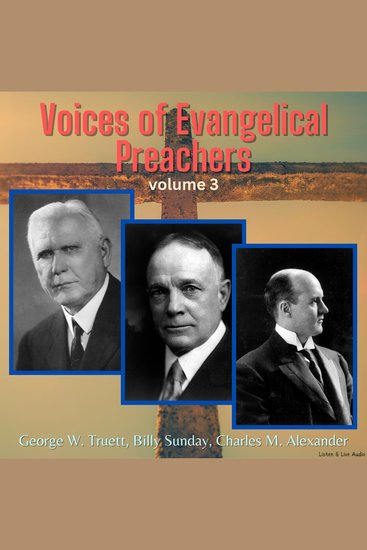
    George W. Truett (May 6, 1867 – July 7, 1944), was an American clergyman who was the pastor of the First Baptist Church of Dallas, Texas, from 1897 until 1944, and the president of the Southern Baptist Convention from 1927 to 1929. He became one of the most famous Southern Baptist preachers and writers of his era. William Ashley "Billy" Sunday (November 19, 1862 – November 6, 1935) was a popular outfielder in baseball's National League from 1883 to 1890, who later became the most celebrated and influential American evangelist during the first two decades of the 20th century. Known for his colloquial sermons and frenetic delivery, Sunday held campaigns in America's largest cities and attracted the largest crowds of any evangelist before the advent of electronic sound systems. In addition, Sunday was a strong supporter of Prohibition, and his preaching likely played a role in the adoption of the Eighteenth Amendment in 1919. Charles McCallon Alexander (1867 - 1920), a native of Tennessee, studied at Maryville University and eventually became a professor of music. After attending the Moody Bible Institute from 1892 to 1894 he became a popular gospel singer who toured with R.A. Torrey and, later, John W. Chapman to launch the "Chapman-Alexander Simultaneous Campaign."
    Ver libro
  • Darkest Hour - How Churchill Brought England Back from the Brink - cover

    Darkest Hour - How Churchill...

    Anónimo

    • 0
    • 0
    • 0
    “McCarten's pulse-pounding narrative transports the reader to those springtime weeks in 1940 when the fate of the world rested on the shoulders of Winston Churchill. A true story thrillingly told. Thoroughly researched and compulsively readable.”—Michael F. Bishop, Executive Director of the International Churchill Society 
    From the acclaimed novelist and screenwriter of The Theory of Everything comes a revelatory look at the period immediately following Winston Churchill’s ascendancy to Prime Minister 
    “He was speaking to the nation, the world, and indeed to history....” 
    May, 1940. Britain is at war. The horrors of blitzkrieg have seen one western European democracy after another fall in rapid succession to Nazi boot and shell. Invasion seems mere hours away. 
    Just days after becoming Prime Minister, Winston Churchill must deal with this horror—as well as a skeptical King, a party plotting against him, and an unprepared public. Pen in hand and typist-secretary at the ready, how could he change the mood and shore up the will of a nervous people? 
    In this gripping day-by-day, often hour-by-hour account of how an often uncertain Churchill turned Britain around, the celebrated Bafta-winning writer Anthony McCarten exposes sides of the great man never seen before. He reveals how he practiced and re-wrote his key speeches, from ‘Blood, toil, tears and sweat’ to ‘We shall fight on the beaches’; his consideration of a peace treaty with Nazi Germany, and his underappreciated role in the Dunkirk evacuation; and, above all, how 25 days helped make one man an icon. 
    Using new archive material, McCarten reveals the crucial behind-the-scenes moments that changed the course of history. It’s a scarier—and more human—story than has ever been told.
    Ver libro
  • Racism - The Enduring Battle for Equality and Human Dignity - cover

    Racism - The Enduring Battle for...

    Marcus Klein

    • 0
    • 0
    • 0
    Racism has been a persistent and destructive force throughout human history, shaping societies, cultures, and institutions in ways that continue to reverberate today. It manifests in myriad forms—through prejudice, discrimination, systemic inequities, and violence—targeting individuals and groups based on their race or ethnicity. While strides have been made in confronting this global scourge, the fight for equality and human dignity remains far from over. This enduring struggle is deeply rooted in historical injustices and perpetuated by contemporary systems of power and privilege.  
      
    Understanding racism requires a close examination of its origins, evolution, and the ways it impacts communities worldwide. Its foundations can be traced back to ancient civilizations, where societal hierarchies and prejudices began to form, later crystallizing during the eras of slavery and colonialism. These periods institutionalized racial inequality, embedding it into economic, social, and political structures. Even as humanity has progressed, racism has evolved, adapting to modern contexts while retaining its insidious influence.  
      
    The importance of addressing racism lies in the profound consequences it has on individuals and societies alike. At an individual level, it strips people of their dignity, identity, and opportunities, often leaving scars that last generations. On a societal level, racism undermines social cohesion, fosters economic inequality, and perpetuates cycles of marginalization and violence. In the face of these challenges, activists, leaders, and everyday citizens have worked tirelessly to dismantle racist systems, foster inclusion, and champion equality. 
    Ver libro
  • Mughal Empire The: The History of the Modern Dynasty that Ruled Much of India Before the British - cover

    Mughal Empire The: The History...

    Editors Charles River

    • 0
    • 0
    • 0
    In the late 15th century, Western Europe entered the Renaissance, which is often credited with the origins of modern, scientific thought. The Age of Exploration also began around that time, and 1517 is when the Reformation began. Meanwhile, the Islamic world was also quickly evolving around the same time, with the Ottoman Empire expanding into Eastern Europe and wiping the Orthodox Christian Byzantine Empire off the face of the map. And while the Ottomans were establishing themselves as the premier Islamic power with the help of early gunpowder weapons, hundreds of miles away in Central Asia, another “gunpowder empire” was forming.  
    	The Mughals, a group with Turkish and Mongolian roots, also used gunpowder weapons to sweep into northern India, topple the existing Islamic dynasty in Delhi, and eventually subject most of India to their rule. The term “gunpowder empire” was originally coined by Russian scholar V. V. Bartold and popularized by American historians William McNeil and Marshall Hodgson in the mid-20th century to describe the Islamic Ottoman, Safavid, and Mughal empires, which they claimed came to power through gunpowder. Although that core thesis has been challenged by historians in recent years, who argue that gunpowder weapons were a feature or result of the rise of these empires, not the cause for them, the term is still used (Streusand 2011, 3).  
    	To be fair, the Mughals rose through a combination of political acumen and battlefield brutality, and they held onto their empire for hundreds of years in much the same way. In the process, the Mughals developed a state that was unique in many ways, adopting elements of Islamic culture and meshing them with native Indian culture and even Western European culture. When the British conquered India in the mid-19th century, they had the benefit of inheriting the Mughal system, which, despite many problems, proved to be a suitable template for rule over a land as vast and diverse as India.
    Ver libro