¡Acompáñanos a viajar por el mundo de los libros!
Añadir este libro a la estantería
Grey
Escribe un nuevo comentario Default profile 50px
Grey
Suscríbete para leer el libro completo o lee las primeras páginas gratis.
All characters reduced
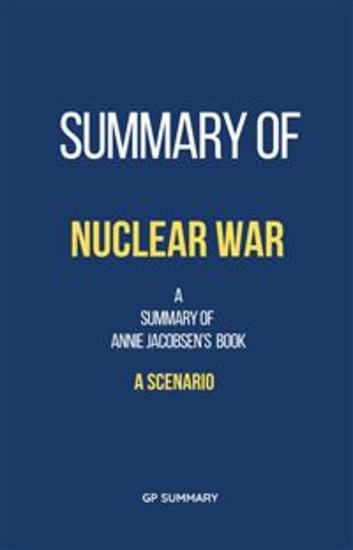
Summary of Nuclear War by Annie Jacobsen: A Scenario - cover

Summary of Nuclear War by Annie Jacobsen: A Scenario

GP SUMMARY

Editorial: BookRix

  • 0
  • 0
  • 0

Sinopsis

DISCLAIMER

This book does not in any capacity mean to replace the original book but to serve as a vast summary of the original book.

Summary of Nuclear War by Annie Jacobsen: A Scenario

IN THIS SUMMARIZED BOOK, YOU WILL GET:

	Chapter provides an astute outline of the main contents.
	Fast & simple understanding of the content analysis.
	Exceptionally summarized content that you may skip in the original book


Nuclear War: A Scenario by Annie Jacobsen is a bestseller that explores the potential consequences of a nuclear missile inbound towards the United States. The book, based on interviews with military and civilian experts, provides a vivid picture of what could happen if our nuclear guardians fail. It is essential reading for understanding the world we live in, where decisions made on seconds' notice require massive intelligence.
Disponible desde: 06/04/2024.
Longitud de impresión: 67 páginas.

Otros libros que te pueden interesar

  • Not Your Mama's Bible (NUMB) - cover

    Not Your Mama's Bible (NUMB)

    Pasha Tay

    • 0
    • 0
    • 0
    This is a bible. Not Your Mama's Bible, though-a different kind. You can say goodbye to those negative voices in your head and focus on the positive ones. You won't find any fake pleasantries here, just honest guidance that you can use to build a solid foundation in your life. In this book, we will break down the barriers of what's holding you back and how to build your self-confidence from there on out.If you are not afraid of the bitter truth, if you are not faint every time you hear a curse word, if you are not lazy and are willing to break some sweat to work on yourself-this book is for you. This no-nonsense guide is perfect for anyone looking to take control of their life, build self-confidence, and break free from negative turmoil within that's holding them back. Packed with practical tips, strategies, and exercises to help you unleash your full potential, this is the ultimate tool to help you live a happier, more fulfilling life.
    Ver libro
  • Bronze Age The: The Rise and Fall of the World’s First Advanced Civilizations - cover

    Bronze Age The: The Rise and...

    Charles River Editors

    • 0
    • 0
    • 0
    When scholars look at the passage of history, certain epochs and transitions to new periods tend to stand out. The transition from the early modern to the Industrial Age in the late 18th century and the collapse of the Roman Empire are two of the more well known, but the transition from the Bronze to the Iron Age during the late 13th and early 12th centuries B.C. arguably changed the structure and course of world history more fundamentally than any period before or since. During this period, numerous wealthy and enduring kingdoms of the eastern Mediterranean Sea region collapsed, and new ones rose in their places.  
    While the Bronze Age is recognized as one of history’s most important phases, it’s been hard for historians to precisely date. The idea of the Bronze Age comes from a three-age system developed in the 19th century through which archaeologists and historians believe cultures evolve. These three ages are the Stone Age, the Bronze Age, and the Iron Age, and the concept of the system stems from the simultaneous development of museums in Europe during that time. In the Royal Museum of Nordic Antiquities in Denmark, Christian Jürgensen Thomsen, the director of the museum, began classifying objects of stone, bronze, or iron to better categorize and exhibit them. Each archaeological artifact was thus sorted according to their materials and further organized by shape and style. Through such methodology, working alongside archaeological reports, he was able to show how certain objects changed over time. 
    Such a typology, combined with stratigraphy noted in archaeological reports, was useful to early archaeologists with no reliable method for dating artifacts. By understanding which object came before or after, early archaeologists had a relative dating system with which to assess the age of an object or culture.
    Ver libro
  • Voices of Baseball's Shot Heard Round The World - cover

    Voices of Baseball's Shot Heard...

    Ralph Branca, Eddie Stankey,...

    • 0
    • 0
    • 0
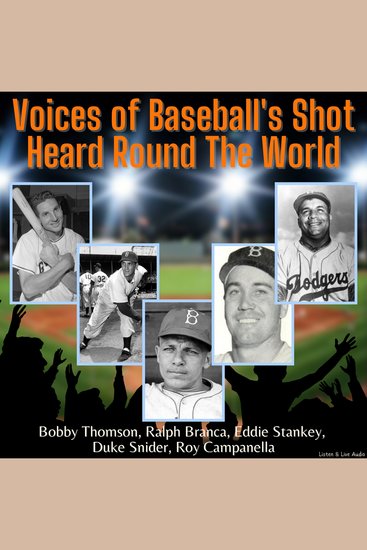
    On October 3, 1951, the New York Giants’ Bobby Thomson hit a dramatic ninth inning game-winning home run off the Brooklyn Dodgers’ Ralph Branca at the Polo Grounds in the decisive third game of a three-game playoff to win the National League pennant. 
    It would be known in baseball lore as the "Shot Heard 'Round the World." 
    The game — the first ever televised nationally—was seen by millions of viewers across America and heard on radio by millions more, including thousands of American servicemen stationed in Korea, listening on Armed Forces Radio. 
    ©2015 Bobby Thomson (P)2015 Bobby Thomson
    Ver libro
  • Ottoman Empire’s Greatest Victories The: The History and Legacy of the Most Important Battles Won by the Ottomans - cover

    Ottoman Empire’s Greatest...

    Editors Charles River

    • 0
    • 0
    • 0
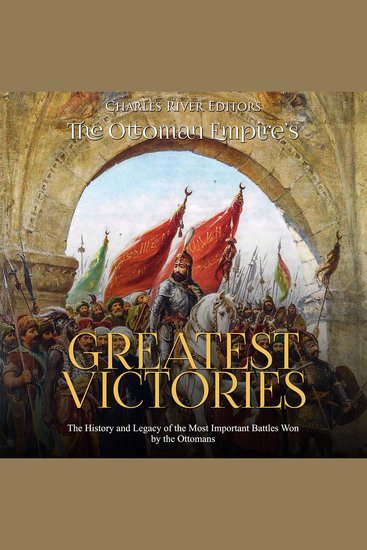
    In terms of geopolitics, perhaps the most seminal event of the Middle Ages was the successful Ottoman siege of Constantinople in 1453. The city had been an imperial capital as far back as the 4th century, when Constantine the Great shifted the power center of the Roman Empire there, effectively establishing two almost equally powerful halves of antiquity’s greatest empire. Constantinople would continue to serve as the capital of the Byzantine Empire even after the Western half of the Roman Empire collapsed in the late 5th century. Naturally, the Ottoman Empire would also use Constantinople as the capital of its empire after their conquest effectively ended the Byzantine Empire, and thanks to its strategic location, it has been a trading center for years and remains one today under the Turkish name of Istanbul.  
    The end of the Byzantine Empire had a profound effect not only on the Middle East but Europe as well. Constantinople had played a crucial part in the Crusades, and the fall of the Byzantines meant that the Ottomans now shared a border with Europe. The Islamic empire was viewed as a threat by the predominantly Christian continent to their west, and it took little time for different European nations to start clashing with the powerful Turks. In fact, the Ottomans would clash with Russians, Austrians, Venetians, Polish, and more before collapsing as a result of World War I, when they were part of the Central powers. 
    In the wake of taking Constantinople, the Ottoman Empire would spend the next few centuries expanding its size, power, and influence, bumping up against Eastern Europe and becoming one of the world’s most important geopolitical players. It was a rise that would not truly start to wane until the 19th century.
    Ver libro
  • From Ancient Arenas to Digital Fields - The Evolution of Sports Through the Ages - cover

    From Ancient Arenas to Digital...

    P Agrawal

    • 0
    • 0
    • 0
    This audiobook is narrated by an AI Voice.  
    From Ancient Arenas to Digital Fields: The Evolution of Sports Through the Ages is a sweeping journey through the history of human competition, play, and physical expression. Tracing the path of sport from its ritualistic beginnings in early human societies to the dazzling world of esports today, this book explores how games have always been more than just recreation. They have been windows into culture, identity, politics, and the human spirit itself. 
    The story begins in the ancient world, where contests were rituals intertwined with spiritual life, survival skills, and community celebrations. The Greeks carried this vision further with the Olympics, merging athletic excellence with ideals of harmony, discipline, and divine honor. Rome added grandeur and spectacle, transforming sport into a mass performance staged in colossal arenas, where gladiators, charioteers, and emperors used entertainment as a tool for both unity and political power. 
    Moving into the Middle Ages, the book explores the martial sports of knights, jousts, and chivalry, alongside the rough folk games played in village squares. These events reveal how sport both reflected and shaped social order, from feudal loyalties down to peasant celebrations. The Renaissance and early modern eras introduced rules, codifications, and the beginnings of clubs that would transform chaotic pastimes into recognizable sports, laying the foundation for modern professionalism. 
    The Age of Empires and colonial expansion carried games across borders, introducing cricket, football, and polo to far-flung corners of the world, where they often became symbols of both imperial power and subtle resistance. By the nineteenth century, professionalism took root—clubs, leagues, and international teams turned sport into an institution that began to dominate cultural and national identities.
    Ver libro
  • A Rare Recording of Wernher von Braun - cover

    A Rare Recording of Wernher von...

    Wernher Von Braun

    • 0
    • 0
    • 0
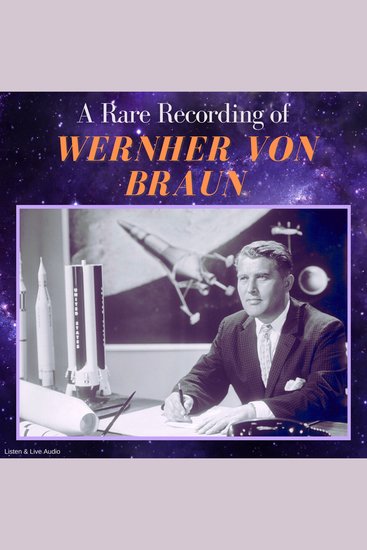
    Wernher von Braun ( March 23, 1912 – June 16, 1977) was a German aerospace engineer and space architect. He was the leading figure in the development of rocket technology in Nazi Germany and a pioneer of space technology and science in the United States. 
    After World War II, von Braun was secretly moved to the US, along with roughly 1,600 other German scientists, engineers, and technicians, as part of Operation Paperclip. He worked for the United States Army on an intermediate-range ballistic missile (IRBM) program, and he developed the rockets that launched the United States' first space satellite Explorer 1. 
    He served as director of the Marshall Space Flight Center and as the chief architect of the Saturn V super heavy-lift launch vehicle that propelled the Apollo spacecraft to the Moon. In 1955, von Braun became a naturalized citizen of the United States. In 1975, von Braun received the National Medal of Science. This recording is from Dr. Von Braun's speech at the 1st Annual SOLE Symposium, September 13, 1966, in Huntsville Alabama.
    Ver libro