Join us on a literary world trip!
Add this book to bookshelf
Grey
Write a new comment Default profile 50px
Grey
Subscribe to read the full book or read the first pages for free!
All characters reduced
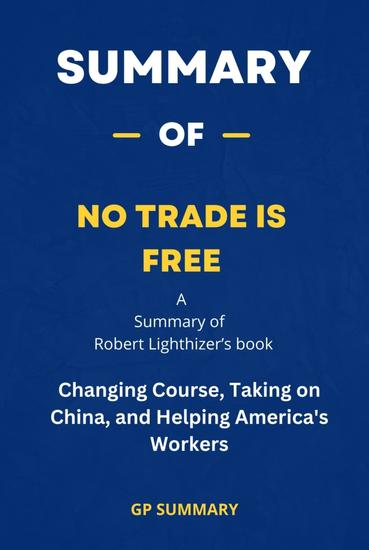
Summary of No Trade Is Free by Robert Lighthizer - Changing Course Taking on China and Helping America's Workers - cover

Summary of No Trade Is Free by Robert Lighthizer - Changing Course Taking on China and Helping America's Workers

GP SUMMARY

Publisher: BookRix

  • 0
  • 0
  • 0

Summary

DISCLAIMER
 
This book does not in any capacity mean to replace the original book but to serve as a vast summary of the original book.
 
Summary of No Trade Is Free by Robert Lighthizer:Changing Course, Taking on China, and Helping America's Workers
 
IN THIS SUMMARIZED BOOK, YOU WILL GET:
 

- Chapter astute outline of the main contents.
- Fast & simple understanding of the content analysis.
- Exceptionally summarized content that you may skip in the original book 
Robert Lighthizer, a key U.S. Trade Representative, led a significant reset of American trade policy over 40 years. He fought against one-sided free trade policies, focusing on corporate profits, cheap imports, and foreign governments. This led to a focus on corporate profits, cheap imports, and foreign governments, resulting in economic inequality and trade deficits. Lighthizer's book, No Trade is Free, is a memoir, history, and policy analysis that highlights the importance of a worker-focused trade policy and the fight for American jobs. It serves as a guide to the new world economy, which requires a worker-focused trade policy.
Available since: 07/02/2023.
Print length: 108 pages.

Other books that might interest you

  • Populism and Democracy - Examining the Intersection of Populism and Democratic Systems (3 in 1) - cover

    Populism and Democracy -...

    Arlo Holders

    • 0
    • 0
    • 0
    This is a combo of three titles, which are: 
      - Populism vs. Liberalism: Political ideologies form the foundation of how societies organize governance, economics, and social structures. They are systems of ideas and beliefs that provide a framework for political thought and action, influencing policies, institutions, and the behavior of individuals and groups. Among the diverse range of ideologies, populism and liberalism have emerged as two of the most significant and often opposing forces in modern political discourse. This chapter introduces the concepts of populism and liberalism, highlights their importance, and sets the stage for the comparative analysis that follows. 
      - The Populist Playbook: Populism, as a political ideology and movement, is rooted in the idea of a fundamental divide between "the people" and "the elite." It asserts that the common people, often portrayed as hardworking and morally upright, are being oppressed or ignored by an elite class of politicians, businessmen, and intellectuals who are perceived as self-serving and out of touch with the needs of the general public. The term "populism" has evolved over time and can be used to describe a range of political movements and leaders who claim to represent the interests of the ordinary person against established powers. 
      - The Impact of Populism: The roots of populism stretch back to the 19th century, with early movements advocating for the empowerment of ordinary citizens, particularly in agricultural societies. However, the modern manifestation of populism began to take shape in the mid-20th century and accelerated in the 21st century, fueled by growing disillusionment with traditional political elites. The rise of social media, economic inequality, and a globalized world have all contributed to populism's recent resurgence, particularly in Western democracies.
    Show book
  • The Awkward Questions in Education - The Elephants in the Room from AI to Teacher Retention - cover

    The Awkward Questions in...

    Al Kingsley

    • 0
    • 0
    • 0
    Schools and systems face unprecedented challenges, such as falling attendance, recruitment, and retention issues; the validity of external monitoring of schools; and the advent of artificial intelligence (AI). In The Awkward Questions in Education, Al Kingsley tackles the tough, often-avoided issues plaguing the sector today. 
     
    Drawing on over thirty-five years of experience, Kingsley explores the deep-seated challenges that many in education encounter daily and opens critical conversations that we need to have if we're to enact real, sustainable change. Chapters address key questions such as the following: 
    Are we teaching students the right skills for the future?Do we need more and different spaces to improve attendance and engagement?How should we handle the integration of AI in classrooms?What can be done to solve the ongoing teacher recruitment and retention crisis? 
     
    Featuring interviews with key stakeholders, including school leaders, policy-makers, teachers, and governors, this is a must-listen for school leaders, multi-academy trusts (MATs), teachers, governors, trustees, and anyone passionate about the future of education.
    Show book
  • A Rare Recording of Gertrude Stein Reading Her Own Writing - cover

    A Rare Recording of Gertrude...

    Gertrude Stein

    • 0
    • 0
    • 0
    Gertrude Stein (February 3, 1874 - July 27, 1946) was an American novelist, poet, playwright, and art collector. Born in Allegheny, Pennsylvania, and raised in Oakland, California, Stein moved to Paris in 1903, and made France her home for the remainder of her life. She hosted a Paris salon, where the leading figures of modernism in literature and art, such as Pablo Picasso, Ernest Hemingway, F. Scott Fitzgerald, Sinclair Lewis, Ezra Pound, Sherwood Anderson and Henri Matisse, would meet. The following three recordings are from Stein's novel, The Making of Americans (1925), and her poems, How She Bowed to her Brother (1931) and If I Told Him - A Completed Portrait of Picasso (1923)
    Show book
  • The Copenhagen Papers - An Intrigue - cover

    The Copenhagen Papers - An Intrigue

    David Burke, Michael Frayn

    • 0
    • 0
    • 0
    In a brilliant coda to the play Copenhagen, Michael Frayn receives mysterious letters that take him back to the theme of his bestselling novel, Headlong -- human folly, this time his own.Michael Frayn's Copenhagen has established itself as one of the finest pieces of drama to grace the stage in recent years. The subject of the Tony-winning play is the strange visit the German nuclear physicist Werner Heisenberg made to his former mentor, scientist Niels Bohr, in Nazi-occupied Copenhagen and the quarrel that ensued. Heisenberg's intentions on that visit, for good or for evil, have long intrigued and baffled historians and scientists. One day, during the British run of Copenhagen, Frayn received a curious package from a suburban housewife, which contained a few faded pages of barely legible German writings. These pages, which she claimed to have found concealed beneath her floorboards, seemed to cast a remarkable new light on the mystery at the heart of play. As more material emerged -- specifically notes that appeared to give instructions on how to put up a table-tennis table but perhaps containing important encoded information -- actor David Burke, who was playing Niels Bohr, began to display extreme, even suspicious interest in Frayn's growing obsession with cracking the riddle of the papers. And Frayn, for his part, lost all sense of certainty. Was he the victim of an elaborate hoax? By turns comic and profound, The Copenhagen Papers explores the conundrum that is always at the heart of Frayn's work -- human gullibility and the eternal difficulty of knowing why we do what we do.
    Show book
  • Battle of Lützen The: The History and Legacy of Gustavus Adolphus’ Last Battle during the Thirty Years’ War - cover

    Battle of Lützen The: The...

    Editors Charles River

    • 0
    • 0
    • 0
    The Thirty Years' War was one of the most horrific conflicts in history, and though it is widely viewed as a religious struggle, that was only part of the complicated war. Calvinists and Lutherans did not get along, and both persecuted some of the more radical Anabaptist sects. At the same time, one major motivation behind the war was Holy Roman Emperor Ferdinand II’s determination to rule all of the empire and not be just a figurehead. There were struggles between rulers and their estates over power, and Catholic France later entered the war on the side of the Protestants in order to counter the Habsburgs’ power.  
    	The Battle of Breitenfeld, fought in September 1631, was the first major Protestant victory and widely considered the crowning achievement of Swedish King Gustavus Adolphus’ military career. Through his establishment of communication and supply lines at strategic points across the Baltic Sea, the securing of Protestant alliances, and his use of combined arms, amongst his other trademark techniques, the Swedish forces, against all odds, defeated their rivals. Such was the devastation inflicted upon their opponents that the Count of Tilly, the chief commander of the Catholic League's armies, had no other choice but to retreat. 6,000 or so Catholic soldiers were captured, many of them later incorporated into the Protestant forces. Whatever remained of the survivors vanished into the dark of the night.   
    	Gustavus’s triumph at Breitenfeld was a great victory that permanently affected the war, and for a time the Swedes were the most powerful military force in Central Europe, but Gustavus’s life ended slightly more than a year after the battle. On November 16, 1632, the king led a Protestant army of Swedes and German allies against Wallenstein’s army near Lützen in Saxony, and during a hard-fought Protestant victory that forced Wallenstein to retreat, Gustavus was killed while leading a cavalry charge.
    Show book
  • Minnie - The remarkable story of a true trailblazer who found freedom and adventure in the outback - cover

    Minnie - The remarkable story of...

    Marianne van Velzen

    • 0
    • 0
    • 0
    The inspiring story of a feisty pioneering woman who sought freedom and adventure in the outback and became the first woman to work as an opal miner in Australia. 
     
    People always asked her if she was ever afraid, living out in the desert alone with all those rough and scruffy men. But Minnie Berrington was not the faint-hearted type, and never had been. Being tough came naturally to her, growing up with three brothers and a family that went from riches to ruins. 
     
    Only a slip of a girl, Minnie could match any man in stamina, perseverance and strength. She arrived in Coober Pedy when camels still brought in essential supplies, and water was so scarce that no-one washed. Together with the other miners, she braved the heat, the flies and the dust. Every day she waited for that special sound the pick made when it cracked opal. 
     
    The first woman to dig her own shafts in the Australian opal fields, Minnie began her working life as a typist in London. But she and her younger brother, Victor, sought freedom and adventure in the 1920s and found plenty of it in the outback. 
     
    'Destined to become an outback classic' LIZ HARFULL, bestselling author of Women of the Land 
     
    'Minnie brings to life a gutsy, independent woman living a remarkable but simple life in the harshest of conditions' JULIET WILLS, author of The Diamond Dakota Mystery
    Show book