¡Acompáñanos a viajar por el mundo de los libros!
Añadir este libro a la estantería
Grey
Escribe un nuevo comentario Default profile 50px
Grey
Suscríbete para leer el libro completo o lee las primeras páginas gratis.
All characters reduced
Summary of Fat Talk by Virginia Sole-Smith: Parenting in the Age of Diet Culture - cover

Summary of Fat Talk by Virginia Sole-Smith: Parenting in the Age of Diet Culture

GP SUMMARY

Editorial: BookRix

  • 0
  • 0
  • 0

Sinopsis

DISCLAIMER 
  
This book does not in any capacity mean to replace the original book but to serve as a vast summary of the original book. 
  
Summary of Fat Talk by Virginia Sole-Smith: Parenting in the Age of Diet Culture 
  
IN THIS SUMMARIZED BOOK, YOU WILL GET: 
 Chapter astute outline of the main contents.Fast & simple understanding of the content analysis.Exceptionally summarized content that you may skip in the original book 


Virginia Sole-Smith's book Fat Talk exposes the daily onslaught of fatphobia and body shaming that kids face from school, sports, doctors, diet culture, and parents. It offers strategies for how families can change the conversation around weight, health, and self-worth. It also offers a new approach for thinking about food and bodies, and a way for us to work towards a more weight-inclusive world.
Disponible desde: 21/12/2023.
Longitud de impresión: 98 páginas.

Otros libros que te pueden interesar

  • Mirror to the Church - Resurrecting Faith after Genocide in Rwanda - cover

    Mirror to the Church -...

    Emmanuel M. Katongole, Jonathan...

    • 0
    • 0
    • 0
    We learn who we are as we walk together in the way of Jesus. So I want to invite you on a pilgrimage. Rwanda is often held up as a model of evangelization in Africa. Yet in 1994, beginning on the Thursday of Easter week, Christians killed other Christians, often in the same churches where they had worshiped together. The most Christianized country in Africa became the site of its worst genocide. With a mother who was a Hutu and a father who was a Tutsi, author Emmanuel Katongole is uniquely qualified to point out that the tragedy in Rwanda is also a mirror reflecting the deep brokenness of the church in the West. Rwanda brings us to a cry of lament on our knees where together we learn that we must interrupt these patterns of brokenness But Rwanda also brings us to a place of hope. Indeed, the only hope for our world after Rwanda’s genocide is a new kind of Christian identity for the global body of Christ—a people on pilgrimage together, a mixed group, bearing witness to a new identity made possible by the Gospel.
    Ver libro
  • The Royal Station Master's Daughters at War - 'A heartwarming historical saga' Rosie Goodwin (The Royal Station Master's Daughters Series book 2 of 3) - cover

    The Royal Station Master's...

    Ellee Seymour

    • 0
    • 0
    • 0
    The second heartwarming book in The Royal Station Master's Daughters series. For readers of Maisie Thomas and Daisy Styles. It is 1917 and Maria has adapted well to her new life on the royal Sandringham estate where she works as a maid in the Big House for Queen Alexandra and is in awe of the many treasures around her. It is two years since she turned up at the royal station master's house to escape her secret past, destitute and with nowhere else to turn. Having proven herself to Harry Saward and his daughters, she is now welcomed by them as one of the family. But when Nellie, a mysterious relative turns up, on the run from the law, Maria's new-found happiness could be under threat. Meanwhile, the impact of World War I is felt deeply in the community as the fate of missing men from the Sandringham Company, who fought in Gallipoli, is still unknown. Harry's daughters pull together to support each other and women on the royal estate as they face their sorrows and challenges. Ada's husband, Alfie, is away fighting on the front line while Beatrice is now a VAD nurse at a cottage hospital. Jessie has become a land army girl, proudly doing a man's job, while pining for her sweetheart Jack. In a community torn apart by loss and tragedy, how will the station master's family survive and find the happiness they're all searching for?The Royal Station Master's Daughters at War is the second book in the WWI saga series, inspired by the Saward family, who ran the station at Wolferton in the late 19th and early 20th centuries. Through this family we get a glimpse into all walks of life - from royalty to the humblest of soldiers.
    Ver libro
  • Wicked Charleston - The Dark Side of the Holy City - cover

    Wicked Charleston - The Dark...

    Mark R. Jones

    • 0
    • 0
    • 0
    Wicked Charleston: The Dark Side of the Holy City, by local resident and tour guide Mark R. Jones, explores the dark alleys and seedy characters not often associated with the Charleston of today. 


    A beautiful Southern city distinguished by its opulent homes, towering church steeples, and hospitality, Charleston, South Carolina, has long been associated with the genteel side of Southern living. However, beyond the outward appearances that most people associate with Charleston, there is another side that most visitors and residents would dare not believe is part of the very fabric from which the city's history was woven. From the sexual escapades of an original Lord Proprietor and the comings and goings of the most notorious pirates, to secret brothels and nightclubs, Jones leads the reader back to a time when "drinking, eating, and whoring with more than fifty wenches" was perhaps more common in the Holy City than one may imagine.
    Ver libro
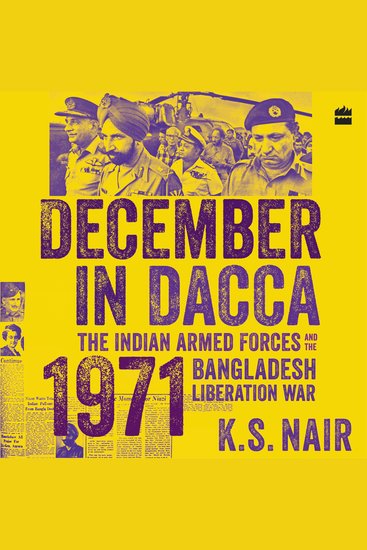
  • December in Dacca - The Indian Armed Forces and the 1971 Bangladesh Liberation War - cover

    December in Dacca - The Indian...

    KS Nair

    • 0
    • 0
    • 0
    The 1971 war between India and Pakistan, to help liberate the beleaguered people of Bangladesh, is considered one of the last 'just wars' of the twentieth century. Good triumphed decisively, unequivocally and indisputably. Yet, given the scale of atrocity that was halted in its tracks, it is shocking that the compelling circumstances as well as numerous poignant and heart-warming stories of the war have failed to become iconic representations of military intervention and success in the folklore and popular culture of India, Bangladesh and beyond. 
    December in Dacca seeks to right this wrong. From the dramatic dogfight over Boyra to the cornering of Pakistani naval vessels at Karachi to the Indian helicopter-riding infantry and paratroopers forcing the enemy to retreat, the book retells the many thrilling anecdotes, setting them within their diplomatic, strategic and tactical contexts. 
    It also provides a glimpse into the lives of some of these heroes once the dust had settled. Most importantly, it offers thoughts on why the events of 1971 are not better known, and how a better understanding of those could help India reaffirm her sense of self.
    Ver libro
  • Descartes meditations - cover

    Descartes meditations

    René Descartes

    • 0
    • 0
    • 0
    Rene Descartes is often described as the first modern philosopher, but much of the content of his Meditations on First Philosophy can be found in the medieval period that had already existed for more than a thousand years. Does God exist? If so, what is his nature? Is the human soul immortal? How does it differ from the body? What role do sense experience and pure reason play in knowing?
     
    Descartes stands out from his predecessors because of the method he developed to treat these and other fundamental questions. Drawing on his study of mathematics, he searches for a way to establish absolutely certain conclusions based on indubitable premises. His importance in modern philosophy lies in the challenge he offers to every subsequent thinker in philosophy and science.
    Ver libro
  • The End of Feudalism - How Societal Changes Transitioned to Modern Economic Systems - cover

    The End of Feudalism - How...

    Arlo Holders

    • 0
    • 0
    • 0
    Feudalism was a social, political, and economic system that dominated medieval Europe, particularly from the 9th to the 15th century. Its structure was based on the exchange of land for loyalty, military service, and labor. At its core, feudalism established a hierarchical order in which the king, or monarch, granted land, known as fiefs, to vassals (nobles) in exchange for their service. In turn, these vassals would grant portions of their land to serfs or peasants, who worked the land in return for protection and sustenance. This land-based economy was highly localized, with power concentrated in the hands of a few, and much of daily life revolved around agricultural production. 
    The decline of feudalism did not happen overnight but was a gradual process influenced by several interconnected factors. Key to its decline was the increasing centralization of power by monarchs. As monarchs gained more control, often through military conquest or strategic marriages, they began to diminish the power of feudal lords. This shift marked the beginning of the nation-state as a powerful political entity, replacing the decentralized feudal system. Additionally, the rise of a money-based economy undermined the land-based economy that feudalism relied upon. The growth of trade, the development of markets, and the emergence of a merchant class further destabilized feudal structures. 
    Another critical event in the decline of feudalism was the Black Death in the 14th century. The plague decimated large portions of Europe’s population, resulting in severe labor shortages. This, in turn, weakened the traditional feudal relationships between lords and serfs. With fewer workers available, peasants were able to demand better conditions, higher wages, or even freedom from their obligations. This shift in labor dynamics helped to weaken the power of feudal lords, who could no longer rely on a subjugated, large labor force to maintain their estates.
    Ver libro