¡Acompáñanos a viajar por el mundo de los libros!
Añadir este libro a la estantería
Grey
Escribe un nuevo comentario Default profile 50px
Grey
Suscríbete para leer el libro completo o lee las primeras páginas gratis.
All characters reduced
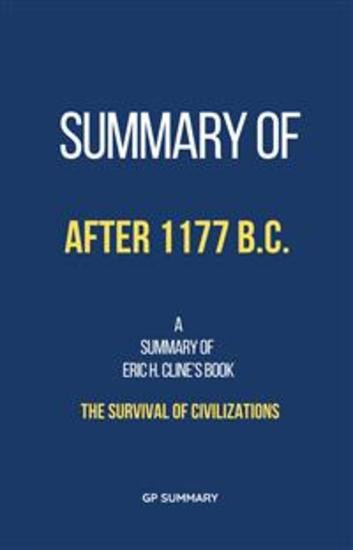
Summary of After 1177 BC by Eric H Cline: The Survival of Civilizations - cover

Summary of After 1177 BC by Eric H Cline: The Survival of Civilizations

GP SUMMARY

Editorial: BookRix

  • 0
  • 0
  • 0

Sinopsis

DISCLAIMER

Please note that this book contains a summary of the original content, which is a condensation of the key ideas and information found in the original book.

Therefore, it is recommended to read the original book for a comprehensive and detailed understanding of the topics discussed.

This summary is provided for informational purposes only and is not intended to infringe upon the intellectual property rights of the original book.

Summary of After 1177 B.C. by Eric H. Cline: The Survival of Civilizations

IN THIS SUMMARIZED BOOK, YOU WILL GET:

	Chapter provides an astute outline of the main contents.
	Fast & simple understanding of the content analysis.
	Exceptionally summarized content that you may skip in the original book

After 1177 B.C. is a sequel to Eric Cline's 1177 B.C., detailing the aftermath of the collapse of the Late Bronze Age civilizations in the Aegean and Eastern Mediterranean. The book explores the resilience, transformation, and success of these societies in an age of chaos and reconfiguration. It highlights the collapse of powerful civilizations, leading to the emergence of new world orders and innovations like the use of iron and the alphabet. The book offers lessons for today's world about why some societies survive massive shocks while others do not, and why this period was a new age with new inventions and opportunities.
Disponible desde: 20/04/2024.
Longitud de impresión: 33 páginas.

Otros libros que te pueden interesar

  • George Washington: A short biography - 5 Minutes: Short on time - long on info! - cover

    George Washington: A short...

    5 Minutes, 5 Minute Biographies,...

    • 0
    • 0
    • 0
    George Washington, Founding Father and first President of the USA: Life and works in a short biography! Everything you need to know, brief and concise. Infotainment, education and entertainment at its best!
    Ver libro
  • Psychopaths - Unraveling the Mind of a Psychopath and Its Impacts - cover

    Psychopaths - Unraveling the...

    Coral Nunez

    • 0
    • 0
    • 0
    Psychopathy is a personality disorder characterized by a lack of empathy, manipulative behavior, and a disregard for social norms. While often associated with violent criminals, not all psychopaths engage in illegal activities. Many live among us, blending into society while exhibiting traits that set them apart. Understanding psychopathy requires examining its defining characteristics, how it differs from other disorders, and how it has been studied over time. 
    At the core of psychopathy is a profound emotional deficit. Psychopaths struggle to feel deep emotions such as guilt, remorse, or love. While they can mimic emotions to manipulate others, their reactions are often shallow and insincere. This emotional disconnect allows them to deceive, exploit, and harm others without experiencing the moral conflicts that most people do. Their ability to charm and manipulate makes them particularly dangerous, as they can easily gain trust and control over those around them. 
    A common misconception is that psychopathy and sociopathy are the same. While they share some similarities, they are distinct disorders. Psychopaths are typically more calculated, controlled, and charismatic. They can function in society, often excelling in careers that require persuasion and risk-taking. Sociopaths, on the other hand, are more impulsive and prone to emotional outbursts, making it harder for them to maintain stable relationships or careers. These differences highlight why some psychopaths remain undetected, while sociopaths are more likely to be caught for reckless behavior.
    Ver libro
  • Self-Reliance - cover

    Self-Reliance

    Ralph Waldo Emerson

    • 0
    • 0
    • 0
    "Self-Reliance" is an 1841 essay written by American transcendentalist philosopher and essayist Ralph Waldo Emerson. It contains the most thorough statement of one of Emerson's recurrent themes: the need for each individual to avoid conformity and false consistency, and follow his own instincts and ideas. It is the source of one of Emerson's most famous quotations: "A foolish consistency is the hobgoblin of little minds, adored by little statesmen and philosophers and divines. 
    Emerson focuses on seemingly insignificant details explaining how life is "learning and forgetting and learning again".
    Ver libro
  • Psychoanalytic and Spiritual Perspectives on Terrorism - Desire for Destruction - cover

    Psychoanalytic and Spiritual...

    Nina E. Cerfolio

    • 0
    • 0
    • 0
    Nina E. Cerfolio masterfully explores the deeper spiritual and psychoanalytic understanding of the origins of human aggressive and destructive instincts which underlie mass shootings and terrorism. 


    The author survived two terrorist attacks: developing breast cancer from being a first responder at 9/11, and being poisoned by an FSB agent while providing humanitarian aid in the Second Chechen War. Through a personal, scholarly investigation into her psyche, the author describes the spiritual awakening that was catalyzed by these events and their traumatic impact, and examines how a world could create the firmament for the kinds of destructive aggression that are a daily occurrence. Featuring cutting-edge quantitative research and case material, which illustrates the prevalence of undiagnosed and untreated psychiatric illness among mass shooters and terrorists, this book encourages dialogue about the stigma of mental illness and challenges the perception of terrorists as monsters with no societal responsibility. 


    Championing the forgotten collective humiliation of the marginalized—which in turn breeds terrorism—and documenting a new spiritual lens through which healing is possible, this book will be essential listening for mental health workers and anyone wishing to understand the traumatizing epoch in which we are living.
    Ver libro
  • The Night Trains - Moving Mozambican miners to and from the Witwatersrand Mines 1902–1955 - cover

    The Night Trains - Moving...

    Charles van Onselen

    • 0
    • 0
    • 0
     ON THE NIGHT TRAINS, THE LAST STOP WAS ALWAYS HELL. 
    The price exacted from across the African subcontinent for South Africa’s stalled 20th-century industrial revolution is, in human terms, still largely hidden from history. For half a century, up to the mid-1950s, privately operated trains travelled by night between Ressano Garcia, on the Mozambique border, and Booysens station, in Johannesburg. The night trains carried Mozambicans recruited to work in the mines of the booming Witwatersrand. The up-trains disgorged their human cargo into the maw of the great Rand mining machine, while the down-trains whisked away the time-expired miners – often ill, broken or insane, and preyed on by con men, petty criminals and corrupt officials. While mine labour was recruited from all over southern Africa, Mozambican migrants made up the largest component, and they paid the highest price. 
      
    Charles van Onselen clinically reconstructs the world of the night trains, which were run as a partnership between the mining houses and the railways. By tracing the up and down rail journeys undertaken by black migrants over half a century it is possible to discern how racial thinking, expressed logistically, reflected South Africa’s evolving systems of segregation and apartheid. Mirroring the brutal logic of industrial capitalism, this was a system of transport designed to maximise profit at the expense of the health, well-being and even the lives of those it conveyed. 
    The story of the night trains echoes today through songs such as ‘Stimela’ and ‘Shosholoza’. But the experience of the poverty-stricken Mozambicans who travelled on the trains has never been told. THE NIGHT TRAINS lays bare this hellish world.
    Ver libro
  • Conversation Skills: 7 Easy Steps to Master Listening Skills Interpersonal Feedback Difficult Conversations & Voice Training - cover

    Conversation Skills: 7 Easy...

    Lawrence Finnegan

    • 0
    • 0
    • 0
    Do you want to be more engaging when you talk? Are you tired of people not paying attention, misunderstanding, or even wandering away from you? Have you told yourself you just don't have "the gift of gab?" 
      
    Do not talk yourself out of success; stop feeling dull, shy, or boring, and take action to develop those skills which seem so out of reach. Speak up and be noticed. Never before have so many conversational skills been analyzed, broken down into easy-to-understand lessons, and gathered in one place. Extroverts and introverts can both learn a thing or two within this guide. 
    Excellent conversation skills used to be the exclusive domain of those charismatic, radiant people who just seem to have a knack for inspiring or influencing entire groups. These 7 EASY STEPS are your ticket to deep, meaningful conversations, easy-breezy chats, and everything in between. 
      
    YOU’LL LEARN:How to attract people and keep their interestRemaining receptive and reflective, even mid-conversationThe enormous power of small talkAdjusting your words to match your audience without changing your messageMaster the art of difficult conversationsTools and tricks for you to practice aloneMake sure you have something worth talking aboutAnd so much more! 
      
    By exploring those topics in their entirety, a complete curriculum of interpersonal communication is created. We assume nothing, and every skill is explored with both too much and too little of the ability applied. As interactive as it is thorough, every chapter is jammed full of easy-to-understand and quick to apply advice. What you will find is a conversational playground you will come back to again and again, full of timeless insights and proven exercises. No matter your objectives, you can use the 7 EASY STEPS to grow, explore or just contemplate.  
    Let’s get started!
    Ver libro