Junte-se a nós em uma viagem ao mundo dos livros!
Adicionar este livro à prateleira
Grey
Deixe um novo comentário Default profile 50px
Grey
Assine para ler o livro completo ou leia as primeiras páginas de graça!
All characters reduced
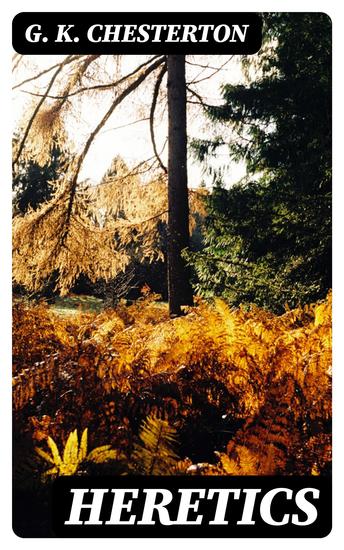
Heretics - cover
LER

Heretics

G.K. Chesterton

Editora: DigiCat

  • 0
  • 0
  • 0

Sinopse

In "Heretics," G. K. Chesterton presents a series of provocative essays that challenge the prevailing intellectual currents of early 20th-century thought. With his characteristic wit and incisive reasoning, Chesterton critiques the dogmas of modernism, liberalism, and other philosophical trends, advocating for a return to a more orthodox and whimsical view of life. His literary style is marked by paradox, humor, and a spirited defense of traditional beliefs, drawing on a diverse array of subjects from literature to psychology. This work stands as a vital contribution to the literature of faith and rational inquiry, illuminating the tensions between skepticism and belief in an age increasingly dominated by empiricism and materialism. G. K. Chesterton, an influential English writer, lay theologian, and social critic, drew inspiration from his own journey of faith and literary exploration. Born in 1874, Chesterton's background in art and literature enabled him to engage deeply with complex societal issues, often contrasting the vitality and richness of faith with the starkness of modern nihilism. His experiences and encounters with various thinkers provided the impetus for "Heretics," marking his foray into public intellectual discourse and establishing him as a defender of traditional Christian values. "Heretics" serves not only as a powerful critique of contemporary thought but also as a clarion call for readers to reassess their own beliefs. Recommended for those intrigued by philosophy, theology, and literary criticism, this book promises to challenge presuppositions and inspire rigorous reflection. Chesterton's eloquence and incisive arguments make this work a timeless exploration of the intellectual battles that rage within the human heart.
Disponível desde: 10/08/2022.
Comprimento de impressão: 216 páginas.

Outros livros que poderiam interessá-lo

  • Before 18: The Untold Stories of Drug Abuse – Part Two - cover

    Before 18: The Untold Stories of...

    Joseph Behnke

    • 0
    • 0
    • 0
    Before 18: The Untold Stories of Drug Abuse – A Childhood Stained, a Voice Reclaimed 
    By Joseph Behnke 
    At just 19 years old, Joseph Behnke returns with a powerful second memoir — and this one cuts even deeper. 
    Before 18: The Untold Stories of Drug Abuse is a gripping continuation of the journey that began in In Joseph’s Footsteps, but it stands on its own as a brutally honest look into the darkest corners of growing up too fast, too rough, and too forgotten. 
    This isn’t just another chapter — it’s the part most people are too scared to tell. 
    Told in Joseph’s signature raw and unfiltered voice, this memoir unpacks the years he spent tangled in addiction — not just to substances, but to escape, to approval, to anyone or anything that made him feel something. He writes candidly about the pills, the powder, the needles, and the moments where rock bottom didn’t even feel low enough. And he also writes about the pain that came before the drugs — the childhood trauma, the broken relationships, the deep-seated shame, and the silent battles with identity that no one saw. 
    But this story is not just about drugs. It’s about damage — and the slow, imperfect path toward healing. 
    Joseph shares the relationships that broke him and the ones that built him back up. He reflects on the people he lost, the love he chased, and the moments that nearly made him give up. And somehow, through all of it, he finds a way to keep going — not as a hero, but as a human being trying his best. 
    If you’ve ever felt invisible, misunderstood, or like you were carrying a weight no one else could see, this book is for you. 
    This is not a redemption story wrapped up with a bow. It’s messy. It’s painful. It’s real. And that’s exactly why it matters.
    Ver livro
  • Biggest Battles of the Pacific Theater The: The History of the Decisive Campaigns that Led to Victory Over Japan in World War II - cover

    Biggest Battles of the Pacific...

    Editors Charles River

    • 0
    • 0
    • 0
    The waters of the Pacific Ocean – stretching deep blue under the tropical sun, or scourged by typhoons – provided World War II's most far-flung battlefield. Two of the world's premier mid 20th century maritime powers, the United States of American and the Empire of Japan, grappled for supremacy across that vast expanse.  
    	Although not as well-remembered as D-Day or even the attack at Pearl Harbor that preceded it, the Battle of Midway was one of the most unique and important battles fought during World War II. In fact, the turning point in the Pacific theater took place between June 4-7, 1942 as a Japanese fleet moved a sizable fleet intending to occupy Midway Island and draw the American navy near. Instead, American aircraft flying from three aircraft carriers that had been away from Pearl Harbor in December 1941 got a bearing on the Japanese fleet and sunk four Japanese aircraft carriers, permanently crippling Japan’s navy. The Battle of Midway was one of the first major naval battles in history where the enemy fleets never actually saw or came into contact with each other.  
    	By the time the Battle of Midway was over, the defeat was so devastating that it was actually kept secret from all but the highest echelons of the Japanese government. Along with the loss of hundreds of aircraft and over 3,000 men killed, the four Japanese aircraft carriers lost, when compared to America’s one lost carrier, was critical considering America’s huge shipbuilding superiority. However, the Battle of Midway could also have easily turned out differently.
    Ver livro
  • Rise and Fall of the Crusader States The: The History of the Outremer in the Holy Land - cover

    Rise and Fall of the Crusader...

    Charles River Editors

    • 0
    • 0
    • 0
    Of the many campaigns during the Middle Ages, few are as remarkable or seemingly impossible to win at the start as the First Crusade (1095-99), and the true crowning achievement of that crusade, which resulted in two centuries of Western European Christian states in the Middle East and the permanent firing of the European imagination, was the conquest of Jerusalem on July 15, 1099 after three weeks of siege. That victorious siege came four years after the call for a crusade first went out, and had the Crusaders not taken Jerusalem, the First Crusade would not likely have been followed by any more and the campaign might have been no more than an historical footnote of what could have been.  
    Despite the successful First Crusade, the Crusader States were relatively small and weak, and while they tried to be a bulwark of Christianity in the Holy Land, the Crusader States were reconquered centuries before modern European colonialism began. Nonetheless, the Crusades and the Crusader States galvanized the Christians of Western Europe to expand their world. While it remains unclear how much that world expanded in practical terms such as trade, or how it affected later attitudes during the expansion to the New World and other regions, it definitely engaged the European mind in both positive and negative ways. As such, the crusades soon achieved near-mythic status in the European literature and remain among the most important events of the Middle Ages. 
    At the same time, the Crusader States were not one homogenized region but actually several distinct territories that had their own unique histories and interests. In fact, many of them were founded a century apart, with the Kingdom of Antioch established in 1097 and the Duchy of Cyprus in 1191, and they stretched across the Near East and the Mediterranean. As such, each one had different political, religious, and economic characteristics.
    Ver livro
  • The Art of Logical Thinking - cover

    The Art of Logical Thinking

    William Atkinson

    • 0
    • 0
    • 0
    "The Art of Logical Thinking" by William Atkinson is a classic work on the principles and techniques of sound reasoning and logical thought. Originally published in 1909, this book delves into various aspects of logic, including deductive and inductive reasoning, fallacies, and methods for improving one's ability to think critically and analytically.
    Ver livro
  • Appreciations with an Essay on Style - cover

    Appreciations with an Essay on...

    Walter Pater

    • 0
    • 0
    • 0
    Appreciations, with an Essay on Style, is a collection of Walter Pater's previously-published essays on literature. The collection was well received by public and critic since its first edition, in 1889. The volume includes an appraisal of the poems of Dante Gabriel Rossetti, first printed in 1883, a few months after Rossetti's death; an essay on Thomas Browne, whose Baroque style Pater admired; and a discussion of Measure for Measure, one of Pater's most often reprinted pieces. The second edition, published in 1890, had a few modifications, and is the basis for all other editions of the book. (Summary by Leni)
    Ver livro
  • The Dead Mountain - The Bizarre True Story of The 1959 Dyatlov Pass Incident - cover

    The Dead Mountain - The Bizarre...

    Daniel Turmoil

    • 0
    • 0
    • 0
    In the winter of 1959, a group of nine young and experienced hikers embarked on a journey into the Ural Mountains of Russia. Although they had previously undertaken cold-weather trips, this particular expedition would tragically be their last. During their trek, the hikers encountered something unexpected in the supposedly desolate region, resulting in the demise of the entire group. The exact events of that fateful night remain unknown, but the incident has since become one of the world's most perplexing mysteries.
    Ver livro