¡Acompáñanos a viajar por el mundo de los libros!
Añadir este libro a la estantería
Grey
Escribe un nuevo comentario Default profile 50px
Grey
Suscríbete para leer el libro completo o lee las primeras páginas gratis.
All characters reduced
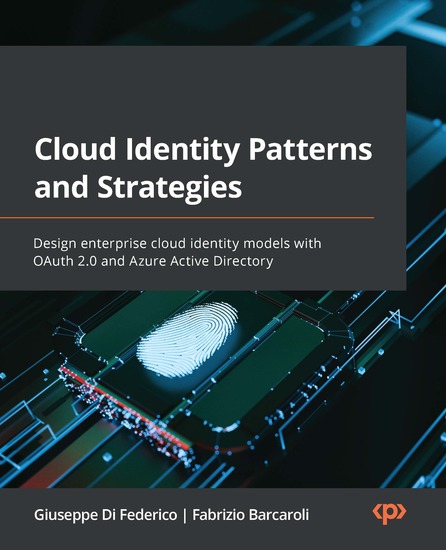
Cloud Identity Patterns and Strategies - Design enterprise cloud identity models with OAuth 20 and Azure Active Directory - cover

Cloud Identity Patterns and Strategies - Design enterprise cloud identity models with OAuth 20 and Azure Active Directory

Giuseppe Di Federico, Fabrizio Barcaroli

Editorial: Packt Publishing

  • 0
  • 0
  • 0

Sinopsis

Identity is paramount for every architecture design, making it crucial for enterprise and solutions architects to understand the benefits and pitfalls of implementing identity patterns. However, information on cloud identity patterns is generally scattered across different sources and rarely approached from an architect’s perspective, and this is what Cloud Identity Patterns and Strategies aims to solve, empowering solutions architects to take an active part in implementing identity solutions.
Throughout this book, you’ll cover various theoretical topics along with practical examples that follow the implementation of a standard de facto identity provider (IdP) in an enterprise, such as Azure Active Directory. As you progress through the chapters, you’ll explore the different factors that contribute to an enterprise's current status quo around identities and harness modern authentication approaches to meet specific requirements of an enterprise. You’ll also be able to make sense of how modern application designs are impacted by the company’s choices and move on to recognize how a healthy organization tackles identity and critical tasks that the development teams pivot on.
By the end of this book, you’ll be able to breeze through creating portable, robust, and reliable applications that can interact with each other.
Disponible desde: 23/12/2022.
Longitud de impresión: 258 páginas.
Otros libros que te pueden interesar

  • 3D-Printing Houses - cover

    3D-Printing Houses

    Martin Drake

    • 0
    • 0
    • 0
    3D printing is transforming industries worldwide, and construction is no exception. As housing shortages and high building costs continue to challenge communities, 3D-printed homes offer a promising solution. This technology enables faster, more affordable, and adaptable construction, making homeownership and safe housing accessible to more people. By automating traditional processes, 3D printing redefines what's possible in construction—reducing waste, customizing designs, and speeding up building times. This book explores the groundbreaking impact of 3D printing on housing, highlighting its potential to revolutionize construction, improve affordability, and reshape the future of urban and rural living. 
      
    3D printing, also known as additive manufacturing, is reshaping the construction industry by introducing innovative approaches to building homes, offices, and infrastructure. Traditionally used in manufacturing and prototyping, 3D printing has now evolved into a reliable construction method that involves layering material to create structures, walls, and entire buildings from digital models. This technology allows construction companies to bypass many of the labor-intensive processes typically associated with conventional building techniques, offering an efficient, cost-effective, and flexible approach to construction. 
      
    In 3D printing for construction, materials like concrete, mortar, and specialized compounds are extruded layer by layer, following a precise digital design that directs robotic arms or large-scale printers. These printers can operate continuously, producing walls, floors, and structural elements at a faster pace than manual construction. As a result, 3D printing not only reduces the time required to build but also significantly decreases labor costs, as fewer workers are needed on-site. Projects that once took months can now be completed in weeks or even days, depending on the scale of the building.
    Ver libro
  • Infinite Darkness - How Dark Matter Shapes Our Reality - cover

    Infinite Darkness - How Dark...

    Dirk Fallon

    • 0
    • 0
    • 0
    Dark matter is one of the most intriguing mysteries in modern science. Despite making up approximately 27% of the universe, it cannot be seen or detected directly using traditional instruments. The name "dark matter" itself stems from the fact that it does not emit, absorb, or reflect light, making it invisible to the electromagnetic spectrum. However, its existence is inferred from its gravitational effects on visible matter, such as galaxies, stars, and other celestial objects. Without dark matter, the motion of galaxies would not make sense, as they appear to be moving far too quickly for the amount of visible matter they contain. This unseen substance holds galaxies together and ensures the stability of the universe’s large-scale structure. 
    The story of dark matter begins in the 1930s with the work of Swiss astronomer Fritz Zwicky. While studying the Coma galaxy cluster, Zwicky found that the visible matter in the galaxies was not enough to account for the way the galaxies were moving. He proposed that there must be some form of unseen mass providing additional gravitational pull, which he called "dark matter." Although his hypothesis was met with skepticism, it laid the foundation for further research into this invisible force. 
    Over the following decades, scientists gathered more indirect evidence supporting the existence of dark matter. In the 1970s, astronomer Vera Rubin and her colleague Kent Ford observed the rotation of galaxies and found that stars on the outer edges were moving much faster than expected. Based on the laws of physics and the visible mass, these stars should have been moving more slowly and would have been flung out of their orbits. The only explanation for their high speed was the presence of a significant amount of unseen mass—dark matter.
    Ver libro
  • Affirmations For Healing 528hz Frequency - cover

    Affirmations For Healing 528hz...

    Affirmational Journey

    • 0
    • 0
    • 0
    "Affirmations For Healing: 528Hz Frequency" is a powerful, single-session audiobook designed to enhance your well-being through the transformative power of positive affirmations. Set against the soothing backdrop of 528Hz frequency, known for its healing properties, this session guides you on a journey of self-healing and inner peace. Whether you're looking to relieve stress, boost your emotional resilience, or promote physical healing, these affirmations are carefully crafted to align with the frequency of love and miracles, helping you tap into your natural ability to heal from within. Embrace serenity, renewal, and a deeper connection to your true self.
    Ver libro
  • Rethinking Intelligence - A Radical New Understanding of Our Human Potential - cover

    Rethinking Intelligence - A...

    Rina Bliss

    • 0
    • 0
    • 0
    A genetics expert and professor challenges our understanding of intelligence, explaining what it truly means to be “smart,” why conventional assessments are misleading, and what everyone can do to optimize their potential. 
    Growing up in middle-class suburban Los Angeles in the 1980s, Rina Bliss saw intelligence as her ticket out. Like height and stature, intelligence was said to run in families. The prevailing idea was that mental capacity was determined by our DNA and could be measured; a simple IQ test could predict a child’s future. 
    Yet, once Dr. Bliss looked closer, first as a student, then as a scientist, and later as a mom of identical twins who share a genome, she began to challenge conventional wisdom about innate intelligence. In Rethinking Intelligence, she shares her findings, drawing on cutting-edge scientific research to offer a new model for how we understand, define, and assess intelligence, using a measurement that is far more flexible and expansive. 
    Intelligence has little to do with standardized test results or other conventional measures of intellect, Dr. Bliss argues. Intelligence is a process, a journey defined by change that cannot be scored or taken away. Intelligence is influenced by our surroundings in ways that are often overlooked—more than Baby Mozart or flash cards or superfoods, factors like stress, connection, and play actually sculpt young minds. 
    In Rethinking Intelligence, Dr. Bliss shares insights from the burgeoning science of epigenetics to help us harness our environments to empower our minds. If we truly want to nurture potential, we must eliminate toxic stress so that our genes can work optimally, in harmony with our environment. Dr. Bliss offers successful strategies we can use as individuals and a society, including embracing a growth mindset, prioritizing connection, becoming more mindful, and reforming systemic issues—poverty, racism, the lack of quality early childhood education—that have a negative and lasting neurobiological impact. 
    Joining acclaimed works by Carol Dweck, Amy Cuddy, and James Clear, Rethinking Intelligence reframes human behavior and intellect, offering a new perspective for understanding ourselves and our children, and the practical tools necessary to thrive.
    Ver libro
  • My Dog Hates My Date! - Teach Dogs to Accept Babies Toddlers & Lovers - cover

    My Dog Hates My Date! - Teach...

    Amy Shojai

    • 0
    • 0
    • 0
    CREATE A FURRY LOVE-CONNECTION! 
    Dogs are considered a part of the family, but what do you do when your dog interferes with love and romance? When your dog hates your date, but you’re smitten, what’s a caring pet owner to do? Or perhaps you’re pregnant, and your longtime “fur-kid” acts jealous, or you worry Grandma’s dogs aren’t used to toddler antics. The stress put on family relationships can make animal behaviors and communication go sideways, and turn a once loving pet bond into a dysfunctional relationship. Dogs often lose their homes or lives when the bond breaks, unless you teach dogs to accept babies, toddlers, and lovers. 
    MY DOG HATES MY DATE! packs prescriptive advice into a short how-to guide that offers step-by-step instructions how to improve family relationships between babies, toddlers, kids and adults, and your furry family members. You’ll learn: Why Some Dogs Hate New People7 Ways Dogs Show Love5 Tips to Jinx Jealous BehaviorThe Health Benefits of Pets & Why Kids Benefit Most!Dog-to-Baby IntroductionsDog-to-Toddler/Kid IntroductionsWhy “Acting” Like Dogs Makes You a Great Romantic Catch 
    With a fun conversational tone and easy to use proven techniques, MY DOG HATES MY DATE! helps ensure your loving bond remains strong and intact. 
    NOTE: If your sweetheart wants you to choose between him/her and your dog, suggest they read this book, before you show ‘em the door. Use the book as a “pet test” to teach dates how to win affection from your furry family members! 
    Ver libro
  • Mother Creature Kin - What We Learn from Nature's Mothers in a Time of Unraveling - cover

    Mother Creature Kin - What We...

    Chelsea Steinauer-Scudder

    • 0
    • 0
    • 0
    What does it mean to be a mother in an era of climate catastrophe? And what can we learn from the plants and creatures who mother at the edges of their world's unraveling? Becoming a mother in this time means bringing life into a world that appears to be coming undone. Drawing upon ecology, mythology, and her own experiences as a mother, Chelsea Steinauer-Scudder confronts what it means to "mother": to do the good work of being in service to the living world. What if we could all mother the places we live and the beings with whom we share those places? And what if they also mother us? 


    Steinauer-Scudder writes of the flight and aural maps of barn owls, of nursing whales, of forests, of tidal marshes, of ancient single-celled organisms, and of newly planted gardens. The creatures inhabiting these stories teach us about centering, belonging, entanglement, edgework, homemaking, and how to imagine the future. Rooted in wonder while never shying away from loss, Mother, Creature, Kin reaches toward a language of inclusive care learned from creatures living at the brink. Despair and fear will not save the world any more than they will raise our children, and while we don't know what the future holds, we know it will need mothers. As the ground shifts beneath our feet, what if we apprenticed ourselves to the creaturely mothers with whom we share this beloved home?
    Ver libro