Join us on a literary world trip!
Add this book to bookshelf
Grey
Write a new comment Default profile 50px
Grey
Subscribe to read the full book or read the first pages for free!
All characters reduced
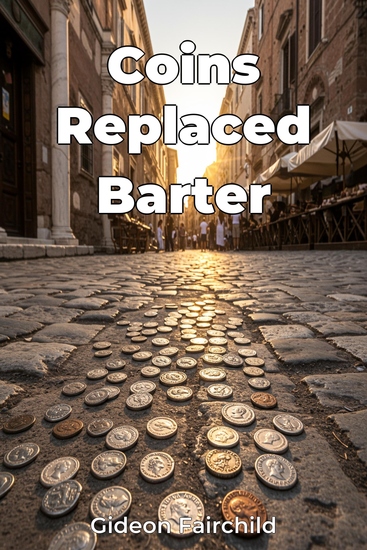
Coins Replaced Barter - cover

Coins Replaced Barter

Gideon Fairchild

Translator A AI

Publisher: Publifye

  • 0
  • 0
  • 0

Summary

Coins Replaced Barter explores the fascinating evolution of monetary systems, detailing how societies progressed from inefficient barter economies to the complex financial landscapes of today. The book illustrates how the inherent limitations of barter, such as the difficulty in standardizing goods and services, spurred the adoption of commodity money like minted coins. These coins, particularly in ancient civilizations, facilitated trade, enabled taxation, and supported military expansion, marking a significant leap in economic development. The book traces the journey through the rise of paper currency, originating in medieval China, and culminating in an analysis of digital currencies. This progression represents a fundamental shift in how societies organize themselves and allocate resources. By examining numismatic data, historical trade records, and contemporary reports, Coins Replaced Barter offers a comprehensive understanding of money's role in shaping civilization. The book adopts an accessible approach, presenting complex economic concepts with real-world examples. Beginning with the limitations of barter, the narrative progresses through commodity money and paper currency before delving into digital currencies. This journey provides a historical context for understanding modern economic challenges and debates surrounding financial regulation, offering valuable insights for anyone interested in history and economics.
Available since: 03/03/2025.
Print length: 64 pages.

Other books that might interest you

  • Kingmaker - Secrets Lies and the Truth about Five Prime Ministers - cover

    Kingmaker - Secrets Lies and the...

    Sir Graham Brady

    • 0
    • 0
    • 0
    THE INSTANT SUNDAY TIMES BESTSELLER A TIMES BOOK OF THE YEARTHE BESTSELLING INSIDER STORY OF WESTMINSTER'S BLOODIEST POWER BATTLES'Myths are debunked, prime ministers exposed and secrets revealed ... essential' The Times'Refreshingly honest' The Telegraph'Entertaining and approachable' The SpectatorDavid Cameron. Theresa May. Boris Johnson. Liz Truss. Rishi Sunak. Five prime ministers, one explosive memoir. Kingmaker lifts the lid on the leadership battles that have defined British politicsThe last fourteen years have seen turbulence at the centre of politics that is perhaps unique in British history. From coalition to Brexit, Covid to Partygate, Trussonomics to this year's election, our government has never felt so fractured. And as Prime Ministers have come and gone, one man has been at the heart of every leadership challenge, seeing all, but saying nothing. Until now.Sir Graham Brady was the Chairman of the 1922 Committee since 2010. As the leader of the group with the power to choose a new leader of the Conservative Party, it was his hand that held the executioner's axe over five consecutive Prime Ministers' heads.Elected to Parliament in 1997 as the youngest Conservative MP in the house, Brady comes from a lower middle-class background and fell into politics age 16 when he joined a campaign to save his grammar school. This book is the story of how a boy from Salford came to be the definitive political insider.With unique access to every key decision-maker of the past fourteen years, it offers insights into the character and choices of successive Prime Ministers and the administrations they led. Ultimately, it reveals where our most recent leadership failures originate, and asks hard questions about who will be fit to lead us tomorrow.
    Show book
  • December in Dacca - The Indian Armed Forces and the 1971 Bangladesh Liberation War - cover

    December in Dacca - The Indian...

    KS Nair

    • 0
    • 0
    • 0
    The 1971 war between India and Pakistan, to help liberate the beleaguered people of Bangladesh, is considered one of the last 'just wars' of the twentieth century. Good triumphed decisively, unequivocally and indisputably. Yet, given the scale of atrocity that was halted in its tracks, it is shocking that the compelling circumstances as well as numerous poignant and heart-warming stories of the war have failed to become iconic representations of military intervention and success in the folklore and popular culture of India, Bangladesh and beyond. 
    December in Dacca seeks to right this wrong. From the dramatic dogfight over Boyra to the cornering of Pakistani naval vessels at Karachi to the Indian helicopter-riding infantry and paratroopers forcing the enemy to retreat, the book retells the many thrilling anecdotes, setting them within their diplomatic, strategic and tactical contexts. 
    It also provides a glimpse into the lives of some of these heroes once the dust had settled. Most importantly, it offers thoughts on why the events of 1971 are not better known, and how a better understanding of those could help India reaffirm her sense of self.
    Show book
  • On Sense and the Sensible - cover

    On Sense and the Sensible

    Aristotle

    • 0
    • 0
    • 0
    On Sense and the Sensible by Aristotle is a philosophical text that discusses the nature of sensation and how it relates to knowledge. Aristotle argues that the senses are the foundation of all knowledge, and that the sensible world is the only true reality. He also contends that the intellect is not capable of grasping abstract concepts without the aid of the senses. Read in English, unabridged.
    Show book
  • How to Save a Constitutional Democracy - cover

    How to Save a Constitutional...

    Tom Ginsburg, Aziz Z. Huq

    • 0
    • 0
    • 0
    Democracies are in danger. Around the world, a rising wave of populist leaders threatens to erode the core structures of democratic self-rule. In the United States, the tenure of Donald Trump has seemed decisive turning point for many. What kind of president intimidates jurors, calls the news media the “enemy of the American people,” and seeks foreign assistance investigating domestic political rivals? Whatever one thinks of President Trump, many think the Constitution will safeguard us from lasting damage. But is that assumption justified?How to Save a Constitutional Democracy mounts an urgent argument that we can no longer afford to be complacent. Drawing on a rich array of other countries’ experiences with democratic backsliding, Tom Ginsburg and Aziz Z. Huq show how constitutional rules can both hinder and hasten the decline of democratic institutions. The checks and balances of the federal government, a robust civil society and media, and individual rights—such as those enshrined in the First Amendment—often fail as bulwarks against democratic decline. The sobering reality for the United States, Ginsburg and Huq contend, is that the Constitution’s design makes democratic erosion more, not less, likely. Its structural rigidity has had unforeseen consequence—leaving the presidency weakly regulated and empowering the Supreme Court conjure up doctrines that ultimately facilitate rather than inhibit rights violations. Even the bright spots in the Constitution—the First Amendment, for example—may have perverse consequences in the hands of a deft communicator who can degrade the public sphere by wielding hateful language banned in many other democracies. We—and the rest of the world—can do better. The authors conclude by laying out practical steps for how laws and constitutional design can play a more positive role in managing the risk of democratic decline.
    Show book
  • Blink: Book Summary & Analysis - cover

    Blink: Book Summary & Analysis

    Briefly Summaries

    • 0
    • 0
    • 0
    This is a concise summary and analysis of Blink, by Malcolm Gladwell. It is not the original book and is not affiliated with or endorsed by Malcolm Gladwell. Ideal for those seeking a quick and insightful overview.
     
    Some decisions are made in an instant, while others take careful deliberation. But what separates a good snap judgment from a bad one? This book explores the power of intuition, the science behind rapid cognition, and the hidden forces that shape our split-second choices. Through fascinating case studies and psychological research, it reveals how our subconscious mind processes information, why some people excel at making quick decisions, and when instinct can lead us astray.
    Show book
  • Inca Empire The: An Enthralling Overview of the Incas Their Civilization in Ancient Peru and the Spanish Conquest - cover

    Inca Empire The: An Enthralling...

    Billy Wellman

    • 0
    • 0
    • 0
    Did you know that the Incas worshiped the mummies of their emperors? 
    For the Incas, death didn’t exist; it simply took the dead to a different plane of life. So, the mummies of their emperors were treated as people; they were given food and drink and even visited each other ceremoniously. They also owned country estates, which generated enough profits to keep them in the style to which they were accustomed. 
    This might sound like a curiosity, but this form of ancestor worship was central to the Inca culture and to the history of the Inca Empire, which stretched from Ecuador and Colombia in the north to Chile in the south. 
    Everyone has seen pictures of one of the Incas’ greatest achievements: the mountain-top wonder of Machu Picchu. But Inca history has always been told by the Spanish colonizers who conquered them since the Inca had no formal writing. Now, archaeology is giving us more information on how the Inca really lived, helping us differentiate real history from myth and propaganda. 
    In this audiobook, you will discover how the Inca created an expansive empire in just a century and why that civilization crumbled so fast once the Spanish arrived. 
    You’ll also discover the following:How the Inca civilization developed out of a number of preceding cultures in the Andes and Peruvian coast;How quickly the Incas were able to expand and why they needed to;How the empire was administered and how runners were able to take messages from one end of it to the other with remarkable speed;The amazing Inca infrastructure program, which included building roads through mountain ranges and across raging rivers;Why Inca cuisine included tasty guinea pigs and llama jerky;And so much more! 
    Scroll up and click the “add to cart” button to learn more about the fascinating Inca Empire!
    Show book