¡Acompáñanos a viajar por el mundo de los libros!
Añadir este libro a la estantería
Grey
Escribe un nuevo comentario Default profile 50px
Grey
Suscríbete para leer el libro completo o lee las primeras páginas gratis.
All characters reduced
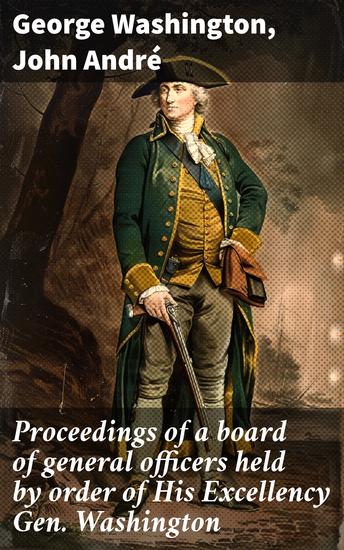
Proceedings of a board of general officers held by order of His Excellency Gen Washington - Strategic Dialogues and Moral Dilemmas of War - cover

Proceedings of a board of general officers held by order of His Excellency Gen Washington - Strategic Dialogues and Moral Dilemmas of War

George Washington, John André

Editorial: Good Press

  • 0
  • 0
  • 0

Sinopsis

The 'Proceedings of a board of general officers held by order of His Excellency Gen. Washington' presents a compelling collection of historical narratives and military strategies from the Revolutionary War period. This anthology expertly curates a tapestry of military deliberations and insights, focusing on strategic decision-making and the burden of command. The themes of leadership, justice, and wartime diplomacy are woven throughout the proceedings, offering readers a multifaceted view of a pivotal era. This collection not only captures the suspense and gravitas of military proceedings but also reflects on the human elements that influence historical events. The contributors, including the renowned figures of George Washington and John André, lend their distinct voices to this rich anthology. Each document within this compendium provides a window into the personal and professional lives of these historical figures, set against the backdrop of the American Revolution. Washington's leadership and André's poignant story unfold within the historical context, highlighting the diversity of perspectives and experiences that shaped the era's military and political landscape. This collection aligns with Enlightenment ideals, illustrating how these luminaries grappled with the complexities of war and justice. This work is indispensable for any reader eager to explore the Revolutionary War from an intimate perspective. It creates a profound dialogue between personal narratives and broader historical movements, offering a holistic view of a transformative period in American history. Readers and scholars alike will appreciate the depth of analysis and the unparalleled access to firsthand accounts, which make this anthology both an educational resource and a catalyst for richer understanding of historical intricacies. Dive into this collection to uncover the nuanced interplay between leadership, strategy, and the human experience during the American Revolution.
Disponible desde: 20/10/2023.
Longitud de impresión: 27 páginas.
Otros libros que te pueden interesar

  • Keeping Family Secrets - Shame and Silence in Memoirs from the 1950s - cover

    Keeping Family Secrets - Shame...

    Margaret K. Nelson

    • 0
    • 0
    • 0
    All families have secrets but the facts requiring secrecy change with time. Nowadays a lesbian partnership, a "bastard" son, or a criminal grandfather might be of little or no consequence but could have unraveled a family at an earlier moment in history. Margaret K. Nelson is interested in how families keep secrets from each other and from outsiders when to do otherwise would risk eliciting not only embarrassment or discomfort, but profound shame and, in some cases, danger. Drawing on over 150 memoirs describing childhoods in the period between the aftermath of World War II and the 1960s, Nelson highlights the importance of history in creating family secrets and demonstrates the use of personal stories to understand how people make sense of themselves and their social worlds. 


    Keeping Family Secrets uncovers hidden stories of same-sex attraction among boys, unwed pregnancies among teenage girls, the institutionalization of children with mental and physical disabilities, participation in left-wing political activities, adoption, and Jewish ancestry. The members of ordinary families kept these issues secret to hide the disconnect between the reality of their own family and the prevailing ideals of what a family should be. Keeping Family Secrets sheds light not only on decades-old secrets but pushes us to confront what secrets our families keep today.
    Ver libro
  • The Shortest History of Japan - From Mythical Origins to Pop Culture Powerhouse―The Global Drama of an Ancient Island Nation - cover

    The Shortest History of Japan -...

    Lesley Downer

    • 0
    • 0
    • 0
    Zen, haiku, martial arts, sushi, anime, manga, film, video games . . . Japanese culture has long enriched our Western way of life. Yet from a Western perspective, Japan remains a remote island country that has long had a complicated relationship with the outside world. 


    Even at the nearest point, Japan—an archipelago strung like a necklace around the Asian mainland—is considerably farther from Asia than Britain is from Europe. The sea provides an effective barrier against invasion and has enabled the culture to develop in unique and distinctive ways. During the Edo period, the Tokugawa shoguns successfully closed the country to the West. After Japan opened, it swung in the opposite direction, adopting Western culture wholesale. Both these strategies enabled it to avoid colonization, one of the very few non-Western countries to do so, and to retain its traditions and way of life. 


    This history will be of interest to people who know nothing about Japan, but also full of insights for those who do. Lesley Downer takes the listener through the great sweep of Japanese history, focusing on the dramatic stories of larger-than-life individuals—from emperors descended from the Sun Goddess to warlords, samurai, merchants, court ladies, women warriors, geisha, and businessmen who shaped this extraordinary modern society.
    Ver libro
  • Spanish Armada and English Armada The: The History of Both Nations’ Ill-Fated Naval Campaigns against Each Other - cover

    Spanish Armada and English...

    Editors Charles River

    • 0
    • 0
    • 0
    On July 12, 1588, the legendary Spanish Armada headed for the English Channel. The Spanish plan was to take this invasion, led by the Duke of Parma, to the coast of southeast England, where they would be unleashed to conquer Elizabethan England for Spain’s King Philip II and Catholic Christendom. The Armada included over 150 ships, 8,000 sailors, and 18,000 soldiers, and it boasted a firepower of 1,500 brass guns and 1,000 iron guns. Just leaving port itself took the entire Armada two days.  
    	As everyone who has been taught history now knows, the Armada was one of the most famous military debacles in history. Regardless of the debate over whether it was simple mathematical miscalculation or plain bad luck, coupled with English fire ships assailing the Spanish ships, the Armada was decisively defeated. The Armada ultimately found its reluctant way home in awful conditions, having permanently lost over a third of the ships, and on the Irish coast, the Armada suffered further losses.  
    	What has since been overlooked is that the undeclared Anglo-Spanish War continued, and it would do so until 1604. The English and their Dutch allies responded to the spectacular and unexpected defeat of the Armada with an attempt of their own to attack Spain with a fleet often called the "Counter Armada" in English. In 1589, once the impact of the previous year upon the Hapsburg naval power became clear, Elizabeth ordered Drake to gather the English fleet to take advantage of the situation. Unlike the Spanish, the English had no illusions of being able to invade their opponent's homelands and overthrow their state; instead, the English had far more modest goals. The English wanted to seek out the remainder of the Spanish fleet and burn it, land troops in Portugal and raise a revolution in that country, and capture the Azores Islands. If possible, they would use a base in the Azores to capture the anticipated treasure fleet from the New World. 
    Ver libro
  • Reimagining Government - Achieving the Promise of AI - cover

    Reimagining Government -...

    Thomas H. Davenport, Faisal...

    • 0
    • 0
    • 0
    How AI can help the government lead with speed, trust, and impact.Artificial Intelligence is reshaping what is possible across every sector—and public service is no exception. Reimagining Government is a bold, practical playbook for harnessing AI to deliver smarter, faster, and more effective outcomes. Inside, you'll find: 
    · Clear breakdowns of AI opportunities and challenges in the government space 
    · Proven frameworks and maturity models for responsible, scalable adoption 
    · Insights and examples from real-world government innovators 
    · Strategies to transform leadership, culture, and public impactWritten for policymakers, technologists, and civic leaders, this book is a guide to making AI work—for people as well as for systems.
    Ver libro
  • A Language Learner's Guide to Russian Idioms - A Window into Russian Culture and Language - cover

    A Language Learner's Guide to...

    Dana Levina

    • 0
    • 0
    • 0
    Unlock the hidden rhythms of Russian conversation with A Language Learner’s Guide to Russian Idioms, narrated by Ernest Timkin and crafted by linguist Dana Levina. This audiobook isn’t just about memorizing phrases—it’s a cultural passport, revealing how Russians weave humor, history, and wisdom into everyday speech. Imagine transforming awkward pauses into confident exchanges by knowing when to say someone’s “counting crows” (считать ворон) instead of daydreaming, or calling out empty promises as “noodles hung on ears” (вешать лапшу на уши). Whether you’re a traveler aiming to navigate local markets without getting “led by the nose” (водить за нос), a student tired of “thumbing wooden blocks” (бить баклуши) instead of studying, or a professional striving to “take the bull by the horns” (брать быка за рога) in meetings, these idioms bridge the gap between textbook Russian and authentic dialogue. Each expression unfolds with vivid context: Learn why “walking on heels” (ходить по пятам) means relentless pursuit, how “sitting on needles” (сидеть как на иголках) captures nail-biting anxiety, and when to “keep your ear sharp” (держать ухо востро) in tricky situations. Perfect for learners craving cultural fluency, this guide turns idioms from curiosities into tools, helping you decode films, literature, and casual chats with ease. Dive in—before you know it, you’ll be swapping stale translations for phrases that make Russians lean in and smile. Удачи! (Good luck!)
    Ver libro
  • Eastern Europe - Learn about Romania Bulgaria Ukraine and Hungary - cover

    Eastern Europe - Learn about...

    Kelly Mass

    • 0
    • 0
    • 0
    This book consists of 4 titles, which are the following: 
    History of Bulgaria - The history of Bulgaria is rich and complex, tracing its roots from the earliest settlements in the region to its emergence as a modern nation-state. The story of the Bulgarian people is intertwined with their origins, showcasing a diverse tapestry of cultures, languages, and traditions that have evolved over millennia. 
    History of Hungary - The history of ancient Hungary begins well before the arrival of the Hungarians themselves, tracing back to the Iron Age and the early cultural developments in the Carpathian Basin. Around 800 BC, the Iron Age began to shape this region, with the emergence of "Thraco-Cimmerian" artifact types that suggested a significant overlap between the pre-Scythian cultures (Novocherkassk culture) and the pre-Celtic Hallstatt culture. This cultural intermingling marked the beginning of a complex interplay between indigenous peoples and incoming groups. 
    History of Romania - The earliest evidence of human habitation in what is now Romania dates back to prehistoric times, but one of the first recorded mentions comes from the writings of the ancient Greek historian Herodotus. In his work Histories, Book IV, written around 440 BC, Herodotus described the Getae, a Thracian tribe residing in the region that would later become Romania. According to Herodotus, the Getae were defeated by Persian Emperor Darius the Great during his military campaign against the Scythians. 
    History of Ukraine - The early history of the territory now known as Ukraine is marked by a series of ancient cultures and civilizations that shaped the region's development before and during the Dark Ages. The area was initially inhabited by the Dacians, a group known for their connections to the wider Thracian culture, alongside various nomadic tribes such as the Cimmerians, Scythians, and Sarmatians.
    Ver libro