¡Acompáñanos a viajar por el mundo de los libros!
Añadir este libro a la estantería
Grey
Escribe un nuevo comentario Default profile 50px
Grey
Suscríbete para leer el libro completo o lee las primeras páginas gratis.
All characters reduced
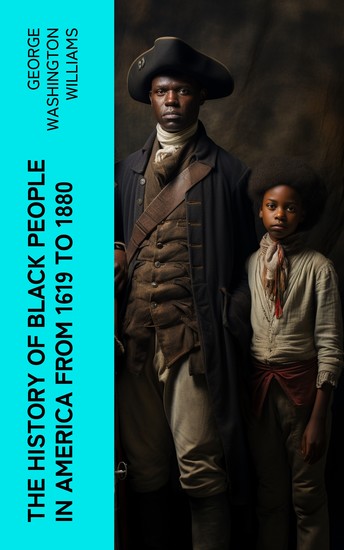
The History of Black People in America from 1619 to 1880 - Account of African Americans as Slaves as Soldiers and as Citizens - cover

The History of Black People in America from 1619 to 1880 - Account of African Americans as Slaves as Soldiers and as Citizens

George Washington Williams

Editorial: e-artnow

  • 0
  • 0
  • 0

Sinopsis

The History of Black People in America from 1619 to 1880 is a two-volume work on African-American history, written by American Civil War soldier and historian George Washington Williams. It is considered to be the first overall history of African Americans, showing their participation and contributions from the earliest days of the colonies. The Work is divided in nine parts presenting African Americans as slaves, as soldiers and as citizens, together with preliminary considerations of the unity of the human family, an historical sketch of Africa, and an account of the negro governments of Sierra Leone and Liberia. Table of Contents: Part I. Preliminary Considerations Part II. Slavery in the Colonies Part III. The Negro During the Revolution Part IV. Conservative Era – Negroes in the Army and Navy Part V. Anti-Slavery Agitation Part VI. The Period of Preparation Part VII. The Negro in the War for the Union Part VIII. The First Decade of Freedom Part IX. The Decline of Negro Governments
Disponible desde: 11/12/2023.
Longitud de impresión: 1156 páginas.
Otros libros que te pueden interesar

  • Paranormal Abilities and the Yoga Sutras of Patanjali - Including Exercises to Learn Many Abilities - cover

    Paranormal Abilities and the...

    Martin Ettington

    • 0
    • 0
    • 0
    The Author is an Engineer and expert on the Paranormal having had many experiences himself, (Mostly with Prophecy) and extensive research on many other phenomena. He is also the Author of the internationally popular book “God Like Powers and Abilities” which is an overview of many paranormal abilities and he has many other books on the spiritual and paranormal.In this book the source of paranormal abilities is explored in detail and how they relate to the 2,000 year old Sanskrit foundation text “The Yoga Sutras of Patanjali”.All God like powers are side effects from spiritual growth. Many reviewed here are not discussed in his previous books.If you want to learn more about consciousness and how our spirit really connects with the Universe then then this book is for you.You will also learn about less commonly known abilities and more possibilities of using your spirit in our world.
    Ver libro
  • The Lost Cause and the Great War - Progressive Reform and Patriotism in the American South - cover

    The Lost Cause and the Great War...

    Robert E. Hunt

    • 0
    • 0
    • 0
    The Lost Cause and the Great War tells the stories of central Tennessee Progressive-era reformers to illustrate the fascinating broader issue of how Southerners steeped in Lost Cause Civil War mythologies simultaneously developed patriotic American fervor. Focusing on Luke Lea, a prominent politician and American army officer who attempted to capture Kaiser Wilhelm II during World War I, the book reveals the intricate interplay between three competing ideas: attachment to the memory of the Confederacy, intense American nationalism, and advocacy for progressive reforms. 


    Hunt shows that Lea and his contemporaries sought either to harmonize these competing loyalties or to compartmentalize them to use when needed. Through insightful accounts of Tennessee's 1928 presidential campaign, the American Legion's response to cuts to veteran benefits in 1933, and the redefinition of America's global role post–World War II, Hunt shows how these reformers achieved a balance that held until the Civil Rights movement disrupted this delicate consensus. 


    Hunt's rich account reveals how Lea and others like him wove national patriotism and Southern collective memory into a cohesive narrative that supported their broader Progressive goals. The book provides vivid examples of how collective memory and narratives shape social and political movements.
    Ver libro
  • The World Is Always Coming to an End - Pulling Together and Apart in a Chicago Neighborhood - cover

    The World Is Always Coming to an...

    Carlo Rotella

    • 0
    • 0
    • 0
    An urban neighborhood remakes itself every day—and unmakes itself, too. Houses and stores and streets define it in one way. But it’s also people—the people who make it their home, some eagerly, others grudgingly. A neighborhood can thrive or it can decline, and neighbors move in and move out. Sometimes they stay but withdraw behind fences and burglar alarms. If a neighborhood becomes no longer a place of sociability and street life, but of privacy indoors and fearful distrust outdoors, is it still a neighborhood? 
      
    In the late 1960s and 1970s Carlo Rotella grew up in Chicago’s South Shore neighborhood—a place of neat bungalow blocks and desolate commercial strips, and sharp, sometimes painful social contrasts. In the decades since, the hollowing out of the middle class has left residents confronting—or avoiding—each other across an expanding gap that makes it ever harder for them to recognize each other as neighbors. Rotella tells the stories that reveal how that happened—stories of deindustrialization and street life; stories of gorgeous apartments with vistas onto Lake Michigan and of Section 8 housing vouchers held by the poor. 
     
    Blending journalism, memoir, and archival research, The World Is Always Coming to an End uses the story of one American neighborhood to challenge our assumptions about what neighborhoods are, and to think anew about what they might be if we can bridge gaps and commit anew to the people who share them with us. Tomorrow is another ending.
    Ver libro
  • The Life of Ancient Romans - cover

    The Life of Ancient Romans

    Francis Caputo

    • 0
    • 0
    • 0
    In 27 BC, when Augustus turned into the first sovereign of the Roman Empire, introducing the supreme period, the country he governed was more than 700 years of age. Rome's rulers had controlled an immense region that stretched out into northern Europe, parts of Africa, and Asia for quite a long time. The city of Rome was the most delightful and refined on the planet. It was filled with parks and gardens, marble curves and sculptures, lavish royal residences, immense amphitheaters, and rambling colleges. All were connected by an unpredictable organization of streets furthermore water-bearing reservoir conduits. Rome was a focal point of world culture as the capital of the most impressive country on Earth. By AD 98, majestic Rome arrived at its most extreme size, becoming the most significant realm ever. The vast domain contained around 60 million individuals, or around one-fourth of Earth's populace. Romans, who spoke Latin, alluded to their properties as the imperium sine fine, or "domain without end." The realm extended through the advanced countries of Spain, France, England, Netherlands, and Germany. It incorporated quite a bit of eastern Europe, including Slovenia, Romania, Armenia, and what's more, Croatia. The domain without end spread across North Africa from Morocco to Egypt and east into Turkey, Syria, and Iraq. Every one of the regions was joined under the Roman principle, wherever the official language was Latin. All over the place, installments were made in sestertii (Roman brass coins). All over, there was just a single law: Roman law.Most Roman subjects lived in separated ancestral networks where life had changed minimally in millennia. Provincial Romans chased, fished, developed small harvests, and tended domesticated animals. During the royal period, London and Paris were minimal more than a few military stations with less than 8,000 individuals. A considerable lot of the inhabitants were Roman officers called legionnaires. In any case, the realm a
    Ver libro
  • Becoming Baba Yaga - Trickster Feminist and Witch of the Woods - cover

    Becoming Baba Yaga - Trickster...

    Kris Spisak, GennaRose Nethercott

    • 0
    • 0
    • 0
    When darkness, fear, and instability inundate our daily lives, folktale figures like Baba Yaga speak to the dichotomy of our existence—the hope and the horror, the magic and the mundane. At once an old hag and an enchantress, a demon and wish granter, a feminist and nothing more than a fairytale, Baba Yaga is an endlessly complex folktale character. 


    Becoming Baba Yaga provides an in-depth look at the Baba Yaga mythos and history through Slavic folklore. Filled with historical and cultural context, analyses, and the stories themselves that add depth to the conversation. A comprehensive resource for anyone hoping to learn more about this ambiguous character and how her multifaceted presence still ripples through the present day, Becoming Baba Yaga is as thoughtful as it is illuminating. 


    Spisak explores Baba Yaga's connection to nature as an Earth goddess and as an herbalist. She also delves into the Shadow Self and Baba Yaga's aspect as a trickster and places her in a modern context as not merely a witch of the woods but also as an archetype and force for finding your own path. Becoming Baba Yaga shares how she is both a force for good as much as evil and a feminist before her time.
    Ver libro
  • The World War II History Journals:1945 - cover

    The World War II History...

    Liam Dale

    • 0
    • 0
    • 0
    Do you want to learn more about World War II, but don’t have time to read/listen to huge, long books? Then let The History Journals take you on an hourly history tour of each year of the war with The World War II History Journals series which includes one book per year from 1939 to 1945. 
     
    Throughout this series of journals released to acknowledge 80 years since the beginning of WW2, we will be looking at the seven years of that conflict on an annual basis. The conflict, the buildup to war, the major battles, the strategies and technological developments, the effect on civilians, and most importantly of all we’ll consider the role of the soldiers, sailors, and airmen who gave their lives fighting for the freedom of others. 
     
    Although the Allied nations faced the New Year of 1945 with a huge sense of hope, there was still a great deal of work to be done if world peace was to become a reality. Adolf Hitler and his Axis powers were finally facing defeat after seven years at war, but just like any wounded animal in the wild, they continued to pose a very real and dangerous threat. Follow us onward into the history of WW2 in 1945 – and the end of the war. 
     
    You will learn about: 
     
    A retreating Japan responds with Kamikaze pilots, Russian push to Warsaw 
    Hitler’s suicide 
    German army withdraws after Battle of the Bulge, American forces target Iwo Jima 
    The last rush for Berlin, VE Day, Truman authorizes nuclear bomb testing 
    Hiroshima, Nagasaki, America drops the atomic bomb, Japan surrenders, VJ Day 
     
    Be sure to read/listen to all the books in the series - one for each year through the end of the war in 1945!
    Ver libro